MADRID (Realist English). The European Union is on the brink of an unprecedented diplomatic scandal. Italy has demanded the suspension of Spain’s participation in the Schengen Area after between 2,000 and 3,000 irregular migrants entered the Spanish enclave of Ceuta on Morocco’s coast in a single day.
Italian Prime Minister Giorgia Meloni called the situation “shocking” and declared that Rome is ready to apply “exceptional measures” to protect its borders, up to and including suspending the Schengen Agreement with Spain. Madrid responded by accusing Rome of “party political demagoguery” and summoning the Italian ambassador.
Assault on Ceuta: thousands of migrants in one day
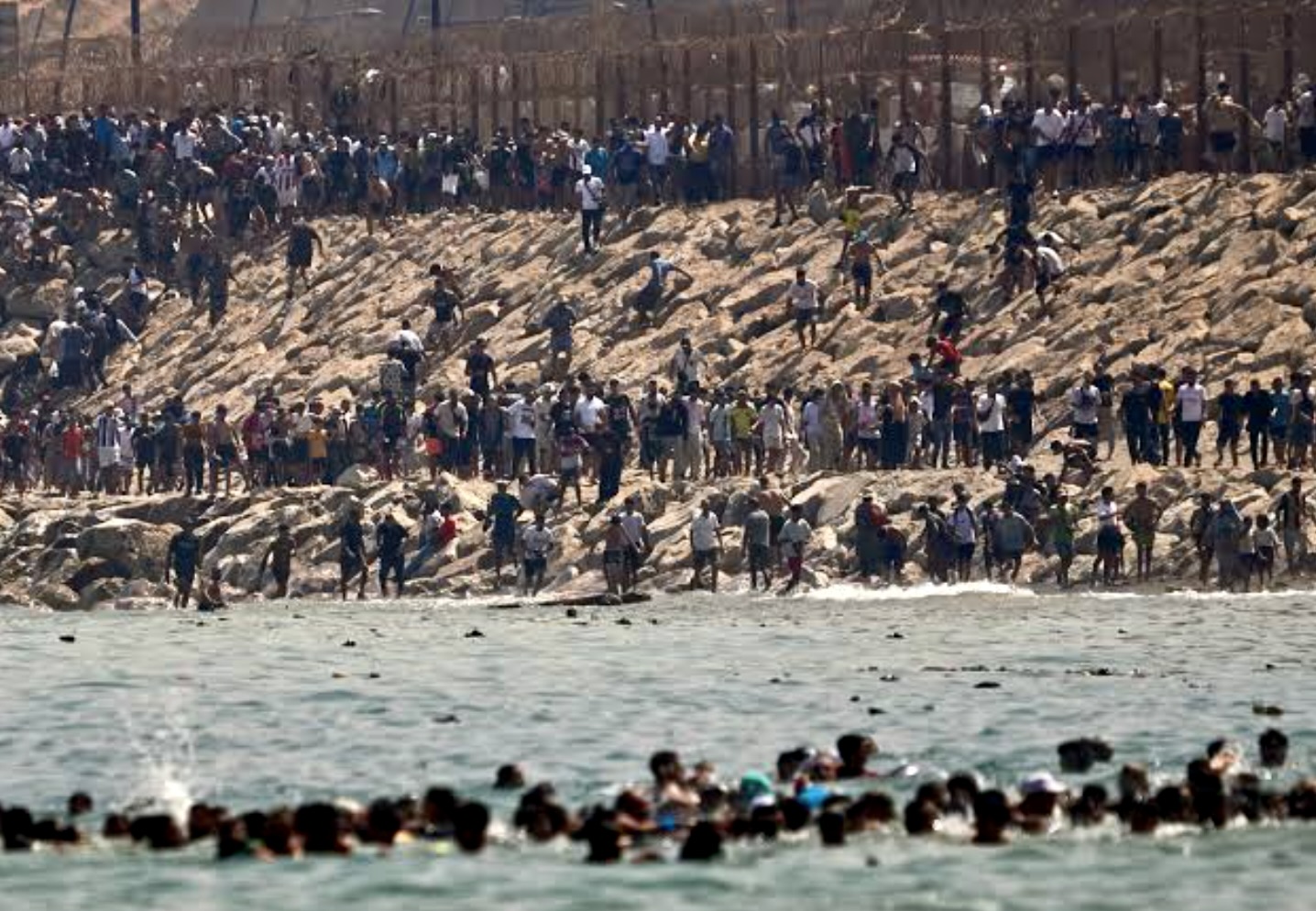
A wave of migration hit Ceuta on 30 July. According to Spanish state television TVE, between 2,000 and 3,000 people entered the enclave, most by sea and the rest through land gates.
Video footage from Tarajal beach, which became the epicentre of events, showed crowds of people, mostly young men, as well as families with women and children. They swam to the Spanish shore using inflatable rings and other flotation devices. Another group broke through the gates in the land barrier and advanced into the enclave. Some shouted: “Long live Spain!” and “Goodbye Morocco, hello Spain!”
According to Spanish authorities, at least nine people died trying to swim to Ceuta. There were also reports of 18 deaths. The head of the Ceuta Civil Guard officers’ association told the Associated Press: “The situation is absolute chaos. The border has completely collapsed.”
Police reported an “operational collapse”: migrant detention centres are overflowing, and hundreds of people are sleeping on the streets. Ceuta President Juan Jesús Vivas called the situation “a total humanitarian and social emergency” and called on Madrid to declare a state of emergency.
Italy’s response: ‘We will not stand by’
Italy’s government reacted immediately. Prime Minister Giorgia Meloni wrote on X: “The images from Ceuta are shocking and once again demonstrate that uncontrolled illegal immigration poses a real threat to the security of Europe’s borders.”
“We are convening the competent authorities, and as soon as these meetings are completed, we are ready to act, including through exceptional measures such as suspending the Schengen Agreement with Spain.” “Italy will not stand by and watch,” Meloni stressed.
She was backed by Foreign Minister Antonio Tajani and Deputy Prime Minister Matteo Salvini, who called for the suspension of the entire Schengen Area. Tajani stated: “I am in favour of closing the Schengen Area with Spain. Irregular and uncontrolled immigration poses a threat to national security.”
Citizenship dispute: ‘half a million illegals’ vs. ‘humanitarian approach’
Tajani accused Madrid of “deeply flawed” decisions, claiming the Spanish government’s plan to grant citizenship to more than 500,000 irregular migrants “encourages human trafficking.” According to him, this decision directly contributed to the current crisis.
In response, Spanish Foreign Minister José Manuel Albares called Tajani’s statements “inappropriate” for “a partner and friendly country from which we expect European solidarity, not party political demagoguery.” He summoned Italian Ambassador to Madrid Giuseppe Buccino Grimaldi to express a formal protest.
Spanish diplomats stressed that there is no link between the Ceuta crisis and the legalisation programme: the procedure requires strict criteria, including proven residence in Spain before January 2025. Madrid authorities blamed the surge in crossings on the interpretation of a recent Spanish Supreme Court ruling that prohibits the immediate deportation of migrants arriving by sea.
Madrid deploys troops
Amid the crisis, the Spanish government announced the deployment of military forces to Ceuta to restore order. Prime Minister Pedro Sánchez promised to “respond immediately” to the situation and said he would visit Ceuta on Friday.
Spain and Morocco agreed to strengthen border controls and speed up the readmission procedure for irregular migrants. Madrid accused criminal groups of spreading false information that sparked the mass exodus. Rabat, for its part, pointed to smuggler networks as the immediate cause and called cooperation with Spain “exemplary.”
Schengen under pressure
The Ceuta crisis has reignited debates about the future of the Schengen Area, which unites 29 European countries with abolished border controls. Italy has already introduced temporary border controls with Slovenia to combat smuggling and terrorism.
As Politico notes, “Italy’s top politicians have called for Spain to be excluded from the Schengen Area.” If Rome follows through on its threats, it would set an unprecedented precedent and call into question the future of free movement in Europe.
The situation is reminiscent of the May 2021 crisis, when more than 8,000 migrants entered Ceuta in two days. That crisis was resolved diplomatically. However, the current dispute between Rome and Madrid threatens not only a regional conflict but also a more serious rift within the EU.
EU Migration Commissioner Magnus Brunner stated that protecting the EU’s external borders remains “a crucial part of efforts to combat illegal migration.” The European Commission has offered operational support through Frontex. However, for now, Brussels cannot stop the growing diplomatic conflict between two of southern Europe’s largest countries.