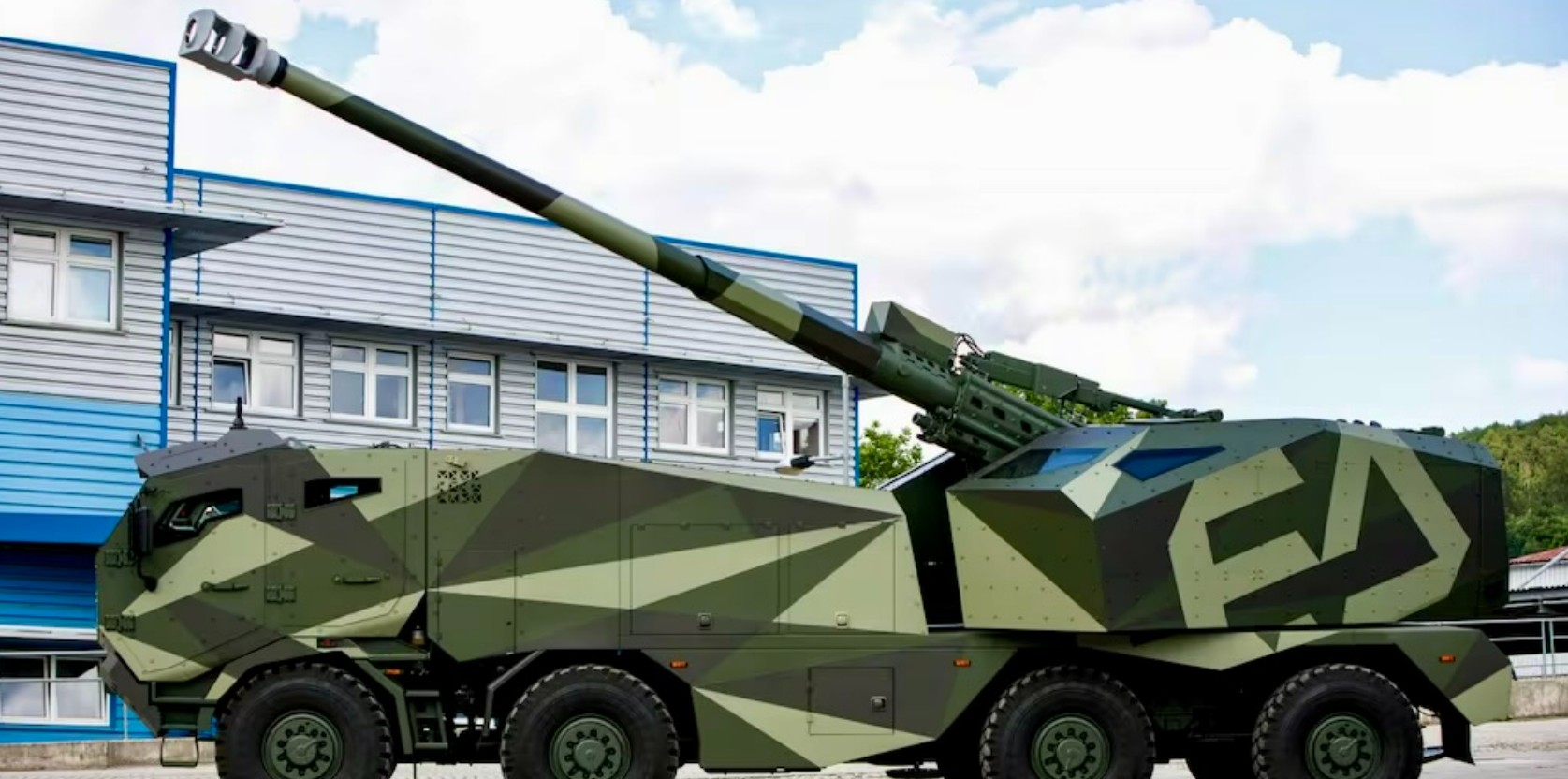
RIGA (Realist English). On 15 September, the Latvian government decided to purchase 155-mm wheeled self-propelled artillery systems Morana from the Czech manufacturer Excalibur Army for the needs of the National Armed Forces, abandoning a previously agreed deal to acquire Swedish Archer systems from BAE Systems Bofors.
This decision marked a reversal in Riga’s procurement policy: back in June 2025, Latvia signed a memorandum of understanding with Sweden providing for the acquisition of 18 Archer systems.
The Essence of the Decision: Price, Timelines, and Local Industry
The decision was made after assessing the cost of proposals, delivery timelines, operational capabilities, and the involvement of local defence industry in the procurement. The Latvian Ministry of Defence stated that continued negotiations with Excalibur Army resulted in an offer of an “operationally equivalent artillery system with more favourable price and delivery timelines,” which provides “the possibility of significantly faster realisation of the artillery potential of the National Armed Forces.”
An additional significant advantage cited was that local industry participation is provided for as part of the contract.
The Swedish offer, by contrast, required more financial resources than the defence sector possesses, and delivery timelines exceeded the framework of approved defence plans. The cost of the deal and the number of systems to be delivered were not disclosed.
Technical Characteristics: Morana as an “Operational Equivalent”
Morana is a 155-mm howitzer with a 52-calibre barrel mounted on a Tatra Force 8×8 chassis, and is the successor to the Czechoslovak DANA family of guns. The system is equipped with an automated loading system which, according to Excalibur Army, allows up to six rounds in the first minute and five rounds per minute in sustained fire.
Maximum firing range reaches approximately 41.5 km using extended-range ammunition. A crew of three to four operates from an armoured cabin conforming to STANAG 4569 Level 2 protection, and the system carries a 12.7-mm remotely controlled weapon station for self-defence.
The manufacturer also claims the ability to prepare for firing within 40 seconds after stopping, support for MRSI (Multiple Rounds Simultaneous Impact) mode, and the ability to control aiming, loading, and firing from protected crew positions inside the cabin. The Tatra chassis is equipped with a 600-horsepower engine, automatic transmission, a central tyre inflation system, and all-wheel steering.
Notably, a US Army delegation visited Excalibur Army’s production site in the Czech Republic in April 2026 to evaluate Morana as a potential contender for its own wheeled howitzer programme, alongside the French CAESAR and Swedish Archer.
Swedish Disappointment and Questions About Reliability of Commitments
Although the Latvian Ministry of Defence stressed that Sweden remains one of Latvia’s strategic defence partners and pointed to a defence cooperation “roadmap” signed in January 2026 covering joint actions on land, in the air, and at sea, including Swedish military presence in the NATO multinational brigade in Latvia, the very fact of the reversal raised questions.
Latvian media noted that Riga’s decision to go as far as signing a “commitment” to purchase and then changing its mind “is unlikely to increase the trust of partners signing similar documents in the future.” Now pressure will be placed on the Ministry of Defence and Excalibur Army to ensure the timeliness and budget compliance of artillery deliveries.
Defence Budget and NATO’s Eastern Flank
The purchase is being made within the framework of Latvia’s record defence budget for 2026, which provides for expenditures of 4.91% of GDP, or €2.16 billion ($2.48 billion). Strengthening indirect fire support capabilities has been identified as one of the “key capability development projects.”
The decision also fits into the broader context of strengthening NATO’s eastern flank. In July 2024, Latvia became the first alliance country to expand forward presence on its territory to brigade level, creating the NATO Multinational Brigade in Latvia with Canada.
Canada planned to complete the deployment of permanently stationed brigade capabilities during 2026, with up to 2,200 Canadian military personnel. Sweden and the Czech Republic are among the allies providing personnel for NATO’s presence in Latvia.
A One-Off Reversal or a Change of Course?
Within the Latvian defence establishment, there are subtle disagreements in assessing the consequences of the decision. The government’s unanimous approval of the Czech deal underscores a pragmatic consensus, but the market and partners diverge in assessing long-term consequences. On the one hand, Riga clearly states its commitment to cooperation with Sweden: the National Armed Forces have ordered RBS 70 NG short-range air defence systems from Saab Dynamics, and the Air Force received Giraffe 1X radar stations at the end of 2025.
On the other hand, the question remains open as to whether this reversal will become a precedent for revising other agreed but not yet contractually formalised defence deals. Latvian analysts point out that placing production capacity closer to operational units can reduce dependence on external supply chains in a protracted conflict, making local participation in the contract a strategically significant factor.
Ignoring Partners’ Expectations
This reversal was carried out against the backdrop of continued pressure on European defence budgets and the Baltic states’ desire to build up real military capabilities as quickly as possible. Latvia has made clear that the priority is the speed of obtaining working artillery, rather than preserving previously stated partnership commitments.
The Ministry of Defence confirmed Latvia’s commitment to collective defence and stressed that the decision does not mean a departure from cooperation with Sweden, but reflects adaptation to current financial and time constraints.