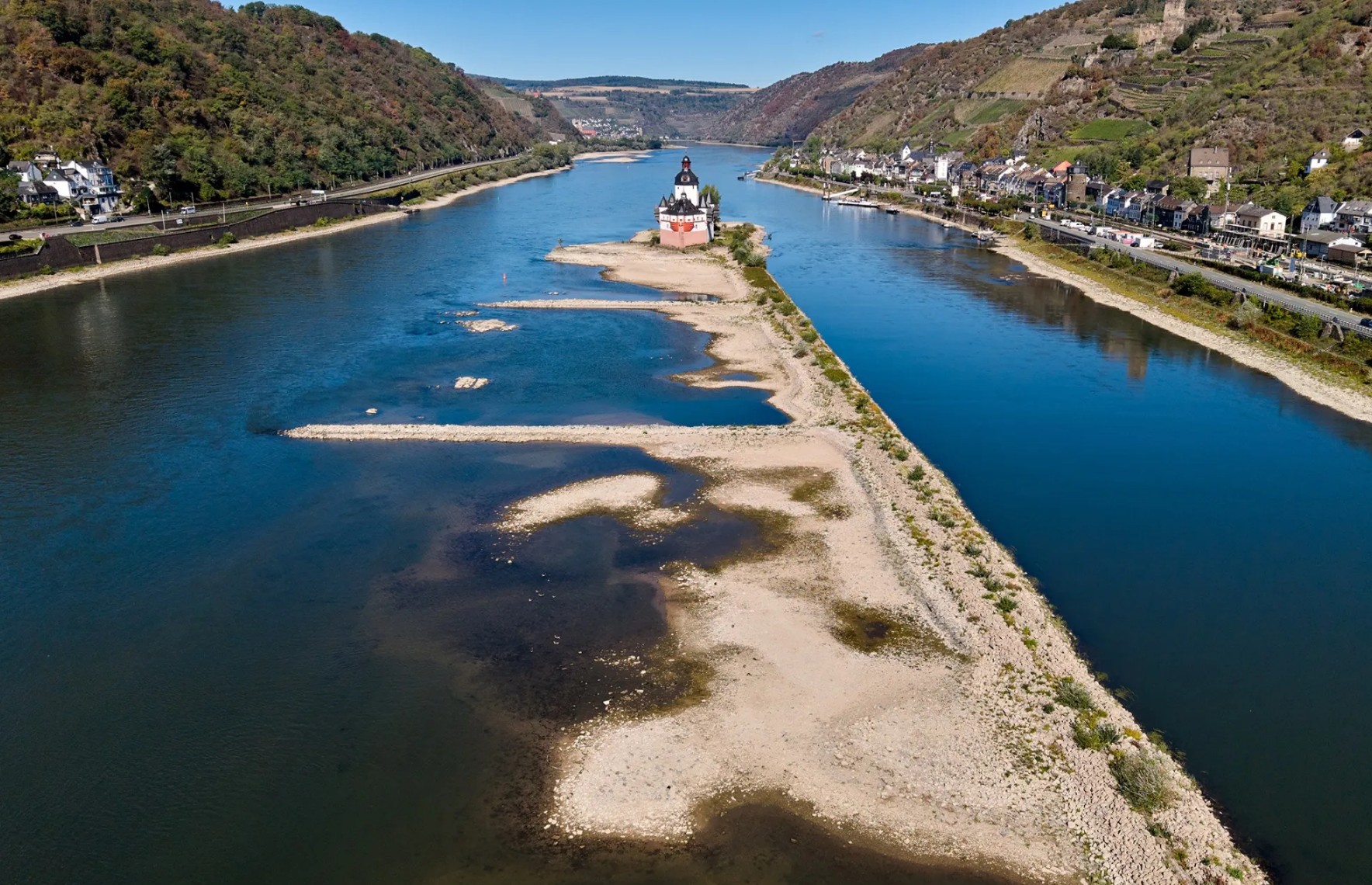
DUISBURG (Realist English). A key hydrological gauge on the Rhine at Kaub recorded 4 centimeters on September 24 — a historic low since 1880. This level is significantly below the 78-centimeter threshold at which vessels must reduce their load by 30%, and below the previous record of 25 centimeters set in 2018.
Scale of the Crisis: 74 Days of Low Water, Far More Than in 2022
According to Volt Power Analytics, in 2026 the Rhine’s water level has already remained below 78 centimeters for 74 days, significantly exceeding the 41 days during the 2022 energy crisis.
The prolonged drop in water levels was caused by the hottest summer in Western Europe on record: Germany experienced its second-hottest summer since 1881, with precipitation about 28% below normal; Switzerland had its hottest and driest summer since 1901; France had its hottest summer on record.
Germany’s Federal Institute of Hydrology forecasts that the water level at Kaub may drop further in the coming days. A continental high-pressure zone is expected to persist until the end of September, continuing to deplete the flow of the Rhine and other major rivers.
Sharp Decline in Shipping Capacity
Data from the International Transport Forum (ITF) shows that barges on the Middle Rhine can operate at only about 15% of normal cargo capacity during severe low water, while vessels on the Danube can operate at about 30%. This means that transporting the same volume of cargo requires more voyages and vessels, and additional capacity is not always available.
The cost of transporting petroleum products from Rotterdam to Karlsruhe has risen from about 180 euros per tonne last week to 185–190 euros per tonne. Rising shipping costs are directly passed on to the chemical, metallurgical, and refining industries that depend on Rhine transport.
Impact on Industries: Chemical Giants Under Pressure
German chemical companies are among the hardest-hit industries. BASF, Covestro, and Evonik plants are concentrated along the Rhine and are extremely sensitive to further disruptions.
BASF CEO Markus Kamieth warned analysts in July that “force majeure declarations or, in some cases, product shortages cannot be ruled out,” noting that a serious shortage of certain raw materials could trigger a “chain reaction” at complex chemical plants.
However, compared to the 2018 crisis, which led to €250 million in lost operating profit, companies have already prepared. BASF reported that the number of vessels in its fleet capable of operating at low water levels has doubled. Covestro built up raw material stocks weeks in advance and switched to shallower-draft vessels.
Thyssenkrupp was forced to limit hot metal production in Duisburg after raw material supply disruptions but stated that customer supplies are “currently not at risk.” The company abandoned the use of its own barges and switched to chartering vessels capable of navigating in shallow water.
Adaptation Strategies: From Forecasts to Fleet Renewal
The Central Commission for the Navigation of the Rhine (CCNR) began developing the “Masterplan Rhine” in spring 2026, aimed at increasing resilience to extreme low water levels in the medium and long term. The “Act Now!” initiative, based on the experience of the 2018 and 2022 low-water events, identified a number of practical measures, including improving water level forecasts, adjusting logistics chains, renewing the fleet with shallow-draft vessels, eliminating infrastructure bottlenecks, and strengthening stakeholder cooperation.
German shipping company HGK proposed a fleet renewal program worth $14.5 billion, envisaging the construction of up to 1,000 river cargo vessels adapted to low water levels. HGK CEO Steffen Bauer stated that its new river tanker Synthese 18 can still carry almost 500 tonnes of cargo at extremely low water levels at Kaub, while other vessel types cannot pass at all.
“We cannot stop low water levels. But we can build vessels that operate longer in difficult conditions,” Bauer said. The German government currently has a river shipbuilding fund of €125 million, but HGK believes a larger-scale program is needed to renew a fleet of a thousand vessels.
“Every Summer Will Be Like This”
Silje Eriksen Holmen, head of hydrology and fundamental analysis at Volt Power Analytics, gave a stark assessment: “This will be the effect of every future summer. This is not a bold assumption. This is how it will be.”
CCNR data shows that thanks to adaptation measures after 2018, readiness in 2026 is “significantly higher than in 2018.” However, the Dutch International Transport Forum notes that the economic impact of low water levels is very real: the low Rhine level in 2018 was associated with a 0.4% decline in Germany’s GDP, and during a month with 30 days of low water, German industrial production is estimated to have fallen by about 1%.
Researchers at the Center for Ship Technology and Transport Systems (DST) in Duisburg are studying how to respond to the river’s new constraints; the model vessels displayed on stands are precisely the types that may be needed in the future for Europe’s busiest waterway.