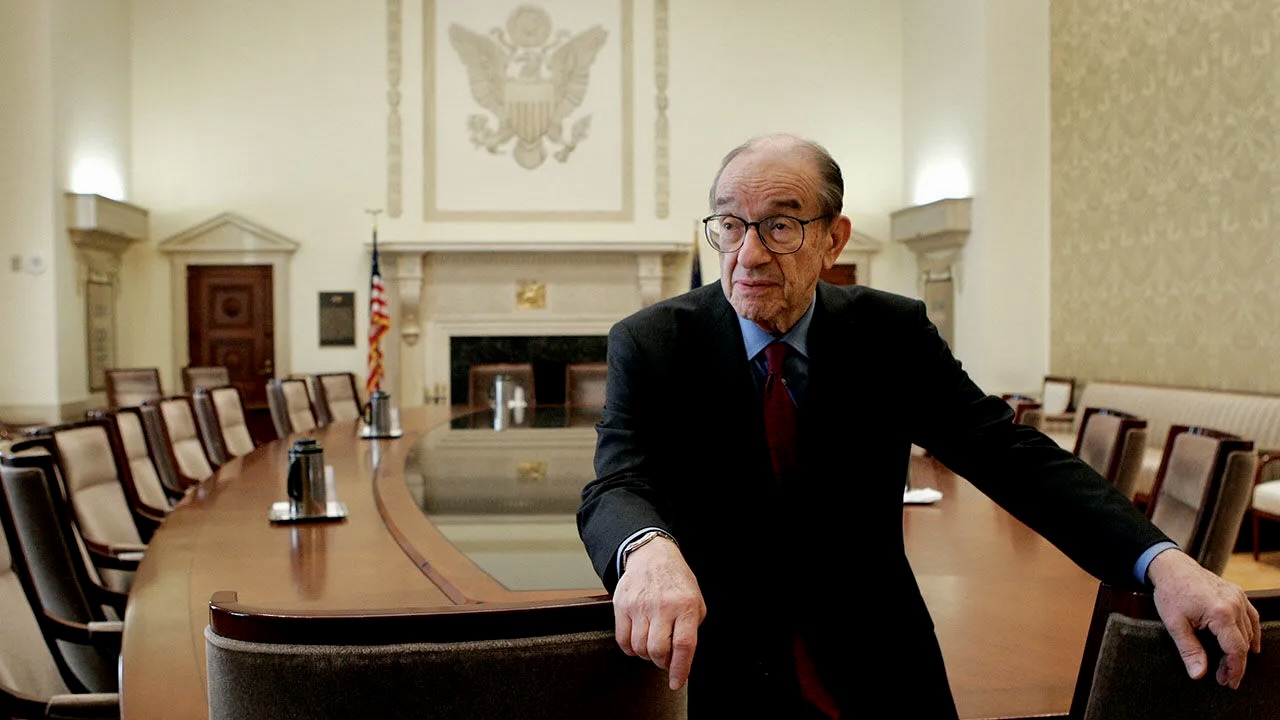
NEW YORK (Realist English). Alan Greenspan, who served as Chairman of the US Federal Reserve for nearly two decades and became one of the most influential economic policymakers in history, has passed away at the age of 100. His death was confirmed by his wife, NBC News Chief Correspondent Andrea Mitchell, who said Greenspan died on the morning of June 22 at his home due to complications from Parkinson’s disease.
Greenspan, who celebrated his 100th birthday in March 2026, led the Federal Reserve for 19 years (1987–2006) , entering history as the architect of modern American economics, having guided the country through a series of turbulent events.
From Musician to Economic ‘Maestro’
The future Fed chairman was born on March 6, 1926, in New York City to a family of Jewish immigrants. His father was a stockbroker, but his parents divorced when Alan was three, and his mother, who worked as a saleswoman in a furniture store, raised him alone.
Greenspan’s path to economics was unconventional. In his youth, he demonstrated outstanding mathematical abilities while also developing a passion for music — he studied clarinet at the prestigious Juilliard School, played in Henry Jerome’s orchestra alongside legendary jazz saxophonist Stan Getz, and toured the country. While his fellow musicians spent their evenings smoking marijuana, Greenspan studied economics and kept the orchestra’s books.
At 19, he enrolled at New York University, graduating with honors in 1948. In 1952, he met writer and philosopher Ayn Rand, whose ideas of radical individualism and government non‑intervention in the economy had a profound influence on him. In 1954, he founded the consulting firm Townsend‑Greenspan & Co.
Career Under Five Presidents
Greenspan’s political career began with his appointment as Chairman of the Council of Economic Advisers under President Gerald Ford (1974–1977). In 1987, President Ronald Reagan appointed him Chairman of the Federal Reserve. He held this position under four presidents — Reagan, George H.W. Bush, Bill Clinton and George W. Bush.
His first major test came with the stock market crash of October 1987, when stocks lost more than 30% of their value in a single day. Greenspan quickly assured markets of the Fed’s readiness to provide liquidity, helping to avert a deeper crisis.
In 1996, he delivered his most famous speech, asking whether “irrational exuberance” was beginning to play a role in the rise of asset prices, thereby warning of an overheating stock market.
Controversial Legacy
Greenspan stepped down in January 2006, but his legacy remains the subject of fierce debate. Supporters call him the “maestro” of the American economy, who delivered the longest period of sustained growth in a generation. Critics argue that his faith in self‑regulating markets and light bank regulation created the conditions for the subprime mortgage crisis and the Great Recession of 2008.
During the financial crisis, Greenspan admitted to Congress that he had been wrong to rely on bank self‑regulation: “Those of us who have looked to the self‑interest of lending institutions to protect shareholder equity, myself included, are in a state of shocked disbelief.”
Selected Quotes from Alan Greenspan:
- On irrational exuberance — “How do we know when irrational exuberance has unduly escalated asset values, which then become subject to unexpected and prolonged contractions?”
- On the uncertainty of his own words — “I know you believe you understand what you think I said, but I’m not sure you realize that what you heard is not what I meant.”
- On being a central banker — “Since I’ve become a central banker, I’ve learned to mumble with great incoherence. If I seem unduly clear to you, you must have misunderstood what I said.”
- On inflation and the gold standard — “In the absence of the gold standard, there is no way to protect savings from confiscation through inflation. There is no safe store of value.”
- On crises — “No crisis is like another, yet at the root of each lies the same cause: in times of prosperity, people tend to believe that the good times will never end and will extend ever further into the future.”
- On the welfare state — “The welfare state is nothing more than a mechanism by which governments confiscate the wealth of the productive members of society.”
- On delivering bad news — “I have learned that bad news should be delivered personally, without witnesses, and well in advance.”
- On Russia — “A country like Russia can rewrite its laws, but to transform its system of cultural norms takes years, if not generations.”