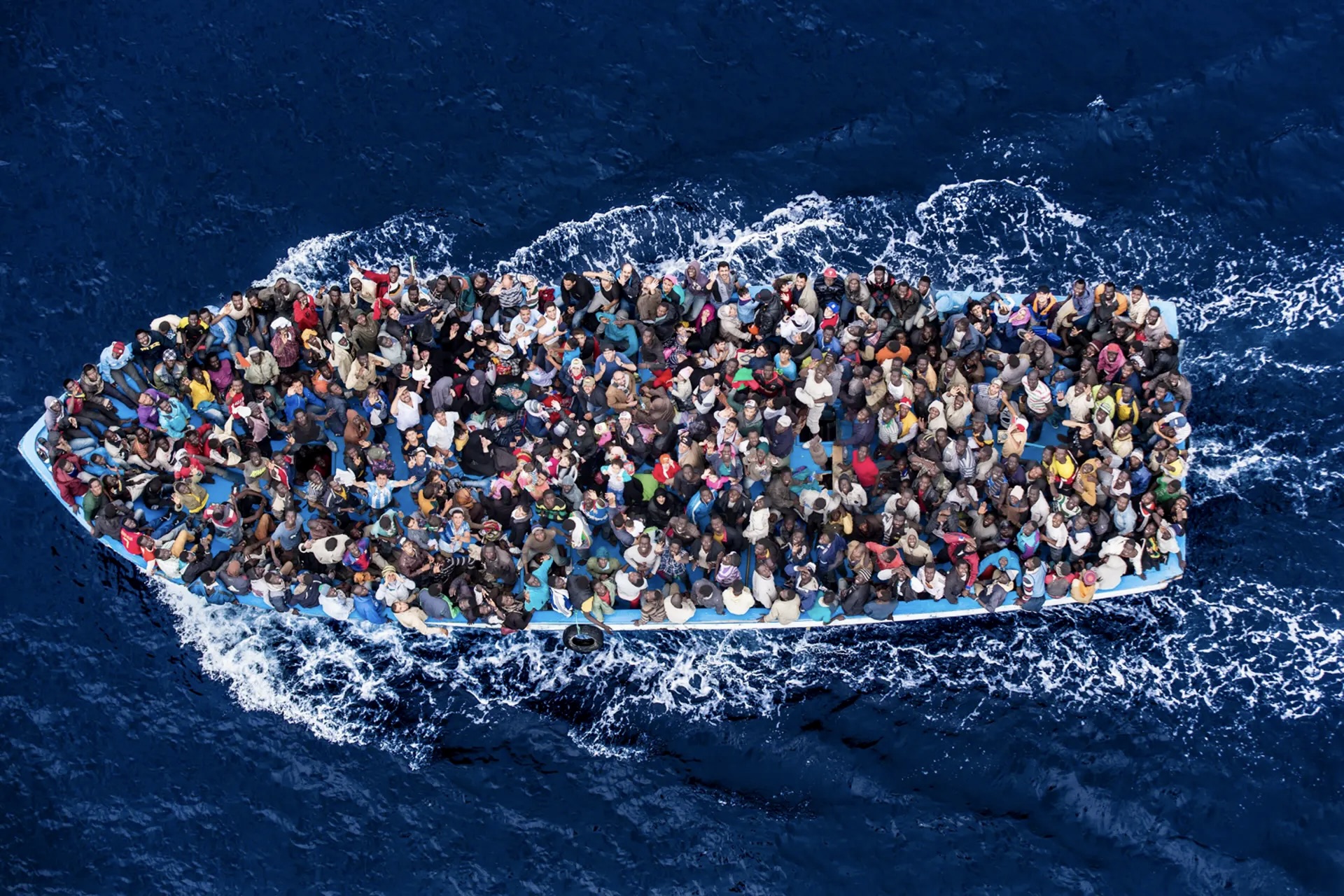
MADRID (Realist English). Europe’s migration crisis has exposed not only divisions between EU member states but also glaring double standards in their approaches to solving the problem.
Italy and Germany, which have led the campaign to pressure Spain after the mass influx of migrants into Ceuta, are themselves pursuing migrant legalisation policies comparable in scale to Spain’s.
Pressure on Madrid and the letter of 22 countries
After around 60,000 migrants entered the Spanish enclave of Ceuta on Morocco’s coast in late July, Italian Prime Minister Giorgia Meloni became one of the fiercest critics of Spain’s migration policy, calling for Spain’s temporary exclusion from the Schengen Area.
In a joint letter signed by 22 EU countries led by Italy and Denmark, leaders demanded action against “pull factors,” in particular the “legalisation of large numbers of irregular migrants.”
This was a direct reference to the recent amnesty announced by Spanish Prime Minister Pedro Sanchez, which was expected to affect around half a million people. However, the number of applications for legalisation more than doubled expectations, reaching 1.2 million.
Italy: nearly 1.1 million permits under Meloni
Criticism of Spain, it turns out, has not prevented Rome itself from pursuing virtually identical policies. Since coming to power in 2022, Giorgia Meloni’s government has issued 590,700 work permits to migrants under the so‑called “Flow Decree.” In 2024, the quota was more than doubled compared to 2021 due to high demand from employers.
According to Italian Interior Ministry data, an additional 497,550 permits are planned for the period 2026–2028. Thus, the total number of legalised migrants during Meloni’s tenure could reach nearly 1.1 million.
Matteo Villa, a researcher at the Institute for International Political Studies, stated bluntly: “The Italian government’s position is definitely hypocritical, because we are doing the same thing — albeit in a slightly different way.” According to him, Meloni’s programme is often applied in practice to those already living illegally in Italy and amounts to a “disguised amnesty.”
Germany: 90,000 ‘tolerated’ people granted status
Germany, which also signed the letter against Spain, is not lagging behind in its own legalisation efforts. Between 2022 and 2025, the country implemented a programme for people with so‑called “tolerated” status — those who do not have the right to reside but are not temporarily deported.
They were given the opportunity to obtain a more stable residence permit for a period of 18 months.
According to the Federal Office for Migration, around 90,800 people took advantage of this opportunity.
Greece and other examples
Greece, another signatory to the letter, which faced a mass influx of refugees in 2015–2016, launched a legalisation programme for irregular migrants in 2024.
Official figures show that around 25,000 applications were approved.
Facts and figures: who is teaching whom?
The comparison shows that criticism of Spain by Italy and Germany is, to say the least, inconsistent.
| Country | Legalisation Programme | Scale |
| Spain | 2026 Amnesty | ~500,000 (expected), 1.2 million (applications) |
| Italy | “Flow Decree” (2022–2028) | Nearly 1.1 million permits |
| Germany | Programme for “tolerated” migrants (2022–2025) | ~90,800 people |
| Greece | 2024 Legalisation Programme | ~25,000 approved applications |
As experts note, Meloni’s government has essentially adopted an approach “very similar to what Sanchez is doing now.” The difference lies only in rhetoric: Sanchez speaks of moral rightness, while Meloni speaks of economic necessity.
Amid the growing scandal, the European Commission reminded that EU countries have the right to legalise migrants on their territory, but must ensure that these decisions “do not jeopardise the proper functioning of the EU’s migration and asylum system.” Interior ministers of the member states will hold an emergency meeting to discuss the crisis and its consequences.
For now, Spain has effectively been singled out in a situation where all players are playing by the same rules, but only Madrid is being blamed.