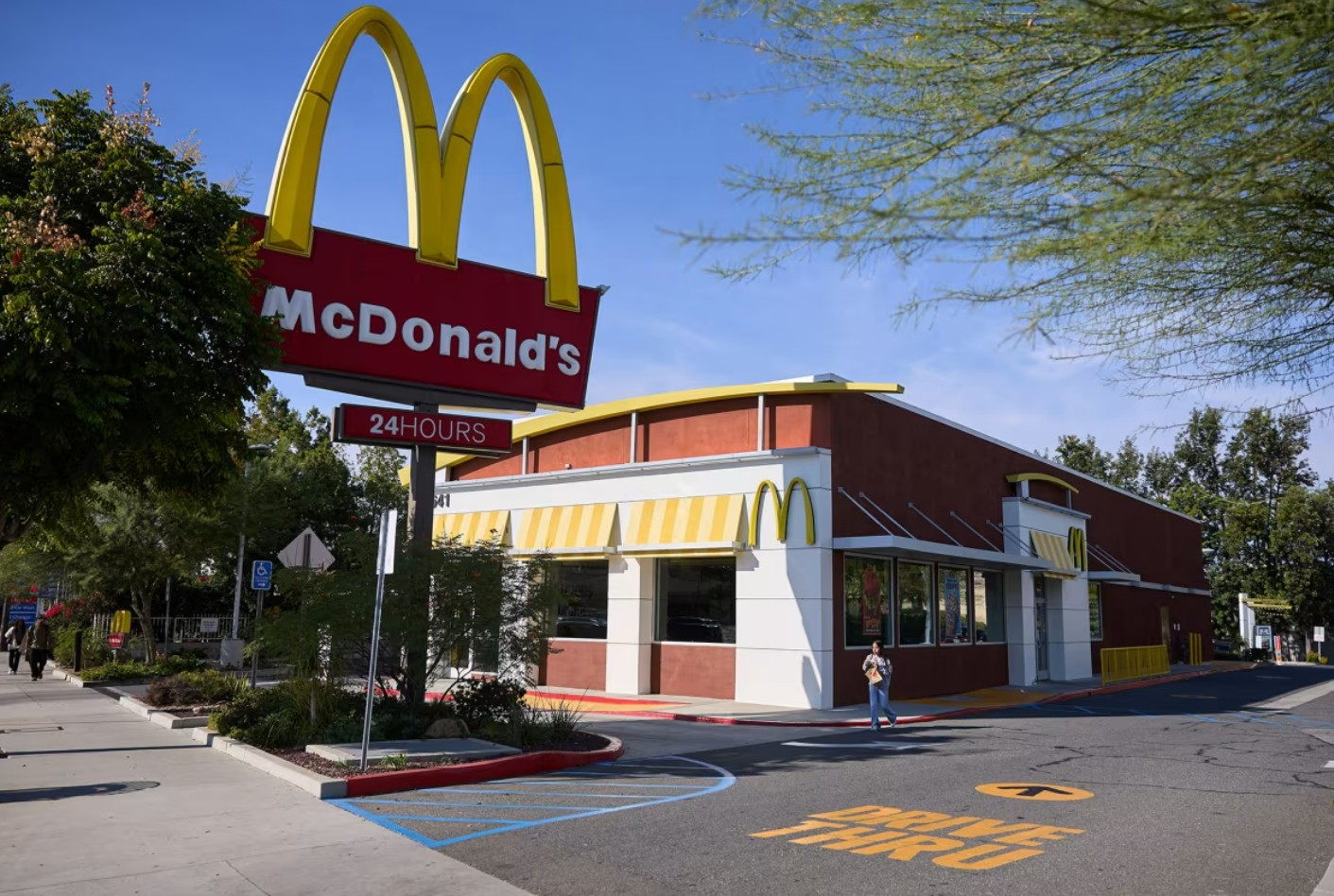
NEW YORK (Realist English). McDonald’s faces a key challenge: how to win back budget-conscious customers who believe its menu has become too expensive. The maker of the Big Mac said Wednesday at an investor event that US sales will be “slightly negative” in the current quarter, while they grew just 0.8% last quarter — the slowest pace in more than a year.
Market Reaction: Four-Year Low
McDonald’s shares plunged 4.81% on Wednesday, September 23, to $238.32, hitting a four-year low — more than 30% below the 52-week high of $341.75. Year to date, the stock has lost about 23%, making it the second-worst performer in the Dow Jones industrial average after Nike.
The $8.5 billion investment program announced at the investor day — to improve service, quality, and restaurant menus through 2030 — raised concerns about margin dilution and triggered a new wave of selling.
Inflation Undermines “Value Perception”
McDonald’s key problem is the collapse in consumers’ perception of its “value for money.” According to a 2024 UBS study, the share of American consumers who consider McDonald’s a good value fell from about 55% in 2020 to about 40% in 2024.
The Economist’s Big Mac Index shows that from 2019 to the end of 2025, the price of a Big Mac in the US rose by about 23%; according to other estimates, the average price of a McDonald’s menu item has risen by about 40% since 2019.
“They have raised prices significantly and are no longer perceived as the best choice in terms of food value for money,” says Melius Research analyst Jacob Aiken-Phillips. “I might rather go to Texas Roadhouse, get a real dining experience, and it won’t be much more expensive.”
The CEO’s “New Normal”
McDonald’s CEO Chris Kempczinski said directly in a CNBC interview on Wednesday that low traffic and high inflation have become a permanent characteristic of the restaurant industry.
“One of the things I told the team: we need to stop calling this a difficult environment and just acknowledge that this is the environment,” Kempczinski said. “Because looking ahead, we don’t expect the situation to change.”
He noted that over the past five years, the cost of beef in its largest market has nearly doubled, while labor and construction costs continued to rise. “Overall, we see that inflation is sticky. Not only in the US, but around the world.”
Franchisee Resistance
About 95% of McDonald’s restaurants are operated by independent franchisees, creating enormous resistance at the execution level of the “value strategy.”
Starting in January 2026, McDonald’s is introducing new standards for franchisees, assessing the extent to which restaurant pricing conveys a “sense of value” to customers. This measure effectively tightens the company’s control over pricing — a key lever that franchisees consider their prerogative.
Franchisees strongly object. The National Owners Association published a “Franchisee Bill of Rights,” emphasizing that operators must retain the ability to set menu prices based on local business conditions without fear of punishment or reduced support. In a Kalinowski Equity Research survey, all surveyed franchisees opposed the new national standards — a rare unanimous disagreement.
The deeper problem is the economic position of franchisees. They bear the costs of food and paper inflation, labor, rising rents, capital expenditures for remodeling, and daily pricing decisions, while paying the company about 8% of total sales as royalties and marketing fees.
Woozle Research analysis indicates that when the franchisee profit and loss statement deteriorates beneath an outwardly stable consolidated margin, “the asset-light premium is achieved by transferring risks that franchisees can no longer comfortably bear.”
Intensifying Competition
McDonald’s problems are not isolated. Burger King posted 8.5% US same-store sales growth last quarter, Taco Bell — 7%, both driven by $5, $7, and $9 meal deals.
“In this environment, the most important thing is being able to win share,” Kempczinski says. “You have to be able to take growth from competitors.”
Strategic Pivot and Market Doubts
At the investor day, McDonald’s presented a new strategy called “Next,” placing chicken at the center. The company notes that the beef market is valued at $50 billion with annual growth of about 3%, while the chicken market is nearly $130 billion with growth of more than 5% per year. McDonald’s plans to increase its share of the chicken market (currently “high teens”) by 1.5 percentage points by 2030.
Morgan Stanley analysts doubt the timeliness of the strategy, believing the return on the investment program is “distant and uncertain,” especially given the company’s recent “uneven execution record.” The bank maintains a “neutral” rating.
TD Cowen analyst Andrew Charles questions whether the recent traffic weakness is structural or cyclical; his forecast for US sales growth in 2026 is just 0.4% — one of the lowest on Wall Street.
Assessment
McDonald’s faces a structural dilemma: rapid post-pandemic price increases have undermined its “cheap” brand image, and in an inflationary environment consumers have become more price-sensitive. Franchisee resistance indicates that the company’s attempt to unify “value perception” through standardization may intensify tensions with operators.
Kempczinski acknowledges that the company “raised prices too quickly” after the pandemic, but the reality of doubled beef costs, labor market tightness, and high energy prices means limited room for significant price cuts.
Whether the $8.5 billion investment program can restore traffic growth in the medium term or becomes just another “belated” measure will depend on franchisees’ willingness to cooperate in execution — and that, judging by the publication of the “Bill of Rights,” is far from guaranteed.