MUMBAI (IA Realist). European haute couture houses have relied on Indian artisans for decades to create the finest hand embroidery, but this fact is rarely acknowledged publicly.
Mumbai textile and embroidery workshop Chanakya International is one of the most prominent forces behind the scenes: it collaborates with more than 50 international brands, including Fendi, Dior, Gucci, and Prada. Amid growing discussions about authorship, cultural appropriation, and transparency, Chanakya is trying to transform from an anonymous supplier into a public representative of Indian craft.
From 22 Artisans to a Global Workshop
In 1986, Vinod Shah, who had previously worked in the steel industry, moved from Gujarat to Mumbai with 22 artisans known as “ustad” and founded Chanakya with the goal of sharing India’s finest crafts with the world.
One of the first brands he began collaborating with was the Italian women’s fashion house Alberta Ferretti. “Although it was a new idea at the time, the Italians were always ready to meet with us,” recalls his daughter, current Creative Director Karishma Swali.
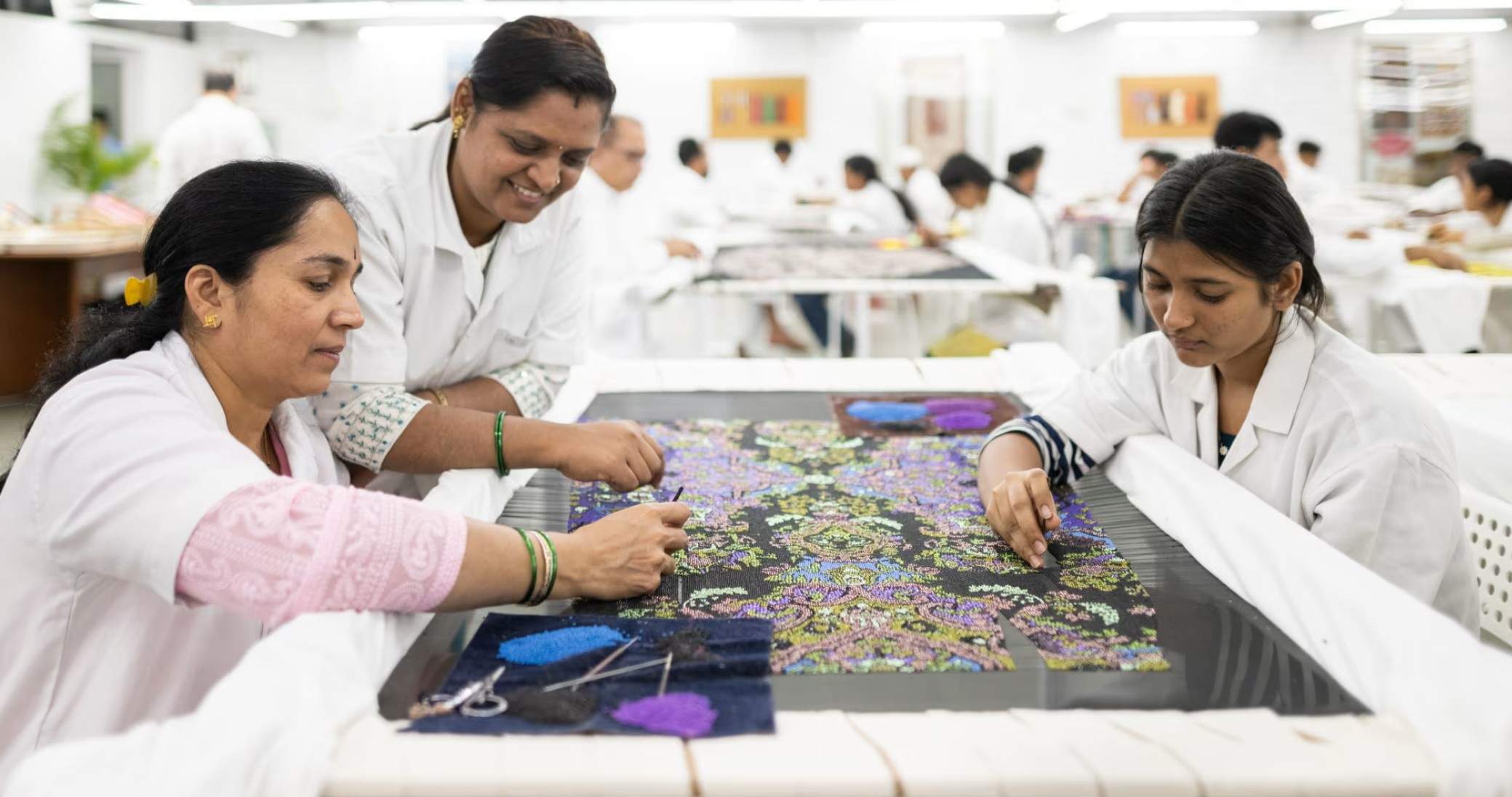
Swali and her brother joined the company in the mid-1990s, both trained in craft communities in Italy and various regions of India. Today, Chanakya’s headquarters remains in Mumbai, with an office in Bologna, Italy; the company employs more than 50 designers and more than 1,400 artisans, some representing families with continuity spanning up to 13 generations. Each year the company creates about 8 textile creative collections, and all global negotiations begin here.
Archive and Research as the Engine of Craft Revival
Chanakya’s key competitive advantage is its extensive research archive: more than 150,000 material samples and 10,000 historical textile items and artifacts. Swali says the goal is to “bring discontinued crafts back in the language of evolution.”
One of her favorite techniques is “chaand jaal” from the 16th-century Mughal era: using pure silver to create standalone openwork lace without a base. The workshop also uses fibers such as raffia, transforming them into garments using lacemaking, appliqué, and quilting techniques. Its eco-friendly collection, made entirely from waste, has been used by Maison Margiela and Dior.
The 2023 Dior Show: A Turning Point
Chanakya’s public image changed dramatically in 2023. Then Dior and its then-Creative Director Maria Grazia Chiuri publicly acknowledged the contribution of Chanakya’s artisans as part of a landmark show in Mumbai.
Chiuri and Swali’s collaboration dates back to the mid-1990s, when Chiuri was responsible for accessories at Fendi. For the Dior show, Chanakya not only executed the embroidery for all the looks but also created a 46-foot embroidered installation (toran), on which 382 artisans worked for 6 months.
Chiuri, now Chief Creative Officer of Fendi, noted in a letter to CNN: “Among the many projects we have realized together, I see that Chanakya has given Indian hand embroidery much greater visibility on the international stage — its depth, refinement, and creative potential — while remaining deeply committed to the people and knowledge that make it all possible.”
Chanakya School of Craft: Opening Craft to Women
In 2016, with Chiuri’s support, Chanakya founded the non-profit Chanakya School of Craft, specifically training women from vulnerable backgrounds in traditional textile techniques. Chiuri notes that over the years of her visits to Chanakya, all the artisans were men. “The idea came from her, and we decided to dedicate this school to women,” says Swali.
The school offers 18-month free courses covering more than 300 hand embroidery techniques; students also receive a transportation allowance. To date, more than 1,400 women have completed training. Swali recounts that at first she went from house to house persuading women to study; “with great skepticism, 22 women decided to try,” and today the school has a waiting list.
Chanakya is SA8000 certified and pays artisans a “living wage” rather than a minimum wage. Swali emphasizes that these courses do not simply train technical workers: “When these women see their work displayed on the global stage — they truly become artists, guardians of these crafts.”
Chorus: Stepping to the Forefront
In November 2025, Chanakya launched its own ready-to-wear brand Chorus in Mumbai, and in January 2026 opened a private showroom in Paris for buyers, planning a global retail launch in May 2026. Prices for Chorus ready-to-wear range from $300 to $5,000, and for custom orders from $5,000 to $35,000.
Swali says Chorus was born from a desire to “share with the world the beauty of collective action.” “In India, craft is not for special occasions, it is part of everyday life. I love how this continuity happens — because craft becomes everyday.”
40th Anniversary Exhibition: Bringing Craft into Public Space
In September 2026, Chanakya held three exhibitions in Mumbai to mark its 40th anniversary. At Mumbai’s oldest museum, the Dr. Bhau Daji Lad Museum, the exhibition “En Route” presented hand-embroidered maps created by Chanakya School of Craft; the exposition was originally commissioned by the Vatican Apostolic Library and shown in India for the first time.
At the company’s headquarters, the exhibition “Garden of Gestures” presented huge dark-red sculptures of Saptamatrika (the seven Hindu “mother” goddesses), entirely hand-made from bamboo, raffia, and cotton.
Swali says these exhibitions are intended not only to promote the workshop’s own work but also to encourage the entire fashion industry to recognize Indian savoir faire (craftsmanship).