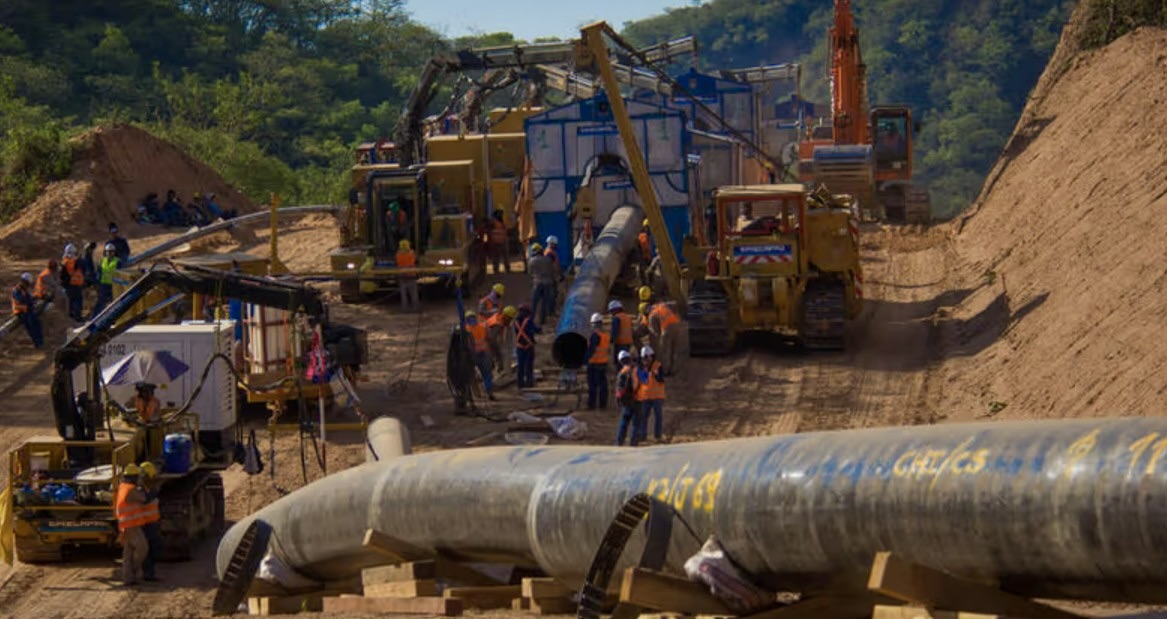
ALGIERS (Realist English). After two decades of delays, the Trans‑Saharan Gas Pipeline (TSGP) – one of Africa’s most ambitious energy projects – has finally entered the practical stage. On 4 June 2026, Algeria officially launched construction of its section of the pipeline, which will connect Nigerian gas fields to European markets via Niger.
The project, unofficially dubbed Africa’s “project of the century,” is set to dramatically reshape the continent’s energy map and reduce Europe’s dependence on Russian gas.
Key project specifications
| Parameter | Value |
| Length | 4,128 km |
| Capacity | 20–30 billion cubic metres (bcm) of gas per year |
| Cost | $10–13 billion |
| Route | Nigeria (1,037 km) → Niger (841 km) → Algeria (2,310 km) |
| Share of EU imports | ~11% of annual gas imports (270 bcm in 2025) |
| Participants | Algeria (Sonatrach), Nigeria (NNPC), Niger (SONIDEP) |
Timeline: from idea to construction
The idea for the Trans‑Saharan Gas Pipeline dates back to the 1980s. In 2006, the first feasibility study was conducted, and in 2009, the three countries signed an intergovernmental agreement, planning to launch supplies by 2015.
However, the project was repeatedly postponed due to security concerns, financing issues and regional instability.
| Date | Event |
| 1980s | Concept of the pipeline first emerges |
| 2006 | First feasibility study |
| 2009 | Intergovernmental agreement signed by three countries |
| 2022 | Project revived following Russia’s invasion of Ukraine |
| February 2025 | Updated agreements on feasibility and financing |
| February 2026 | Algerian President Tebboune announces construction start after Ramadan |
| 4 June 2026 | Official launch of construction on the Algerian section |
| Early 2027 | Planned start of construction on Niger section |
| Early 2027 | Planned start of construction on Nigeria section |
Geopolitical significance: a blow to Europe’s energy dependence
The revival of the project is directly linked to geopolitical shifts after 2022. As France 24 notes, “after Russia’s invasion of Ukraine in 2022, Europe intensified its search for alternative gas suppliers, breathing new life into African projects.”
The Trans‑Saharan Gas Pipeline will transport up to 30 bcm of gas per year – approximately 11% of Europe’s gas imports in 2025. Algeria already covers about 12% of EU gas demand.
According to Brahim Oumansour, a researcher at the Institute for International and Strategic Relations (IRIS), “Algeria and Niger have decided to set aside their differences for a common goal in a geopolitical context that favours them.”
Financing: $13 billion not yet secured
The project is estimated to cost $10–13 billion. The ownership structure is distributed as follows: Nigeria’s NNPC and Algeria’s Sonatrach jointly hold 90%, while Niger’s SONIDEP holds 10%.
However, as The Electricity Hub reports, “sponsors have not yet secured the full $13 billion needed for the TSGP.” Part of the investment is expected to go towards the Niger section, previously reported to be about 841 km in length. Algeria’s Sonatrach has stated it will finance and build the Niger section.
Competition between two routes: Algeria vs. Morocco
The TSGP is not the only project vying for Nigerian gas. The alternative Nigeria‑Morocco Gas Pipeline, estimated at $25 billion and spanning 6,900 km, would run through 13 West African countries to Morocco, and from there to Europe via the existing connection to Spain.
Both projects target the same Nigerian reserves and European consumers. However, the Algerian route is shorter and uses existing export infrastructure, while the Moroccan route requires new construction along the entire Atlantic coast.
As Forbes Africa notes, some analysts consider the Trans‑Saharan route “practically unfeasible due to security risks across the Sahara.”
Risks and obstacles
Despite the political momentum, the project faces serious challenges:
- Security: the route passes through the Sahel – a region with high levels of terrorist activity and political instability;
- Financing: $13 billion has not yet been fully secured;
- Political stability: relations between Algeria and Niger were tense until February 2026;
- Timelines: construction of the Niger section will begin only in early 2027, as will the Nigerian section. Full completion is not expected before the late 2020s – early 2030s.
Strengths and pressure points
For Algeria, the TSGP represents an opportunity to strengthen its position as a key gas supplier to Europe. For Nigeria, it opens a new export corridor and monetises vast gas reserves. For Niger, it offers transit revenues and economic development.
However, the key question is whether the project can attract the remaining $13 billion amid competition with the Moroccan route and global uncertainty in energy markets.
For Europe, the Trans‑Saharan Gas Pipeline is a strategic opportunity to reduce dependence on Russian gas and diversify supplies. But implementation will take years, and its security and financial viability remain in question.
As France 24 notes, “after several false starts, work on the Trans‑Saharan Gas Pipeline officially resumed in early June amid a thaw in relations between Niger and Algeria.” Whether this start will be the final one, or whether the project will be postponed again, remains to be seen.