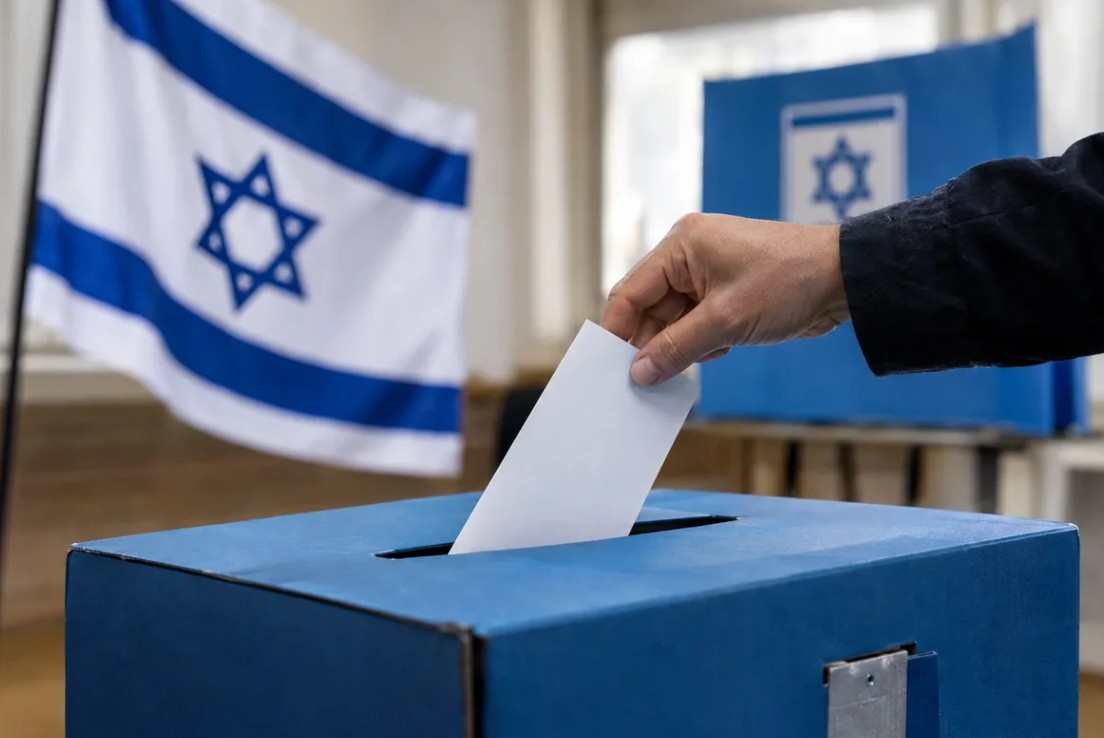
JERUSALEM (Realist English). Israel’s Central Elections Commission in the early hours of 30 October presented the final results of the snap elections to the 26th Knesset held on 27 October. After counting 100% of ballots, the bloc of Prime Minister Benjamin Netanyahu, which includes Likud and allied right-wing and religious parties, receives 53 seats out of 120. The opposition bloc “Change” led by former Chief of Staff Gadi Eisenkot receives 48 seats, Arab parties — 19 seats, an historic high.
Distribution of seats
According to the final data, Likud remains the largest faction with 27 seats. Eisenkot’s party “Yashar” receives 21 seats, Bennett’s bloc “Together” — 12, the Joint List — 11, the Democrats — 8, Ra’am — 8. Next come Israel Our Home (7), United Torah Judaism (7), Otzma Yehudit (7), Shas (6) and Religious Zionism (6). The “Reservists — Economy” party of Yoaz Hendel and “People of Israel” of Ofer Winter did not pass the 3.25% electoral threshold.
Turnout was 77.9% of eligible voters — 5,716,665 voters. This is the highest figure in decades: according to the Central Elections Commission, turnout rose by 7.1 percentage points compared to the 2022 elections.
Arab parties as key balance-broker
The main sensation of the campaign was the surge in support for Arab parties. The Joint List and Ra’am together receive 19 seats — almost double their 10 seats in the previous Knesset. The previous record was 15 seats in 2020.
Joint List leader Yousef Jabarin said Israelis voted for new leadership, and “anyone who wants to offer a substantive and genuine alternative to Netanyahu’s government will have to talk to us.” Ra’am chairman Mansour Abbas signaled readiness to join a coalition led by Eisenkot if it proves viable.
However, most parties in Eisenkot’s bloc, with the exception of Yair Golan’s Democrats, had previously ruled out cooperation with Arab factions. Eisenkot himself resisted an alliance with Arab parties. Golan became the first in the opposition camp to openly call for an alliance: “Netanyahu lost. I can count to 120. We must no longer accept Netanyahu’s racist division between Jewish and Arab votes.”
Possible scenarios
Experts identify three main paths out of the impasse.
Netanyahu’s government. President Isaac Herzog will most likely first grant the mandate to the leader of the largest party. However, Netanyahu has no obvious path to expanding his bloc beyond his existing far-right and ultra-Orthodox allies to 61 seats. The prime minister himself has ruled out cooperation with Arab parties, calling them “anti-Zionist.”
Eisenkot’s minority government. The opposition and Arab parties together hold 67 seats, enough to remove Netanyahu from power. However, to form a cabinet, Eisenkot, Bennett and Liberman would have to abandon campaign promises not to rely on Arab lawmakers. An alternative could be a minority government with external support from Arab parties in parliamentary votes, but few observers believe such a construct would last long.
Repeat elections. If neither bloc can assemble 61 seats, Israel will again find itself in a cycle of snap elections, as already happened in 2019–2022. Herzog urged party leaders to do everything possible to avoid a new round of elections: “We must do everything in our power, especially after yesterday, to avoid another election.”
Dispute over possible Qatari interference
The results were overshadowed by accusations against Arab parties. Netanyahu’s headquarters circulated unconfirmed claims that Ra’am and the Joint List had allegedly received Qatari funding to bribe voters.
Arab parties and Qatar rejected the accusations, and Eisenkot accused Netanyahu of trying to “cast doubt on the legitimacy of the election results.” Israel’s Shin Bet security service said it was conducting a review but stressed it was not aimed at “discrediting a group that participated in voting in a democratic and lawful manner.” The Central Elections Commission called the circulated information “completely unfounded” and confirmed it would not affect the final results to be handed to the president.
The official results capture a paradox: a majority of Israelis voted for parties opposed to Netanyahu, yet he may remain in power — not because his opponents lack the numbers to replace him, but because some of them refuse to recognize Arab lawmakers as legitimate political partners.
Arab parties have gained unprecedented influence, but their ability to convert it into real power remains uncertain. The final results will be officially presented to President Herzog on 4 November, after which consultations with party leaders will begin. The new Knesset must be sworn in on 10 November, regardless of the course of coalition talks. If the deadlock persists, Israel will again face the prospect of elections — a scenario the president and a significant part of society seek to avoid.