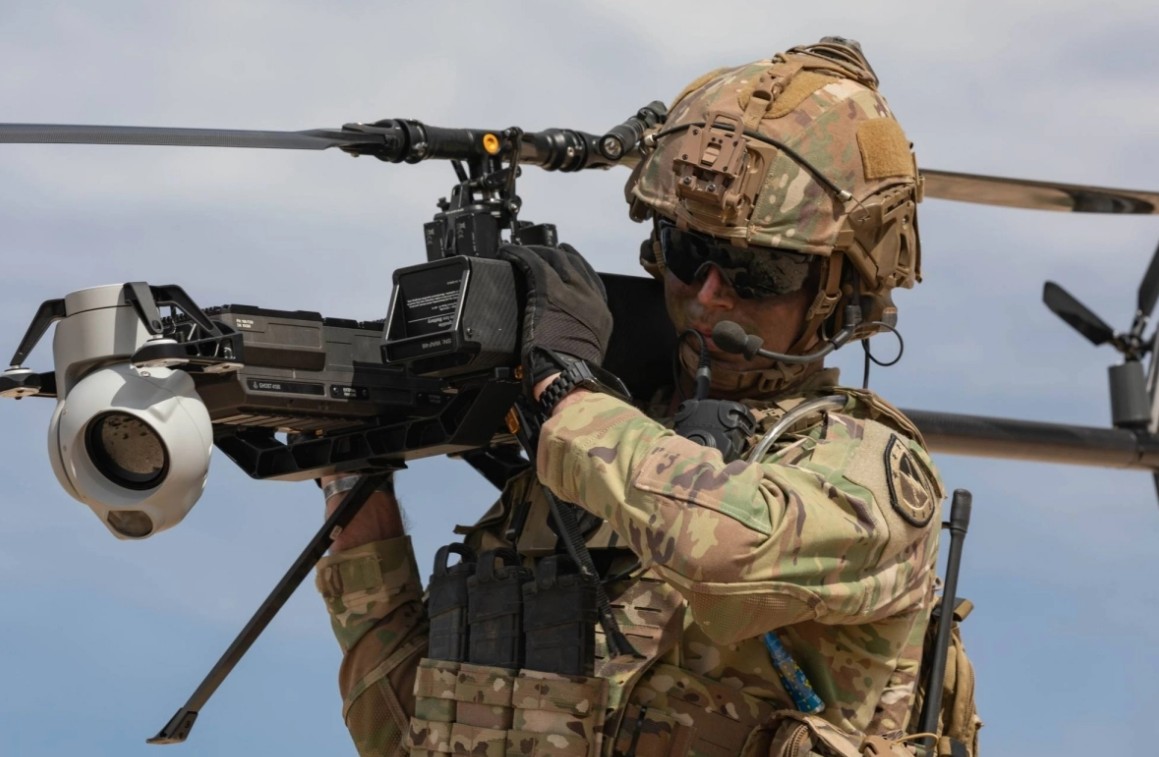
WASHINGTON (Realist English). On October 26, the US Defense Contract Management Agency (DCMA) added the Cerberus MI unmanned aerial vehicle, produced by Australia’s Skyborne Technologies, to the Blue UAS Cleared List.
This means that US military units and other federal agencies can purchase and use the drone without obtaining special exceptions from the policy. The decision was made after an independent review for compliance with cybersecurity standards, supply-chain transparency, and the requirements of the National Defense Authorization Act (NDAA), which restricts the use of components of certain origin.
Key feature: reusable employment
Unlike widely used one-way strike drones and FPV kamikaze drones, which are destroyed on impact with the target, Cerberus MI is designed to return to base, reload, and fly again.
The system carries two types of interchangeable weapons: the 12-shot CHAOS shotgun and the 40mm HAVOC low-velocity grenade launcher, both using standard ammunition. According to the manufacturer, the cost of one engagement is measured in “hundreds of dollars,” which means the emphasis is not on the cheapness of the platform itself but on the repeated use of the same machine.
Technical parameters
According to Skyborne Technologies, Cerberus MI belongs to the small Group 2 class. The system weighs 18 kg without a payload and 22 kg in fully equipped condition, allowing servicemen to carry it manually. With weapons installed, the drone can stay airborne for about 35 minutes; without a payload, flight time increases to 42 minutes. Maximum speed reaches 54 km/h.
The design was initially developed to absorb recoil during firing: three tilting rotor arms simultaneously serve as shock absorption and weapon aiming without the use of a separate mount.
The onboard EXITUS AI program combines data from electro-optical, infrared, and laser rangefinder sensors to calculate a firing solution, but the final decision to open fire remains with the operator. The target engagement range exceeds 300 meters.
| Parameter | Value |
| Class | Group 2 |
| Weight without payload | 18 kg |
| Weight fully equipped | 22 kg |
| Flight time with weapons | ~35 minutes |
| Flight time without payload | ~42 minutes |
| Maximum speed | 54 km/h |
| Engagement range | more than 300 m |
| Armament | 12-shot CHAOS shotgun, 40mm HAVOC grenade launcher |
| Status | Included in the Blue UAS Cleared List |
Tests and previous developments
In July 2025, during flight tests, the Cerberus version equipped with a shotgun hit four target drones. An even earlier modification, Cerberus GL, in late 2019 fired five 40mm grenades in the presence of US Army servicemen as part of the Army Expeditionary Warrior Experiment. Skyborne Technologies was founded in 2014 and has offices in Virginia (USA) and Brisbane (Australia); its US division was opened in August 2025.
Shotgun as a counter-drone means
The use of shotguns against unmanned aerial vehicles had previously been considered mainly as the “last line” of ground defense. In the Ukrainian conflict, FPV drones equipped with shotguns and grenade launchers have already appeared to intercept enemy reconnaissance and strike systems.
Cerberus MI takes this logic into the air: instead of expensive missiles or one-way kinetic interceptors, it envisions a reusable platform with relatively cheap ammunition. The Blue UAS program, launched in 2020, was initially created to select drones meeting government standards, and one of its priorities is excluding Chinese-made components that dominate the global commercial market.
Inclusion in the Blue UAS Cleared List is a permission to purchase, not a contract itself. Skyborne Technologies has not yet announced deals for the supply of Cerberus MI, and the list does not indicate specific customers.
This is about passing a procedural barrier that opens the way to possible orders, whereas the path from “approved for acquisition” to actual entry into the force includes budget decisions, establishment of organizational structures, training of crews, and tactical verification in field conditions.
Nevertheless, the direction is set: kinetic means of engaging air targets are gradually moving from ground firing positions onto the drones themselves. Whether Cerberus MI will remain a niche solution or become a mass platform depends on the results of troop trials and the army’s readiness to change its usual procurement schemes.