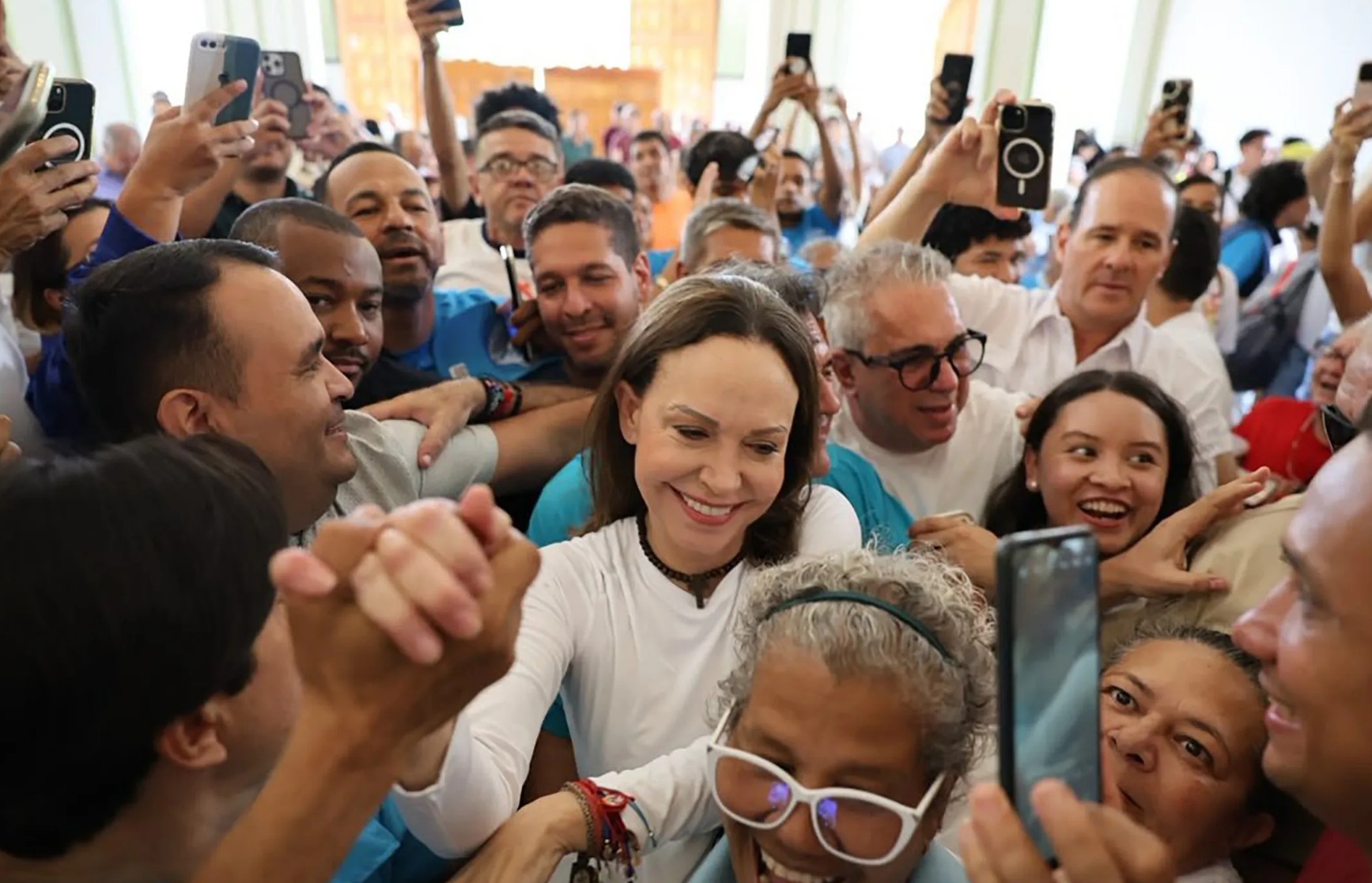
CARACAS (Realist English). On 25 October, María Corina Machado, Nobel Peace Prize laureate and opposition leader, returned to Venezuela after ten months of absence. Her motorcade from the western state of Lara to Caracas was greeted by thousands of supporters. Yet behind the outward triumph lies a paradox: Machado enjoys unprecedented popular legitimacy but has virtually no institutional tools to influence the transition process.
What changed during the exile
Venezuela’s political landscape has undergone radical changes. Nicolás Maduro was forcibly removed by the US military on 3 January 2026 and taken to New York, where he faces charges of drug trafficking, illegal arms dealing and torture. Former Vice President Delcy Rodríguez became interim president and, according to analysts, enjoys the full confidence of the White House. The Trump administration concluded a large-scale oil agreement with Rodríguez’s government, granting the US a 100-year concession over 65 billion barrels of Venezuelan oil.
The trap of the “three-phase plan”
US Secretary of State Marco Rubio outlined a three-phase strategy for Venezuela: stabilisation, economic recovery and political transition. Talks on reforming electoral institutions — the National Electoral Council and the Supreme Court — are underway between the interim government and opposition groups, but Machado’s “Vente Venezuela” movement is not included. As El Nacional notes, Chavismo retains control of the state apparatus and can “manage the timing” of its own transformation, stretching the process through incremental concessions. A hypothetical timetable matching the interim government’s interests envisages municipal elections in 2027, regional elections in 2028, parliamentary elections in 2029 and presidential elections only in 2030.
Machado’s dilemma: insist or wait
Machado herself insists on holding presidential elections as early as 2027. However, her demand to accelerate the vote could “lock” relations with Washington, which is pursuing its own three-phase plan and is in no hurry. As political scientist Ricardo Ríos explained, the negotiations envisage holding regional elections first and then presidential ones, and Machado will likely seek electoral guarantees and an early vote, but the question remains what guarantees the ruling sector would receive in the event of defeat.
The New York Times captures the key contradiction: Rodríguez’s legitimacy “stems exclusively from the White House,” whereas Machado’s legitimacy comes “from the Venezuelan people.” James Story, US ambassador to Venezuela in 2018–2023, called the interim government’s approach to softening authoritarian rule “milquetoast” and lacking a detailed plan for presidential elections. In his view, Machado’s return increases pressure to accelerate that process.
Analytical conclusion
Machado finds herself in a situation where her main resource — popular support — does not convert directly into political influence. As an El Nacional columnist put it, the equation is: high legitimacy (L↑) plus virtually zero institutional influence (I≈0) plus growing time until elections (T↑) equals an uncertain political outcome (¿P?). She has two paths: either use the current mobilisation to change the terms of the deal between Washington and Caracas, or accept a lengthy transition and wait while maintaining support.
The first path requires not only rallies but also institutional alliances and convincing Washington that ignoring her is riskier than including her in the process. The second requires patience — which, as Bloomberg ironically notes, Machado has a “master’s degree” in, but which could drain the energy of the streets that brought her back. The coming months will show whether she can turn a moral victory into political capital without entering open conflict with the only ally that currently controls her country.