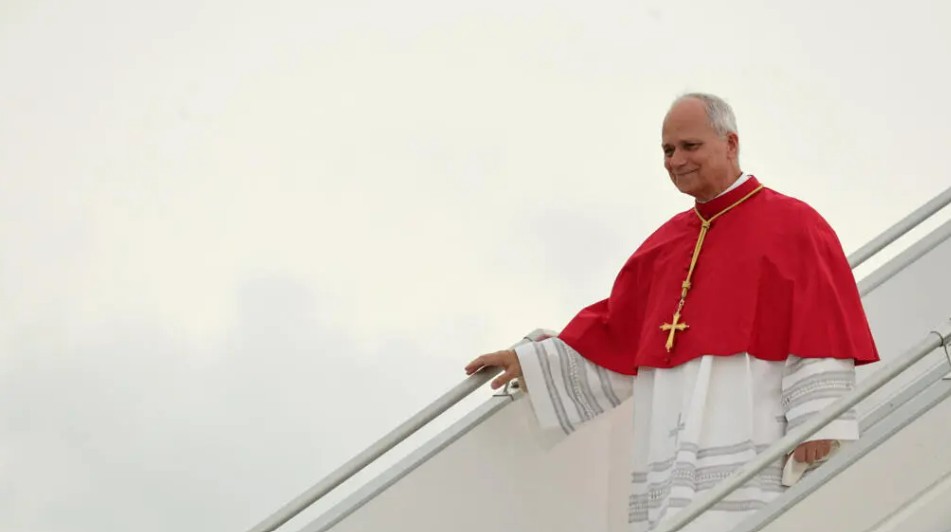
LIMA (Realist English). Pope Leo XIV, born Robert Prevost, who served in Peru as a missionary and bishop for more than two decades, has returned there as pontiff for the first time. The plane landed at the Callao airbase on 11 November at 17:30 local time, where he was met by President Keiko Fujimori and two children with flowers.
“I am returning home”
In his first address to the president and government members, the pope stressed that the Peruvian citizenship he received in 2015 only cemented a connection that had begun long before.
“Today I understand how much of this land remains with me and how much of my own history belongs to you. Therefore I can say to you with deep gratitude that I am also returning to my homeland,” AP quoted him as saying. The crowd chanted “The Pope is Peruvian!”, and during the official ceremony Leo XIV, together with Fujimori and a children’s choir, performed the Peruvian national anthem.
Route and programme of the visit
The pontiff’s motorcade, more than ten kilometres long, travelled from Callao to the Government Palace; the pope covered part of the route in a closed car and switched to the popemobile as he approached central Lima. The visit, which will last until 16 November, includes a meeting with Peru’s bishops and midday prayer in Lima Cathedral on 12 November, as well as trips to Chiclayo, Cajamarca, Cusco and Pucallpa. The tour will conclude with a Mass at the Las Palmas airbase in the Surco district on 16 November.
Symbolism and political situation
Ahead of the visit, a 14-metre monument to the pontiff was erected in the port of Callao. The visit takes place against the backdrop of political and social tensions in Peru, and observers note that the arrival of a pope who knows the country from the inside is intended to become a “point of support” for society. The ceremony featured music of the Quechua indigenous people and the traditional marinera dance from Chiclayo — the diocese Prevost headed before his election as pope.
The return of Leo XIV to Peru is not just the final stop of a South American tour but a deeply personal and symbolic gesture. For Peruvians, who greeted “Padre Roberto” as a national hero, it confirms that their country and its problems are not forgotten.
For the pontiff himself, it is an opportunity to use his moral authority and knowledge of local realities to call for dialogue and solidarity amid political turbulence. The massive turnout (about 3 million people) contrasts with the declining influence of the Catholic Church in the region, making this visit an important test of the Vatican’s ability to mobilise believers and influence the public agenda.