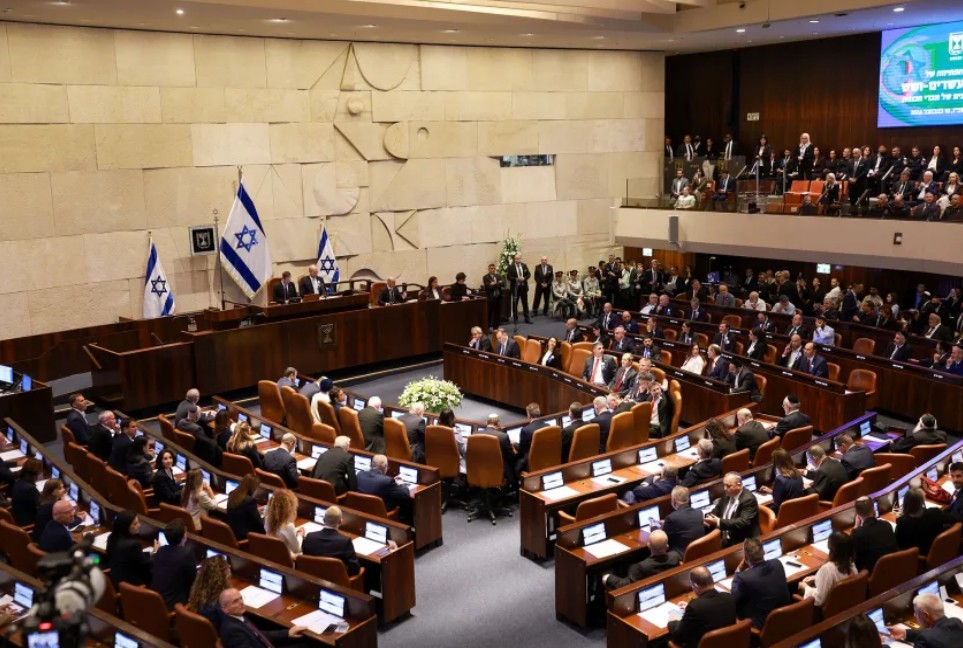
JERUSALEM (Realist English). The political crisis in Israel that began after the elections to the 26th Knesset has entered a decisive phase. President Isaac Herzog on 8 November tasked the leader of the Yesh Atid party and former Chief of Staff Gadi Eisenkot with forming the government. However, despite the existence of a potential majority, coalition negotiations are stalled due to ideological contradictions and the taboo on cooperation with Arab parties.
Loss of majority: the end of the Netanyahu era?
In the elections, the Netanyahu bloc, which includes Likud and allied right-wing and religious parties, received only 53 seats out of 120 — 11 fewer than in the previous Knesset and significantly below the threshold of 61 seats needed to form a stable coalition. Moreover, after the ultra-Orthodox party United Torah Judaism refused to recommend Netanyahu, his support dropped to 46 lawmakers.
The loss of control over the Knesset marked the end of a four-year period during which Netanyahu enjoyed a comfortable majority of 68 seats. For a politician who has dominated Israeli politics for nearly two decades, this was a serious blow.
Eisenkot’s mandate and insurmountable barriers
On paper, Eisenkot has a majority: 67 out of 120 seats in the Knesset, since his bloc is supported by two Arab parties. However, these 67 votes are made up of six ideologically diverse parties — from right-wing to Arab — which find it extremely difficult to agree on a joint government.
The key problem is that most Jewish opposition parties, with the exception of the left-wing Democrats led by Yair Golan, refuse to cooperate with Arab parties, even if they are ready to support the government from outside.
The leader of the Yisrael Beiteinu party, Avigdor Lieberman, who is considered the main obstacle to Eisenkot’s plan, categorically rejects participation in a government dependent on Arab parties and proposes an alternative — a coalition of 61 seats with the participation of ultra-Orthodox parties but without Arabs.
Arab parties as “key” and “taboo”
The historic result of the Arab parties — 19 seats (almost double than in the previous Knesset) — made them a key factor in forming the government.
The leader of the Joint List, Yousef Jabarin, said that his bloc would act as a “safety net” for the new government, supporting it from outside in order to remove Netanyahu from power, and cited cooperation with Yitzhak Rabin’s government in the 1990s as an example. The leader of Ra’am, Mansour Abbas, also expressed readiness to join a government headed by Eisenkot.
However, these proposals encounter deep resistance. Many Israelis, including some opponents of Netanyahu, do not consider Arab parties legitimate coalition partners. This creates a paradoxical situation: arithmetically, Arab parties can ensure a change of power, but politically their participation remains taboo for most Zionist parties.
Legal pressure on Netanyahu
The political crisis is compounded by the ongoing trial of Netanyahu. He is accused in three corruption cases: Case 1000 (fraud and breach of trust), Case 2000 (fraud and breach of trust) and Case 4000 (bribery, fraud and breach of trust). Netanyahu denies all charges, calling them “fabricated” as part of an attempted political coup.
Recently, Attorney General Gali Baharav-Miara stated her readiness for a “direct dialogue” on a possible plea deal, although she rejected the judges’ proposal for a closed-door meeting. Netanyahu’s legal troubles are an important factor pushing the opposition to try to form a government in order to strip him of immunity and the ability to influence the judicial system.
Possible scenarios: what will end the uncertainty?
Experts identify several ways out of the impasse:
- A minority government led by Eisenkot. This is the most likely, albeit fragile, scenario. Eisenkot forms a government of four Jewish parties (48 seats), which will rely on the outside support of Arab parties (19 seats) and possibly United Torah Judaism. Such a government could be sworn in, but its stability will depend on the goodwill of partners not in the cabinet.
- A national unity government with Likud. Netanyahu calls for the creation of an “emergency national government,” but only on his terms — with retention of the post of prime minister and inclusion of his entire right-wing bloc. Eisenkot rejects this, calling it “pathetic PR,” and demands that Netanyahu break with his far-right partners.
- New elections. If Eisenkot fails to form a coalition within 28 days (with the possibility of extension), the mandate may return to the president or be given to another candidate. If all attempts fail, the Knesset will be dissolved, and Israel will go to elections again, which will likely only reproduce the current impasse.
The political crisis in Israel is not just a power struggle between two leaders but a reflection of a deep structural split in society. Netanyahu, remaining the country’s most experienced and cunning politician, has lost the ability to assemble coalitions but retains enough influence to block an alternative.
Eisenkot, having received a historic chance, has become a hostage of ideological contradictions within his own camp, where the refusal to cooperate with Arab parties outweighs the desire for a change of power.
The key question is whether the Israeli political system can overcome this paralysis, or whether the country is entering a period of permanent instability, where governments will change every few months, and Netanyahu, even weakened, will remain the central figure around whom all politics revolves.