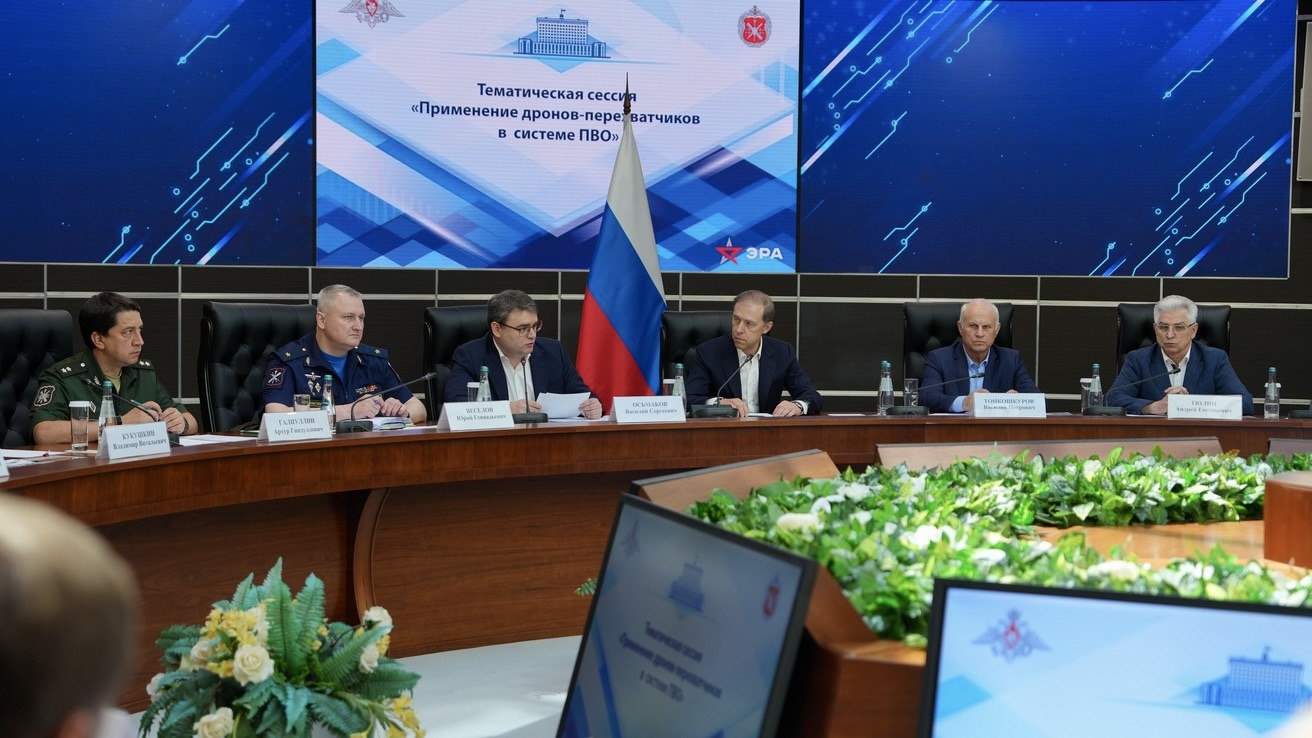
MOSCOW (Realist English). First Deputy Prime Minister Denis Manturov chaired a thematic session on the use of interceptor drones in the zone‑based and object‑based air defense system.
The meeting was attended by Deputy Defense Minister Vasily Osmakov, Deputy Minister of Industry and Trade Vasily Shpak, representatives of the Military‑Industrial Commission, defense industry enterprises, and research centers.
Participants discussed tactical and technical requirements for interceptor drones, their place in the air defense system, combat experience in protecting critical civilian infrastructure, and the industry’s capacity to increase production.
“Stay One Step Ahead”
Denis Manturov outlined key priorities for this direction. According to him, it is necessary to clearly define requirements for UAV interceptors to counter medium‑ and long‑range drones, and to develop approaches for mass production of models with different deployment methods — both hand‑launched as part of mobile fire teams and launched from air defense missile system launchers.
“It is important to standardize components and optimize serial production costs. To improve interceptor effectiveness, we need to enhance their interaction with detection, targeting, and control systems, and ensure their integration with other counter‑UAV measures,” Manturov said.
The first deputy prime minister stressed the need to stay ahead of the adversary: “We must be one step ahead of our opponents. We need to increase the speed, maneuverability, autonomy, targeting accuracy, and group‑use capabilities of our domestic systems.”
Air Defense on a Unified Information Basis
Deputy Defense Minister Vasily Osmakov noted that air defense is being built on a unified information‑management system, with real‑time data processing using advanced information technologies, including artificial intelligence.
Deputy Minister of Industry and Trade Vasily Shpak, in turn, emphasized the importance of collecting and processing all types of data — from acoustic, thermal, and optical systems for detecting enemy UAVs.
From Interceptors to Ground Systems
Participants viewed an exhibition of projects from industrial enterprises and research organizations. Among the showcased developments were:
- interceptor drones in various configurations;
- new air defense systems;
- ground‑based robotic counter‑UAV complexes;
- ground control and communication stations for UAVs;
- specialized software and hardware‑software complexes.
Why Interceptor Drones Have Become a Priority
The widespread use of drones during the Special Military Operation has fundamentally changed the nature of combat. The enemy actively uses UAVs for reconnaissance, fire adjustment, and strikes on critical facilities. In this environment, interceptor drones are becoming one of the most effective and cost‑effective means of countering aerial threats.
Earlier, in June 2026, President Vladimir Putin instructed the government and regions to develop an air defense system to protect critical infrastructure from drone attacks. Manturov’s session was a practical step in implementing this directive.
As Osmakov stressed, the key task is to integrate interceptor drones into a unified air defense system and ensure their interoperability with existing detection and engagement systems. Manturov, for his part, emphasized the need for standardization and mass production to meet frontline requirements as quickly as possible.
Following the session, specific tactical and technical requirements for interceptor drones will be developed, optimal models for serial production will be identified, and integration pathways into the unified air defense system will be mapped out.
As Manturov noted, work in this direction will continue with a focus on outpacing the potential adversary in speed, maneuverability, and autonomy of Russian developments.