
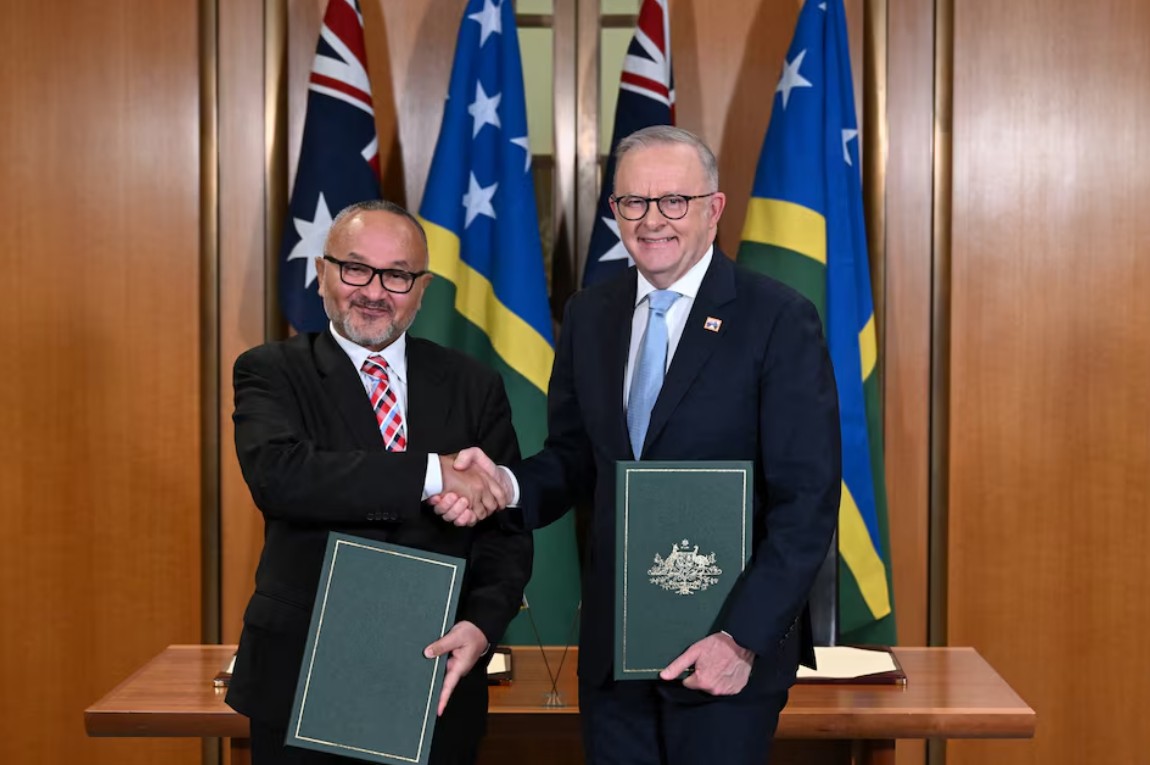
CANBERRA (Realist English). Australian and Solomon Islands Prime Ministers Anthony Albanese and Matthew Wale signed a bilateral treaty on 25 November that secures for Canberra the role of Honiara’s main security partner and closes the path to a potential Chinese military presence in the South Pacific.
Content of the treaty: ban on foreign bases and PIF priority
According to a joint statement, the new document confirms the “sovereign decision of Solomon Islands” that there will be “no foreign military or security bases” on its territory. In addition, Honiara undertakes to ensure that its “sensitive infrastructure remains free from militarisation, any foreign interference or unauthorised access.”
It is separately stipulated that future security needs of Solomon Islands that cannot be met by members of the Pacific Islands Forum (PIF) will be addressed with priority for PIF countries. China is not a PIF member, although it has dialogue partner status.
The treaty is not limited to security: Australia has committed to investing in infrastructure, education, renewable energy and sport, as well as opening new migration pathways for Solomon Islanders in aged care and childcare.
Background: abandoning the agreement with China
The signing of the treaty with Australia followed reports in Australian media that Wale’s government had notified Beijing that it would not extend the security and police cooperation agreement signed in 2022 under former Prime Minister Manasseh Sogavare. That pact expires in April 2027.
Wale himself declined to confirm or deny the information, citing a non-disclosure clause in the agreement with China. “Unfortunately, there is a non-disclosure clause in the agreement with China. So I cannot talk about it. We have ongoing discussions with China,” he told journalists in Canberra.
At the same time, Wale made clear that the previous government’s course was a thing of the past: “Solomon Islands has been a source of uncertainty and doubt in the region for a number of years. Those days are over. Gone.”
China’s reaction
Chinese Foreign Ministry spokesman Guo Jiakun, commenting on the situation, neither confirmed nor denied reports that the pact with China had been terminated. He stressed that cooperation between China and Pacific region countries “does not contain elements of geopolitical rivalry or bloc confrontation.”
A series of pacts and strategic competition
The treaty with Solomon Islands became the latest in a series of bilateral security agreements Australia has concluded with Pacific neighbours since China signed an agreement with the previous Solomon Islands government in 2022. Similar pacts were previously concluded with Papua New Guinea, Vanuatu, Fiji and Tuvalu.
According to Oliver Nobetau, director of the Pacific programme at the Lowy Institute, the treaty “demonstrates that Australia is listening to what partners in the Pacific want.”
As observers note, the key feature of the situation is Honiara’s formal retention of freedom to choose partners while the priority of Australia and PIF countries is effectively consolidated. The treaty does not contain a direct ban on cooperation with China, but the mechanism of prior consultations on sensitive infrastructure and the linking of future security needs to the PIF create institutional barriers for Beijing.
Chinese experts point to the risk of “securitisation” of economic projects: “sensitive infrastructure” includes ports, energy and telecommunications, which could complicate Chinese companies’ participation in tenders.
For regional diplomacy, the immediate effect will be most noticeable primarily in whether the treaty is followed by practical steps to push out Chinese projects and whether a balance is maintained between partnership with Australia and economic ties with China — and that is precisely where it is most sensitive for the durability of Honiara’s new course.