NEW YORK (Realist English). Columbia University has suspended admissions to one of the flagship master’s programs at its Journalism School. As it turns out, the decision is directly linked to a sharp drop in applications from international students — and this drop is driven by the tightening of the Trump administration’s visa policy.
What happened
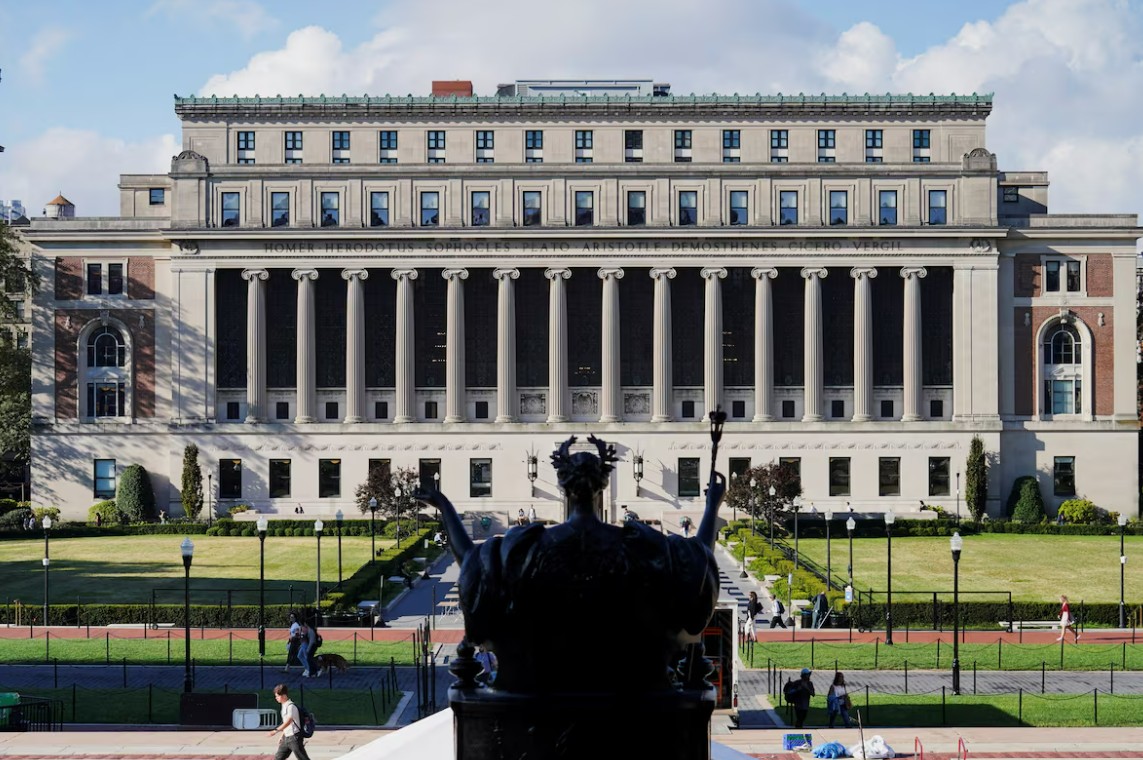
Columbia University’s Journalism School announced on October 1 a one-year suspension of admissions to its Master of Arts (MA) program. The official wording is a “critical reassessment” of the program, created in 2005.
School Dean Jelani Cobb confirmed to Reuters that changes in visa policy were “part of the considerations” in making the decision. According to him, the program needs reworking because “the journalism market looks different” than it did in 2005.
Scale of the problem
According to four sources familiar with the situation, international students make up roughly half of those enrolled in the MA program. Visa difficulties and uncertainty in immigration policy have deterred a significant portion of applicants from abroad. The exact size of the drop in applications has not been disclosed.
A telling example: Indian journalist Kaushik Raj, admitted to a separate MS program in data journalism, was denied a student visa in 2025. The denial letter stated that he “did not demonstrate sufficient ties to India” to prove intent to return after his studies.
Background: what exactly changed
The admissions suspension came amid a series of measures by the Trump administration aimed at restricting the stay of international students and journalists in the US.
In July 2026, DHS announced new rules: student visas (F) and exchange visitor visas (J) were limited to four years, and visas for foreign journalists (I) to 240 days, replacing the “duration of status” system that had been in place for decades. For Chinese journalists, the term was 90 days.
In September 2026, Federal Judge Dennis Saylor in Massachusetts blocked the rule, calling its justification “exceptionally weak” and “bordering on absurd.” The judge noted that “the opportunities for abuse are boundless,” especially regarding journalists critical of the government.
However, even the temporary uncertainty had an effect. As Reuters notes, the Trump administration had earlier suspended student visa interview scheduling, then resumed it with expanded social media vetting.
Why this matters
Columbia’s Journalism School is one of the leading institutions in its field in the US. It also administers the Pulitzer Prize, the country’s highest professional honor.
The MA program is aimed at mid-career journalists specializing in politics, business, and science. It is smaller than the MS program, which is designed for students with less experience. The suspension does not affect the MS.
The cost of the nine-month MA program is estimated at about $120,000 before financial aid. About 80% of students receive aid, including grants and scholarships.
What next
Cobb said the school is considering creating a new fundraising strategy for the MA program and is exploring the possibility of launching a partial version. At the same time, on October 1 the school announced a two-year online MS program in a part-time format. According to the dean, this is not connected to the MA suspension, but the online format theoretically allows recruiting international students without visa restrictions.
Will Columbia University be able to maintain its status as a global center for journalism education if visa policy continues to deter international students? Or will the “critical reassessment” of the program prove to be the first step toward its full reformatting for the domestic market?