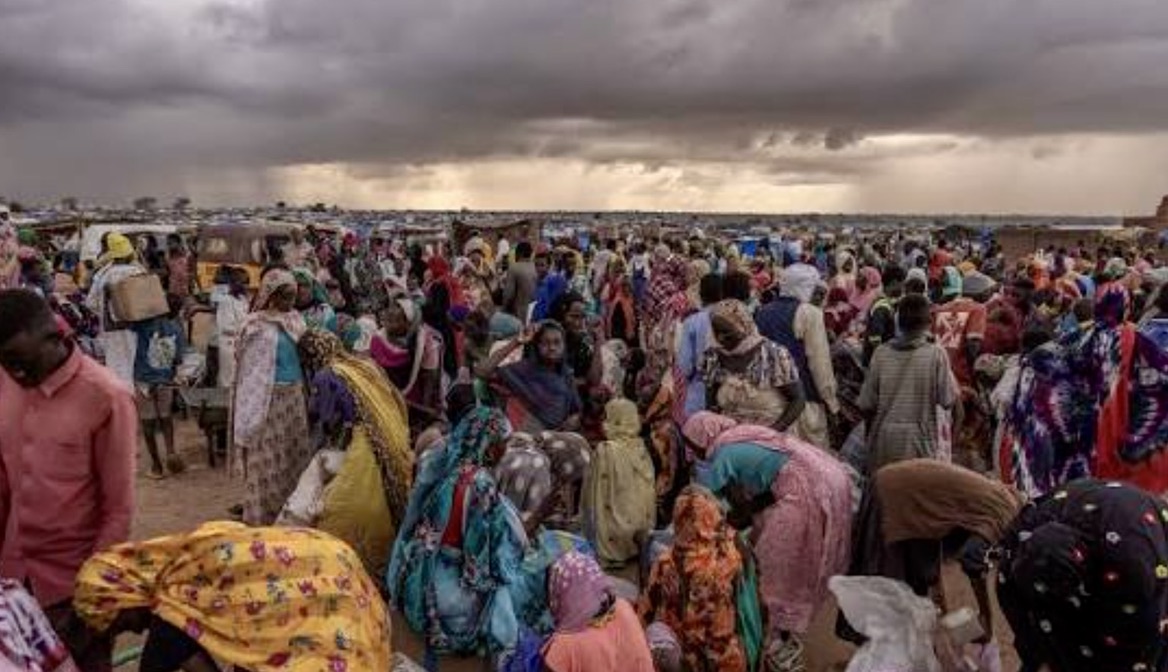
EL-OBEID (Realist English). In the first four months of 2026 alone, drone strikes killed at least 880 civilians in Sudan — accounting for more than 80% of all UN‑recorded civilian deaths in the conflict during that period.
In 2025, the number of drone‑related deaths increased by 600% compared to the previous year. This marks a new, even more lethal phase of a war where anyone can become a target at any moment.
“You cannot hide from a drone,” says 27‑year‑old Elsadig. For him, this is not a metaphor but the grim reality of life in the besieged Sudanese city of El‑Obeid, where even the most mundane daily activities can be one’s last.
In late June, Elsadig was sitting at a water station when a drone struck, tearing off his left leg. Nearby was 42‑year‑old Ahmedo, a sewage truck driver. In that same attack, Ahmedo lost his 9‑year‑old son, who had come to meet his father after school, along with two of his colleagues.
“My day started like any other. Drones were flying overhead, but I never thought my child or I would become a target,” Ahmedo told CNN.
The Nightmare of El‑Obeid: A City Under Fire
El‑Obeid — the capital of North Kordofan state with a population of about half a million — has become the epicentre of drone terror. The city, of critical strategic importance, lies on the frontline between the Sudanese Armed Forces (SAF) and the paramilitary Rapid Support Forces (RSF).
In June 2026 alone, according to monitoring group ACLED, 27 drone strikes were recorded in the city — more than in any other month since the conflict began. From June 6 to 28, according to the UN Office for Human Rights, 15 drone strikes killed at least 45 civilians and wounded 41 others.
UN High Commissioner for Human Rights Volker Türk stated: “The signals from El‑Obeid are clear and unequivocal: another human rights catastrophe is unfolding in Sudan.”
A doctor at a local hospital, struggling to hold back tears, told the BBC: “We are truly suffering from drones — no one knows how or when they will die.” Among the most severe cases she treated was a seven‑month‑old child whose arm had to be amputated due to the severity of the injuries, but who could not be saved.
The Arms Race from Above: Who Is Fighting with What
What began as a ground war has increasingly become a battle waged from the air. With the support of foreign suppliers, both sides have expanded their drone fleets — from modified commercial UAVs to advanced military systems.
- The Sudanese army uses Turkish Bayraktar TB2 drones, as well as more advanced Akinci models.
- The Rapid Support Forces (RSF) are using, according to intelligence reports, Chinese long‑range CH‑95 drones, which are widely reported to be supplied by the United Arab Emirates. The UAE denies these shipments.
- According to Africa Defense Forum (a publication of US Africa Command), both sides have “shifted their tactics to aerial weapons and moved away from ground forces, which have largely reached a stalemate.”
Turkey claims it is not providing direct support to the Sudanese army, yet Turkish drones have repeatedly been observed in the conflict zone.
Strikes on Civilians: A Chronicle of Attacks
The list of targets struck is shocking in its cynicism:
- Funeral processions. In November 2025, a drone strike on a funeral in El‑Obeid killed 40 people. In June 2026, another strike on a funeral procession in the same city killed at least four more.
- Weddings. In July 2026, a strike on a civilian vehicle heading to a wedding in North Kordofan killed 13 people, including five women. Another strike on the outskirts of Khartoum killed 10 civilians, including five women from a single family.
- Markets. In March 2025, the army bombed the Tora market in North Darfur during peak hours, killing and wounding hundreds, mostly women and children. The Al‑Zurk market in North Darfur was reduced to rubble by a Turkish drone strike.
- Camps for displaced persons. In October 2025, an RSF strike on the Dar‑al‑Arkam displacement centre in El‑Fasher killed more than 60 people and wounded about 45.
- Hospitals and kindergartens. In December 2025, a triple drone strike on a hospital and kindergarten in Kalogi, South Kordofan, killed 114 people, including 63 children.
- Water facilities. Strikes on water tankers and water sources are becoming common, depriving people of access to drinking water.
Humanitarian Catastrophe: 14 Million Displaced
The war, which began in April 2023 after former allies — army chief Abdel Fattah al‑Burhan and RSF leader Mohamed Hamdan Dagalo (Hemedti) — fell out over power, has led to catastrophic consequences:
- More than 14 million people have been forced from their homes.
- More than 30 million people are in need of humanitarian aid.
- Around 59,000 people have been killed since the start of the war.
- The UN calls this conflict the world’s largest humanitarian crisis.
The UN warns that the conflict is “on the verge of entering a new, even more lethal phase.” El‑Obeid, under army control, has been under siege for 18 months. Residents are being forced to sell their belongings to fund their escape from the city.
Amnesty International Secretary‑General Agnès Callamard has warned that El‑Obeid could repeat the fate of El‑Fasher, where in 2025 the RSF carried out a massacre that claimed more than 6,000 lives in three days. The UN stated at the time that the events in El‑Fasher bore “hallmarks of genocide.”