NEW YORK (Realist English). On September 23, the 81st session of the UN General Assembly adopted by consensus the “UN Declaration on Rising Sea Levels” — the first case of the UN adopting a special political declaration on this issue.
The document confirmed for the first time that the status of states and maritime borders do not automatically disappear due to rising sea levels, marking the entry of international efforts to counter this existential threat into a new stage. World leaders gathered at the UN headquarters in New York during the high-level week of the General Assembly.
UN Secretary-General António Guterres warned that in 2024, global sea levels rose by almost 6 millimeters, setting a historic record, and about 770 million people live within five meters of the maximum tide line.
Guterres: Rising Sea Levels Are Drowning the Future
UN Secretary-General António Guterres delivered a stern warning at the high-level meeting: “Rising sea levels are measured in millimeters, but their cost is measured in millions of broken lives, displaced communities, and stolen futures.” He emphasized: “We cannot allow countries and cultures to disappear beneath the waves.”
Guterres, citing data, noted that in 2024, global sea levels rose by almost 6 millimeters, setting the largest annual increase in the history of observations. The World Meteorological Organization forecasts that due to the lag effect of existing warming, by 2100, a global sea level rise of 0.5 meters will become “inevitable” and “irreversible.”
Without significant emission reductions, sea levels could rise by a meter or more by the end of the century. Currently, about 770 million people — roughly 10% of the world’s population — live within five meters of the maximum tide line.
Guterres called for action in three directions: reducing emissions, protecting communities, and filling legal gaps. Global emissions must immediately peak and be reduced by 60% by 2035; adaptation financing must be tripled.
Legal Breakthrough: State Status and Maritime Borders Do Not Disappear When Submerged
The most groundbreaking content of the declaration lies in its response to legal questions. The document confirms that even if the coastline retreats due to rising sea levels, maritime zones already established by states in accordance with the UN Convention on the Law of the Sea remain valid. The declaration also confirms that “once a state is established, the disappearance of one of its constituent elements does not necessarily mean the loss of statehood.”
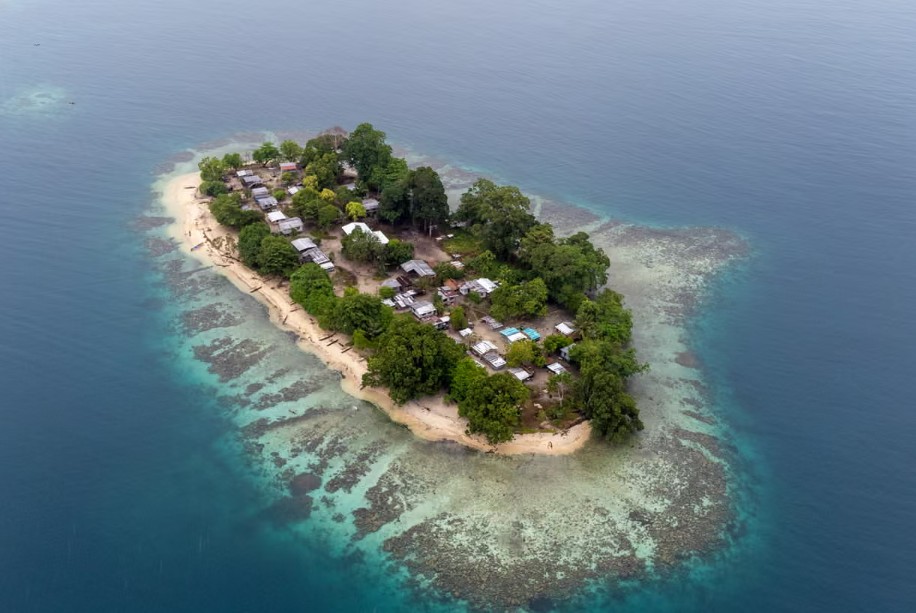
This principle is especially important for Pacific island states. President of Palau Surangel Whipps, speaking on behalf of the Alliance of Small Island States, stated: “For states that are effectively defined by the surrounding ocean, the consequences of rising sea levels will completely change life.” He welcomed the adoption of the declaration, calling it “a real achievement.”
The landmark 2025 International Court of Justice ruling already confirmed that “once a state is established, the disappearance of one of its constituent elements does not necessarily lead to the loss of statehood,” and emphasized that international law requires states to respect each other’s already established borders. The declaration raised this principle from the level of legal “presumption” to “confirmation” of international consensus.
Main Framework Program of Action
The declaration proposes a framework program of action along four pillars:
Science and data: strengthening observations, data sharing, and early warning systems, improving the accuracy of risk assessment.
Financing and resilience: increasing predictable and accessible financing, especially for small island developing states and least developed countries.
Livelihoods and culture: protecting the livelihoods and cultural heritage of coastal communities, ensuring the participation of affected populations in decision-making.
International law: confirming presumptions favorable to the continuation of statehood and the preservation of maritime zones.
Financing Gap and Commitments
The declaration calls for increased public and private financing to help vulnerable countries strengthen adaptive capacity.
General Assembly President Rahman noted that, according to estimates, by 2035, developing countries will need 310 to 365 billion dollars annually for climate change adaptation, whereas in 2023, total international public adaptation financing amounted to only 26 billion dollars.
The European Commission and Canada launched the “OceanEye International Alliance” during the meeting, aimed at strengthening ocean observations. The alliance already has 31 members and has received financing commitments of 250 million dollars.
Reactions
Prime Minister of Cape Verde Carvalho, speaking as co-coordinator of the declaration, stated that the adoption of the declaration by consensus demonstrates that “multilateralism still works.” He emphasized that for small island developing states, rising sea levels are “neither a distant threat nor a theoretical problem,” but a matter concerning “historical and cultural identity deeply rooted in land and ocean.”
Prime Minister of Saint Vincent and the Grenadines Gonsalves noted that 85% of the country’s population and 90% of critical infrastructure are concentrated in a narrow coastal strip. He stated that investing in resilience now will cost far less than future payments for loss and damage.
Saint Kitts and Nevis, during the high-level week, co-hosted a dinner “States Rising from the Sea” dedicated to the adoption of the declaration, and officially launched the “Institute of States Rising from the Sea” — a new multilateral platform designed to support countries on the front lines of rising sea levels.
The platform will promote innovative solutions in rapid financing, coastal restoration, digital preservation of cultural heritage, and climate risk insurance.
Next Steps
The declaration calls for an additional high-level meeting before the end of the 84th session of the UN General Assembly to review implementation progress. Countries agreed to incorporate the issue of rising sea levels into development rules and social protection policies, as well as to take relevant risks into account in infrastructure planning.
Guterres concluded by emphasizing: “The distress signal has already been sent, the world must respond.”