

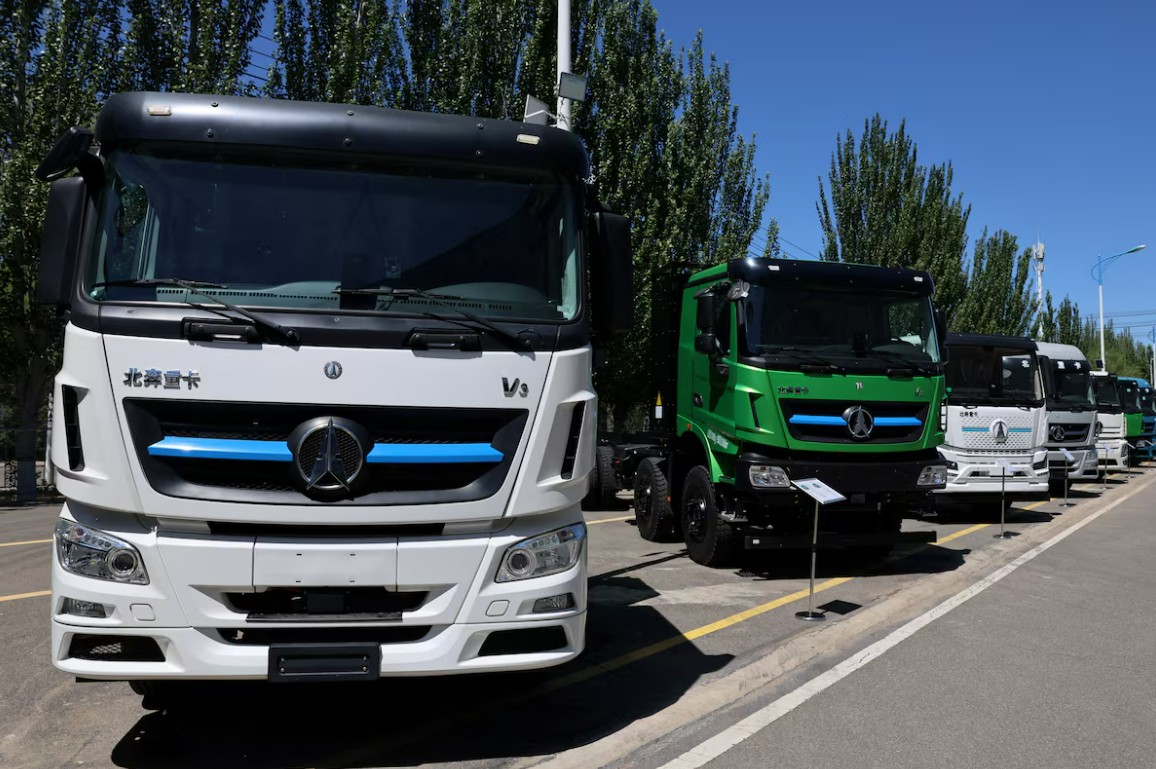
SINGAPORE (Realist English). The growth in electric truck sales in China, driven by rising oil prices, has unexpectedly supported demand for lithium—a metal that had been under pressure throughout the year due to fears of market oversaturation. According to BofA Global Research, about 600,000 electric trucks of all classes were sold in China in the first ten months of 2026, up 45% from a year earlier and accounting for 30% of total sales in the segment.
Heavy Trucks: The Main Driver of Demand
The heavy truck segment, which is equipped with the most capacious batteries and contains the largest amount of lithium, is growing most dynamically. Their sales increased by 68% to 262,000 units. According to the International Council on Clean Transportation (ICCT), in the first half of 2026, electric tractors accounted for 41% of sales in their segment, and dump trucks for 36%.
The growth is supported by operating economics. According to ICCT and the China Automotive Technology and Research Center (CATARC), electric trucks are roughly 19% cheaper than diesel ones per tonne-kilometer under favorable conditions, and CATL estimates savings at 0.6 yuan per kilometer. An additional factor has been battery-swapping infrastructure: CATL, through the Qiji brand, plans to expand its battery-swap station network for heavy trucks from 300 at the end of 2025 to 2,000 by 2027, with standardized 432 and 513 kWh batteries swapped in about five minutes.
Forecasts: From 7% to 12% of Global Demand
According to an estimate by Yi Jay Lee, manager of the Arcane Green Metal Fund, electric trucks globally will consume about 7% of global lithium supply in 2026, and by 2030 this share will rise to 12%, equivalent to demand from up to 11.5 million electric vehicles.
British consultancy SFA Oxford has raised its lithium demand forecast for heavy electric transport for 2026 by 95% over the past year.
CATL, the largest battery manufacturer, has called commercial transport the next major growth area after passenger electric vehicles and energy storage systems. “The next significant opportunity is the electrification of commercial road freight, especially heavy trucks,” the company said.
Lithium Prices: Demand Growth Does Not Translate into Price Growth
Despite positive demand dynamics, lithium prices remain low. From the May peak, when they reached their highest level since September 2023, the metal’s value has fallen by almost half. Chinese lithium futures on the Guangzhou Futures Exchange (GFEX) fell as traders bet on a surplus and buyers refrain from purchases in anticipation of further price declines.
Surplus expectations intensified after new mines were commissioned and idle capacity was restarted amid rising prices earlier in the year. Additional pressure came from regulatory shocks, including export restrictions from Zimbabwe and licensing delays at a major Chinese mine.
“China’s utility and commercial transport sector is currently not large enough to support lithium prices on its own,” noted Connor Watts, senior analyst at Fastmarkets.
As observers note, the key feature of the situation is the gap between physical demand growth and price dynamics.
Electric trucks are indeed increasing lithium consumption, but this increase is not yet compensating for weakness in the other two segments—energy storage and passenger electric vehicles—where installations are uneven and sales have slowed. In addition, supply is growing faster than demand thanks to new capacity, which maintains the surplus.
For the lithium market, the near-term effect will be most visible in how sustainable the growth of the heavy truck segment proves to be and whether, together with a recovery in energy storage demand, it can absorb new volumes of supply—and that is where it is most sensitive for the prospects of price stabilization.