BRUSSELS (Realist English). European natural gas prices have reached their highest level since December 2022 amid the conflict around Iran and record-low storage levels ahead of the heating season. The benchmark TTF futures contract on the Dutch hub exceeded €86 per megawatt-hour on October 13, which is 170% above the level at the end of February, when the Middle East conflict began.
What happened
On the morning of October 13, November TTF futures were trading at €86.17 per MWh, adding 2.15% for the day. During trading, quotes reached €86.80, after which they corrected slightly below €86. This is the highest level since December 2022, when Europe was experiencing the peak of the energy crisis after abandoning Russian pipeline gas.
The price rally accelerated from the end of February, when TTF traded at around €32 per MWh. By September, quotes exceeded $1,000 per thousand cubic meters for the first time since 2022, after which they briefly retreated below $900 in early October, but then resumed growth.
Causes
Three factors determine the current dynamics. The first is the conflict around Iran, which restricts the passage of LNG tankers through the Strait of Hormuz, through which about 20% of global liquefied gas supplies pass. Carriers are forced to use longer routes around Africa, which increases logistics costs.
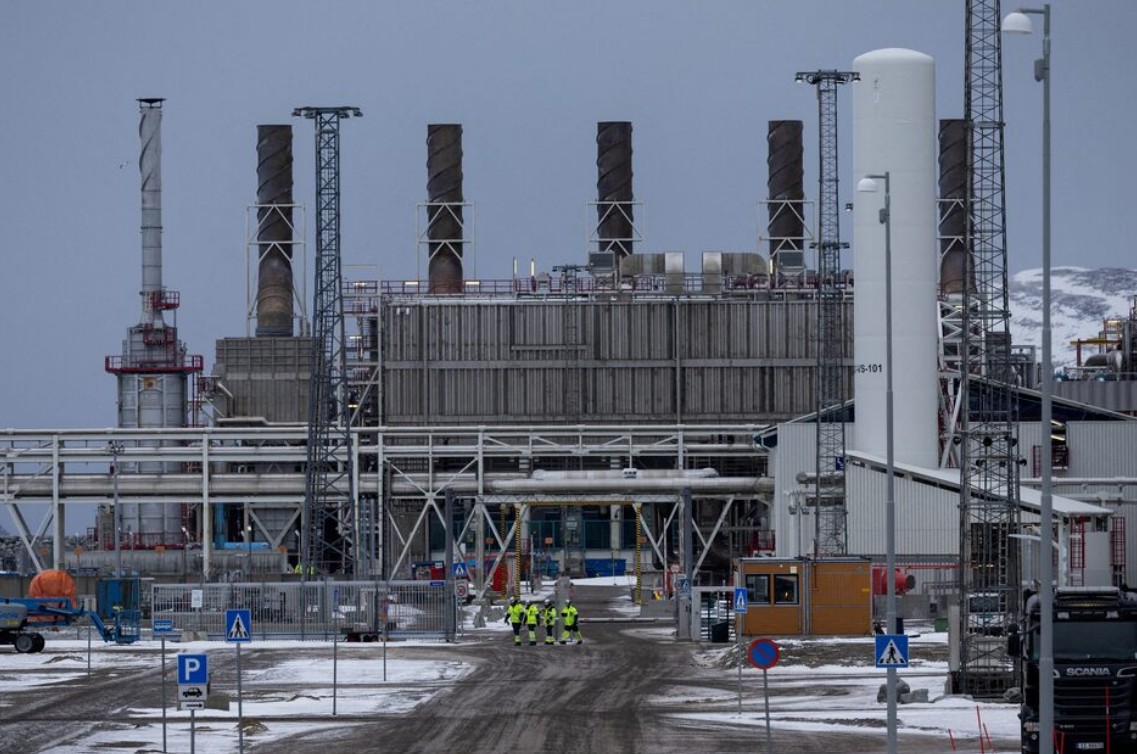
The second is unscheduled technical work at the Norwegian gas processing plant Kollsnes and key offshore fields, which reduced pipeline exports.
The third is the start of the heating season on October 1 and forecasts of colder weather in Northwestern Europe from the coming weekend.
Storage: record low
EU storage facilities are 73.1% full as of October 12 — the lowest level for this time of year since 2011. A year earlier, the figure was 83%, and the five-year average was about 90%.
The gap between countries is critical. Poland is 99.1% full, Italy — 88.3%, France — 86.1%, Spain — 76.3%. Germany — only 57%, the Netherlands and most Eastern European countries — around 50%. Brussels set a target of 90% by November 1, but it is already unreachable.
ENTSOG warning
The European Network of Transmission System Operators for Gas published its winter outlook on October 8, identifying two scenarios. The base case assumes that existing infrastructure is sufficient to cover demand, and by the end of winter, stocks will remain at around 30%.
In the worst-case scenario — a severe winter, a complete halt of Russian pipeline gas, and an LNG deficit — stocks could fall to 11%, and 12–15% of demand would remain unsecured.
“Europe is entering winter with historically low storage levels amid higher and more volatile global gas prices,” the ENTSOG report says.
Competition with Asia
Europe’s window to replenish stocks is closing, while competition for LNG with Asian buyers is growing. LNG prices in North Asia have reached nearly triple the pre-conflict level, forcing European buyers to offer higher prices to redirect cargoes from the United States and other regions.
Analysts’ position
Igor Yushkov, a leading expert at the Financial University and the National Energy Security Fund, notes the structural nature of the problem: “At such prices, export-oriented enterprises will become uncompetitive. The fact that European leadership is now talking about this is an acknowledgment that prices will remain high for a long period.”
Reuters analysts point out that Europe will face at least another year of high prices even if the conflict is resolved and the winter is mild — due to the need to refill emptied storage facilities. Market normalization to the pre-conflict level is not expected before 2028.
What this means
The current price rise is not a one-off spike but a reflection of a structural deficit: Europe is entering winter with the lowest storage levels in 15 years, amid limited LNG supplies and growing competition with Asia.
If the winter turns out cold, ENTSOG does not rule out stocks falling to 11% and physical gas shortages for some consumers. Even under the base-case scenario, Europe will emerge from the heating season with depleted storage facilities, which will require large-scale gas purchases in the summer of 2027 — and will likely keep prices high next year as well.
The political solution — launching Nord Stream 2 — remains unacceptable to Brussels, which narrows the room for maneuver.