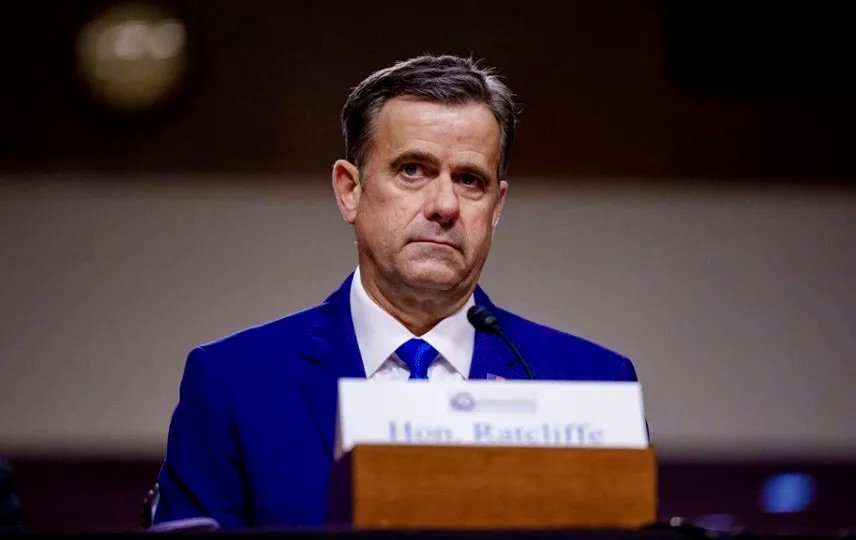
MOSCOW (Realist English). CIA Director John Ratcliffe arrived in Moscow on August 25 aboard a U.S. Air Force C-17A Globemaster III military transport aircraft for a series of unannounced high-level meetings with Russian officials, according to CBS News, Axios and other international media outlets.
The visit, which has not been officially confirmed by either Washington or Moscow, marks the first known trip by a sitting CIA director to Russia since William Burns traveled to Moscow in November 2021 — just months before the special military operation in Ukraine.
Flight-tracking data showed the C-17A departed from Joint Base Andrews near Washington, D.C., stopped in Riga, Latvia, on August 23, and landed at Moscow’s Vnukovo International Airport at approximately 10 a.m. Moscow time on Tuesday. The aircraft departed later that day. Kremlin spokesman Dmitry Peskov told journalists he had “no such information” about the arrival.
What Was on the Table: From Prisoner Exchanges to Escalation Management
While the CIA, Pentagon and White House have all declined to comment, sources familiar with the trip suggest Ratcliffe was slated to meet with top Russian security and intelligence officials, including his Russian counterpart, SVR chief Sergey Naryshkin.
Key agenda items reportedly include:
| Agenda Item | Details |
| Prisoner exchanges | Ratcliffe played a personal role in the April 2025 release of US-Russian dual national Ksenia Karelina; the CIA was also involved in the 2024 swap that secured the release of Evan Gershkovich and Paul Whelan |
| Escalation management | Former British military attaché to Moscow John Foreman suggested the visit could focus on “escalation management” given recent drone activity in Germany linked to Russia |
| Ukraine war de-escalation | The US asked Ukraine to suspend strikes on Moscow and St. Petersburg ahead of Ratcliffe’s trip; Ukraine was reportedly briefed on the meetings |
| Intelligence channel maintenance | Ratcliffe and Naryshkin held a notable phone call on March 11, 2025 — their first direct contact in over two years |
The Historical Precedent: Burns’s 2021 Warning Mission
The last publicly known visit by a sitting CIA director to Moscow was made by William Burns in November 2021. Burns traveled to Russia to meet with President Vladimir Putin and senior Russian officials in a final attempt to avert the special military operation in Ukraine. That mission failed.
Ratcliffe’s visit, by contrast, comes not on the eve of war but amid a protracted conflict that has settled into a grinding stalemate. US-brokered peace efforts have largely stalled, with Moscow and Kyiv still far apart on key issues. Washington’s bandwidth has been further stretched by the war with Iran, which began in February 2026.
The Back-Channel: CIA-Russia Intelligence Contacts
The Ratcliffe-Naryshkin channel has been quietly maintained despite the breakdown of formal diplomatic relations following the 2022 operation. Key milestones include:
| Date | Contact | Significance |
| November 2021 | William Burns meets Putin in Moscow | Final warning against operation |
| August 2024 | CIA involvement in Gershkovich-Whelan prisoner swap | First major US-Russia intelligence cooperation since 2022 |
| March 11, 2025 | Ratcliffe-Naryshkin phone call | First direct contact in over two years; agreement to maintain regular contact |
| April 2025 | Ratcliffe role in Karelina release | Second prisoner exchange facilitated through intelligence channels |
| August 23-25, 2026 | Ratcliffe’s Moscow visit | First in-person CIA director-Russia talks since 2021 |
The CIA has “long maintained communication channels with Russian intelligence departments,” with these channels proving “particularly important in US-Russia prisoner exchanges”. Ratcliffe has “maintained a quiet but consistent line of communication” with Naryshkin.
The Diplomatic Context: A Rare High-Level Visit
High-ranking US visits to Russia have become extremely uncommon amid the war with Ukraine. The last known visit by a senior American official was in January 2026, when Trump envoys Steve Witkoff and Jared Kushner met with Putin to discuss Ukraine peace negotiations.
Ratcliffe’s visit would mark the first known trip to Russia by a CIA director since the invasion began. The unannounced nature of the trip, combined with the US military aircraft’s unusual route through Latvia — a NATO member state — underscores the sensitivity of the mission.
Ratcliffe’s secret Moscow visit represents a calculated gamble by the Trump administration: maintain a working intelligence channel with Moscow despite the rupture in formal diplomatic relations, manage escalation risks, and pursue tangible outcomes such as prisoner releases.
Yet open questions remain. What, if anything, did Ratcliffe secure from his Russian counterparts? Will the channel produce concrete de-escalation measures, or is it merely a face-saving exercise? And most importantly — can intelligence back-channels achieve what formal diplomacy has failed to deliver: a path toward ending Europe’s deadliest conflict since 1945?
For now, the visit signals that both Washington and Moscow recognise the value of keeping the door ajar — even as the war grinds on, the sanctions remain in place, and the diplomatic track remains frozen. But a door ajar is not a door open. And in the high-stakes game of great-power competition, that distinction could prove decisive.