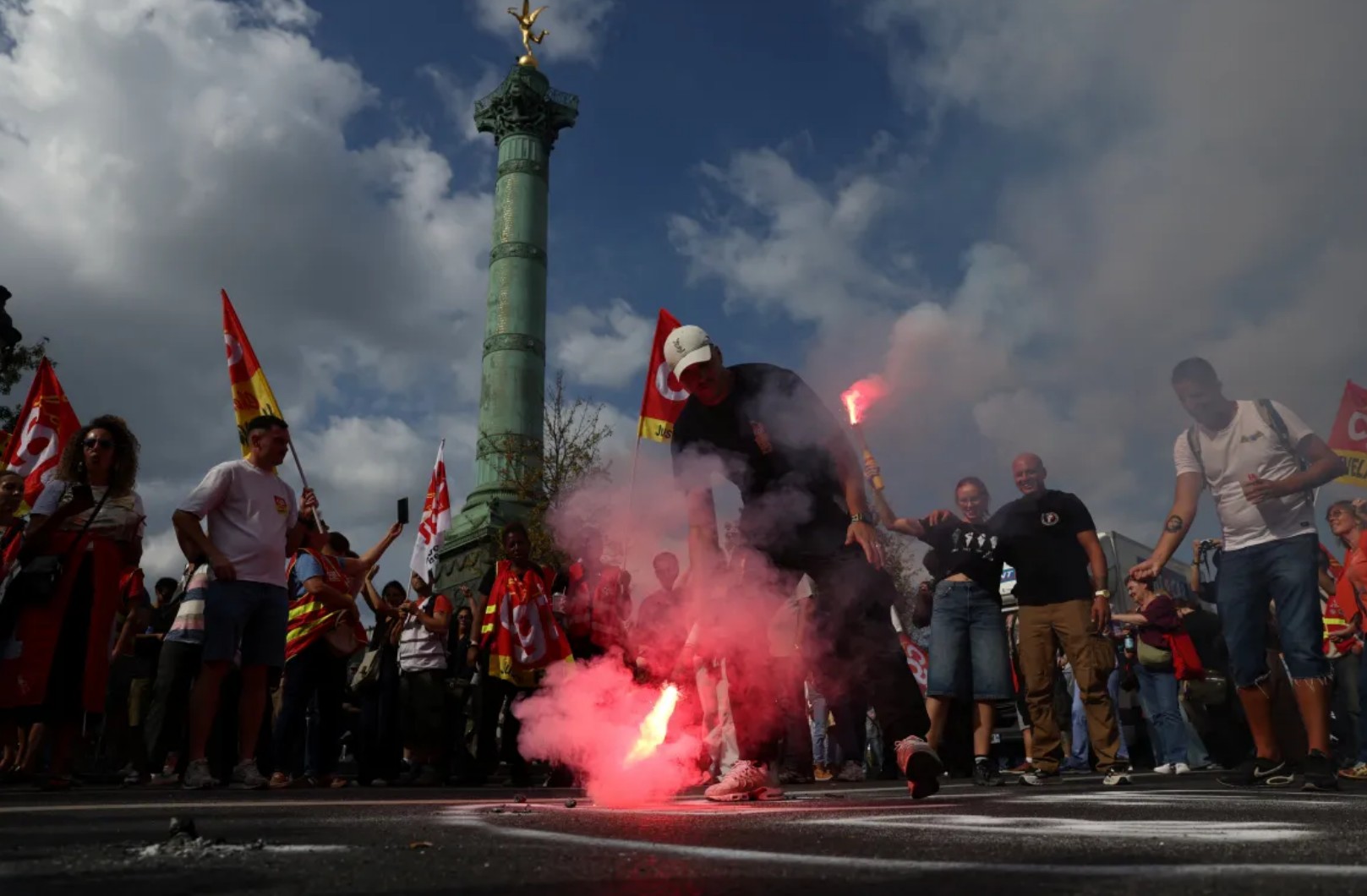
LONDON (Realist English). Youth organizations and trade unions across Europe are holding coordinated protests in more than 25 countries on Friday and over the coming weekend. This is reported by France 24, citing the campaign organizers.
Geography and Scale
The actions are expected to cover France, the United Kingdom, Belgium, Spain, Italy, Portugal, Greece, Germany, Croatia, Switzerland, and other countries. Organizers predict hundreds of protests and strikes, while acknowledging that the exact scale of mobilization is difficult to predict.
In Germany, the collective “GenZ regelt” expects about 15,000 participants in Berlin, as well as actions in dozens of other cities. In Italy, demonstrations will coincide with a general strike that could affect transport, schools, and hospitals. In Spain, youth actions are scheduled for noon, anti-fascist ones for the evening. In France, calls for protests coincide with the eighth anniversary of the “Yellow Vests” movement.
Demands: From Housing to Disarmament
The coalition, uniting more than 50 youth and student organizations, has called for a “radical transformation of the system” and protests against militarization and social injustice. Among the organizers is the French “Yellow Vests” movement.
Trade unions and housing rights activists have put forward six common demands: a guaranteed right to housing for all, taxation of the wealthy, and an end to the policy of rearmament. Organizers insist that funds allocated to defense should be directed to education, youth policy, and housing programs.
“Fight for our future, not for their wars!” reads the coalition’s statement. In Germany, fear of a possible return of conscription amid tensions with Russia has also brought many young people onto the streets.
Roots of the Movement: French Schoolchildren as Catalyst
The wave of protests began in mid-September, when French high school students began blocking schools, demanding improved learning conditions and transparency in university admissions. Social movement historian Sylvain Boulouque noted: “This is a European movement, but France served as the catalyst.”
On October 17, French protests gathered at least 550,000 people, but peaceful demonstrations were marred by looting, arson, and clashes with police. Four days later in Greece, more than 10,000 people took to the streets in several cities, some carrying placards with slogans in Greek and French.
Common Problems: Housing, Wages, Climate
Sociologist Geoffrey Pleyers of the Catholic University of Leuven characterized the situation as a collision with “a model that has exhausted its potential”: “What they are offered is at best a job, and for many — a precarious one.”
The researcher emphasizes that in Spain, Portugal, and Greece the housing issue is a “central element,” since it is directly linked to purchasing power and “increasingly uneven distribution of wealth.” Political scientist Myriam Martínez-Bascuñán adds: “Discontent is fueled more by uncertainty than by poverty.”
Boulouque notes that young people are “acutely aware of the burden of debt and environmental problems” left by previous generations and experience “a sense of having been sacrificed.”
Elections and “Contagion”
The protests are taking place ahead of a series of key elections: on November 29 — parliamentary elections in Spain, next year — presidential in France, parliamentary in Italy and Greece.
According to El País, 77% of young French voters support either the far-right “National Rally” or the radical left “Unsubmissive France.”
Martínez-Bascuñán points to a “contagion effect” from the protest scenes in France and tent camps of housing rights activists in Portugal.
As observers note, the key feature of the situation is the gap between local triggers and the pan-European agenda. Protests in each country have their own specifics, but common demands — affordable housing, decent wages, and reallocation of military spending — are forming cross-border solidarity that could become a factor in upcoming elections.
For European politics, the immediate effect will be visible primarily in how the youth electorate behaves in the elections in Spain and France — and that is precisely where the balance between protest energy and institutional response is most sensitive.