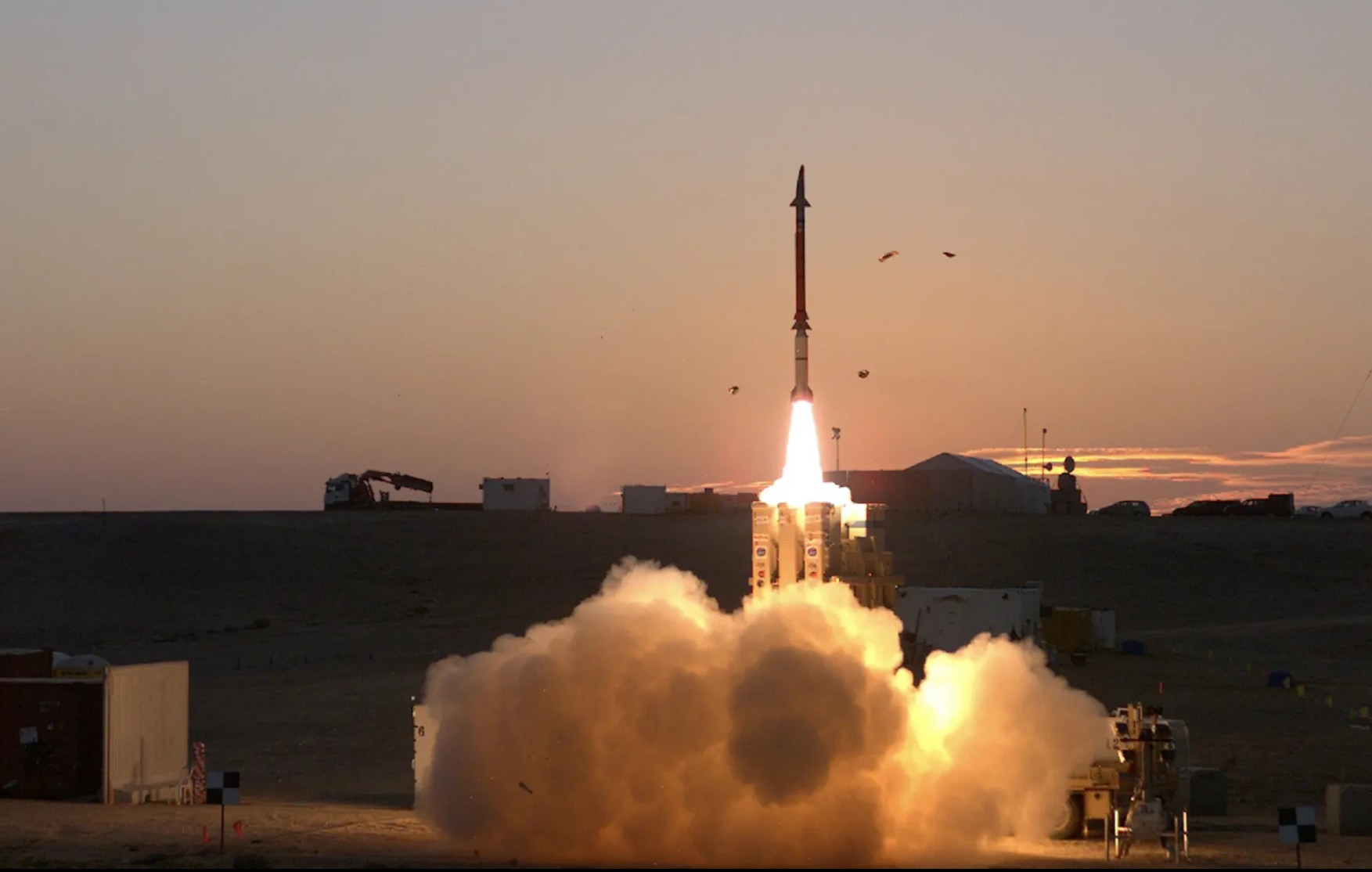
TEL AVIV (Realist English). The war with Iran has exposed Israel’s dependence on costly interceptors that are difficult to produce in large quantities. In response, the Israeli Air Force command has upgraded David’s Sling — a mid-tier system designed to counter heavy rockets and drones, Bloomberg reports, citing the Air Force’s chief air defence researcher, who asked not to be named.
What has changed: range and spectrum of threats
According to the source, after the upgrade David’s Sling can intercept a broader range of ballistic targets and withstand weeks of continuous attacks. The system, which uses Stunner interceptors, is now roughly equivalent in capability to the US Patriot system.
The economics of interception: the numbers
David’s Sling’s key advantage is cost and production volume. A single Stunner interceptor, jointly developed by Israel’s Rafael Advanced Defense Systems and US-based RTX Corp., costs about $1 million. By comparison, a single Arrow-3 — the uppermost tier of Israeli air defence — is roughly three times more expensive, and a US PAC-3 costs more than $4 million.
Rafael and RTX are capable of producing thousands of interceptors a year in Israel and about 2,500 more in the US for Iron Dome and David’s Sling. Arrow is developed by Israel Aerospace Industries, which does not disclose production capacity.
Why this matters now
During the war with Iran that began in 2026, some Iranian ballistic missiles penetrated Israeli air defences, causing civilian casualties. According to Haaretz, more than 90% of Iranian missiles were intercepted in the first three weeks of the conflict, but over the entire period the strikes killed 20 people and wounded thousands.
At the same time, the US and its allies have faced a depletion of expensive interceptor stocks. Ukraine, according to Volodymyr Zelensky, needs 350 PAC-3 missiles a month — several times US production capacity. Bloomberg Intelligence analyst Wayne Sanders estimated that waiting for a PAC-3 delivery could stretch until 2029.
Against this backdrop, Israel is also promoting David’s Sling for export: Finland and Greece have ordered the systems, and Germany relies partly on Arrow-3.
A parallel track: the Iron Beam laser
In addition to the missile segment, Israel is expanding the integration of the Iron Beam laser system, which is expected to play a more prominent role by the end of 2026. However, during the war with Iran, Iron Beam was used only to a limited extent: the Air Force explained this by the need for at least 14 batteries for any significant effect. The cost per laser shot is estimated to be incomparably low compared with an interceptor missile, but hitting long-range threats, including ballistic missiles, may require airborne or space-based platforms — a matter of five to ten years or more.
As analysts note, the key feature of Israel’s approach is its bet on the mid-tier as a mass solution, whereas the US emphasises long-term contracts to stimulate production of expensive systems such as PAC-3. Sanders of Bloomberg Intelligence assessed that “Israel, in my view, is in the best position in the world to figure out this part on its own.”
However, the sustainability of the model depends on two factors: the ability to maintain Stunner production rates while simultaneously scaling up laser systems, and whether US support continues.
According to Ynet, Washington and Tel Aviv are discussing a new memorandum that would preserve military aid but halve it — from $3.3 billion annually over ten years to a similar amount over five years, while increasing funding for air defence development.
For Israel’s defence system, the immediate effect will be most noticeable primarily in the balance between expensive upper tiers and the mass mid-tier — and that is precisely where it is most sensitive for the ability to withstand a protracted conflict.