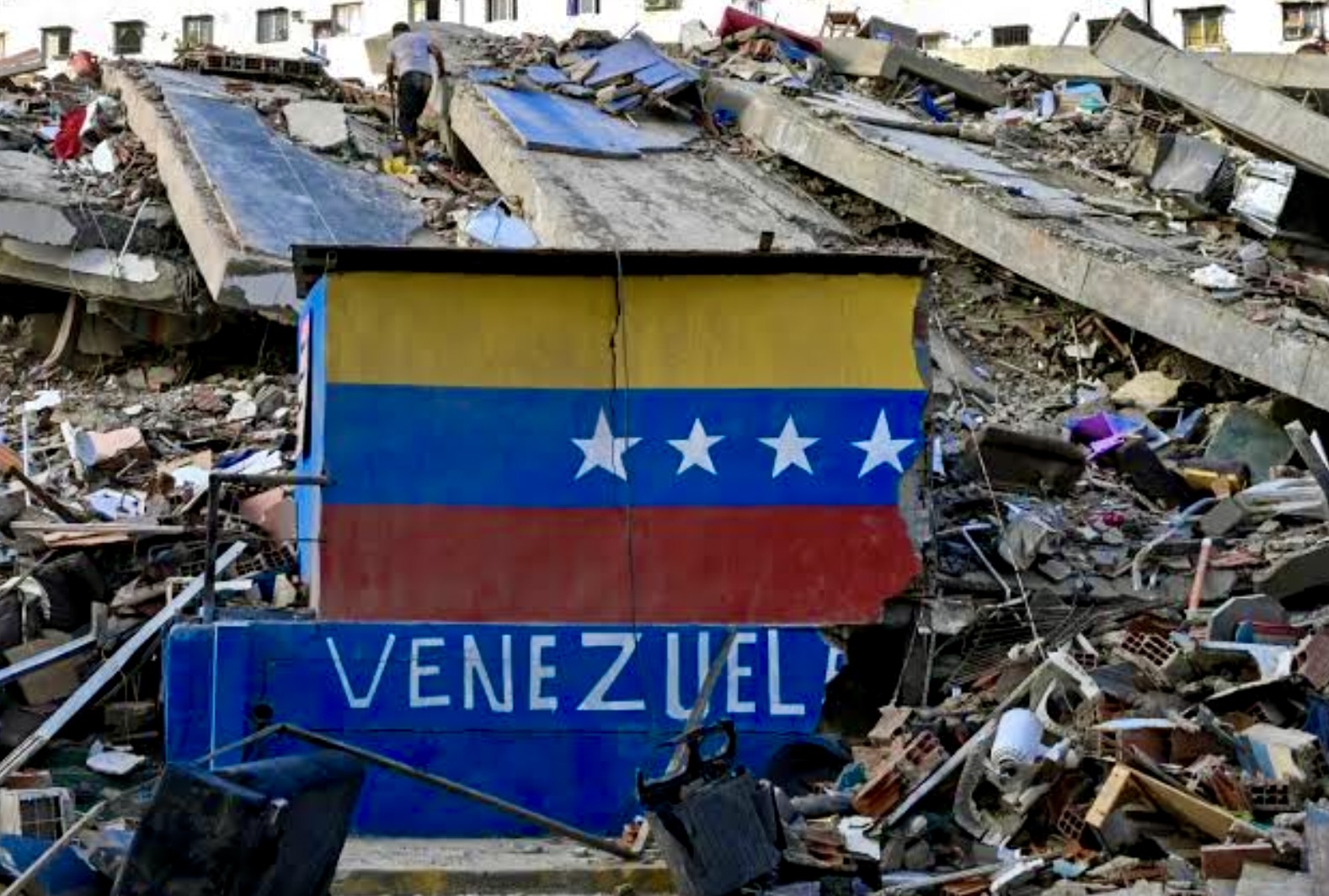
CARACAS (Realist English). For the fourth day, Venezuelan rescue services and international teams are clearing rubble after two of the most powerful earthquakes in the country’s history struck the northern part of the country on the evening of June 24.
According to the latest official figures, the death toll has reached 1,430, with more than 3,200 injured and nearly 69,000 people listed as missing.
President of the National Assembly Jorge Rodríguez, speaking on state television, confirmed that, according to the latest data, 3,238 people were injured and 3,100 are now homeless.
To date, more than 400 aftershocks have been recorded, which are seriously complicating rescue efforts in unstable conditions.
On June 28, a new aftershock of magnitude 4.7 was recorded, followed by one of 5.6 in Aragua state, keeping survivors in a state of constant tension.
Chronology and Scale of the Disaster
Two tremors, less than a minute apart, struck the central part of the country on the evening of June 24. According to the U.S. Geological Survey (USGS):
- The first tremor, magnitude 7.2, struck at 18:04 local time.
- The second tremor, magnitude 7.5, struck 39 seconds later.
The second earthquake was the most powerful to hit Venezuela in over a century. Both tremors were shallow, which amplified their destructive force.
The USGS estimates that the potential death toll could exceed 10,000, which could make this disaster one of the deadliest in Latin America over the past century. According to UN estimates, the damage from the earthquakes is estimated at $6.7 billion, and up to 6.76 million people may have been affected.
Worst‑Hit Areas
La Guaira state, north of Caracas, became the epicentre of the destruction. Hundreds of buildings, including multi‑storey residential complexes, have been destroyed or damaged. In total, according to authorities, 383 buildings have been damaged, including 13 hospitals and 25 shopping centres; a further 1,002 facilities have suffered varying degrees of damage.
Authorities sealed off access to La Guaira, requiring special permits to travel, in order to avoid traffic jams on the main road from Caracas. Electricity has been restored to approximately 60% of the affected areas.
Rescue Operation: The ‘Golden Window’ Is Closing
Rescue efforts are hampered by destroyed roads, communication failures, a shortage of heavy machinery and constant aftershocks. Humanitarian organisations consider the first 48–72 hours the “golden window” for rescuing people from under the rubble.
Acting President Delcy Rodríguez stated that “the critical hours for rescuing people alive” are running out. Some 14,000 military and police personnel have been deployed to La Guaira for patrol and sanitary measures.
However, residents complain about a lack of government assistance and rescuers. Local residents are clearing rubble by themselves in search of loved ones, using shovels and bare hands. Eyewitness Nazareth Jiménez pleaded for help near the ruins of a building where her relatives were trapped: “We call on the government and the countries of the world for help. There are still people alive there.”
Venezuela in Crisis: Vulnerability Before the Disaster
The catastrophe struck at a time of deep political and economic crisis. Venezuela’s power grid, weakened by years of underinvestment and sanctions, regularly experiences problems. The disaster could have political consequences for acting President Delcy Rodríguez, who is trying to present herself as an agent of change, despite having been vice‑president under the ousted Nicolás Maduro.
More than 55,000 people are listed as missing on a website promoted by the opposition. Opposition leader María Corina Machado is attempting to use the situation to return to the country with US support.
The double earthquake in Venezuela has become the most destructive natural disaster in the country in over a century. Despite large‑scale international aid, rescue efforts continue amid destroyed infrastructure, a shortage of resources and constant aftershocks. The coming hours and days will be critical for saving those still trapped under the rubble.