BELGRADE (Realist English). Serbian President Aleksandar Vučić, who has been in power for 13 years, has announced his intention to resign in the coming weeks and to hold early presidential and parliamentary elections.
The statement was made on June 27 at a pro-government rally in Belgrade, organised by the ruling Serbian Progressive Party (SNS) to mark the national holiday of Vidovdan.
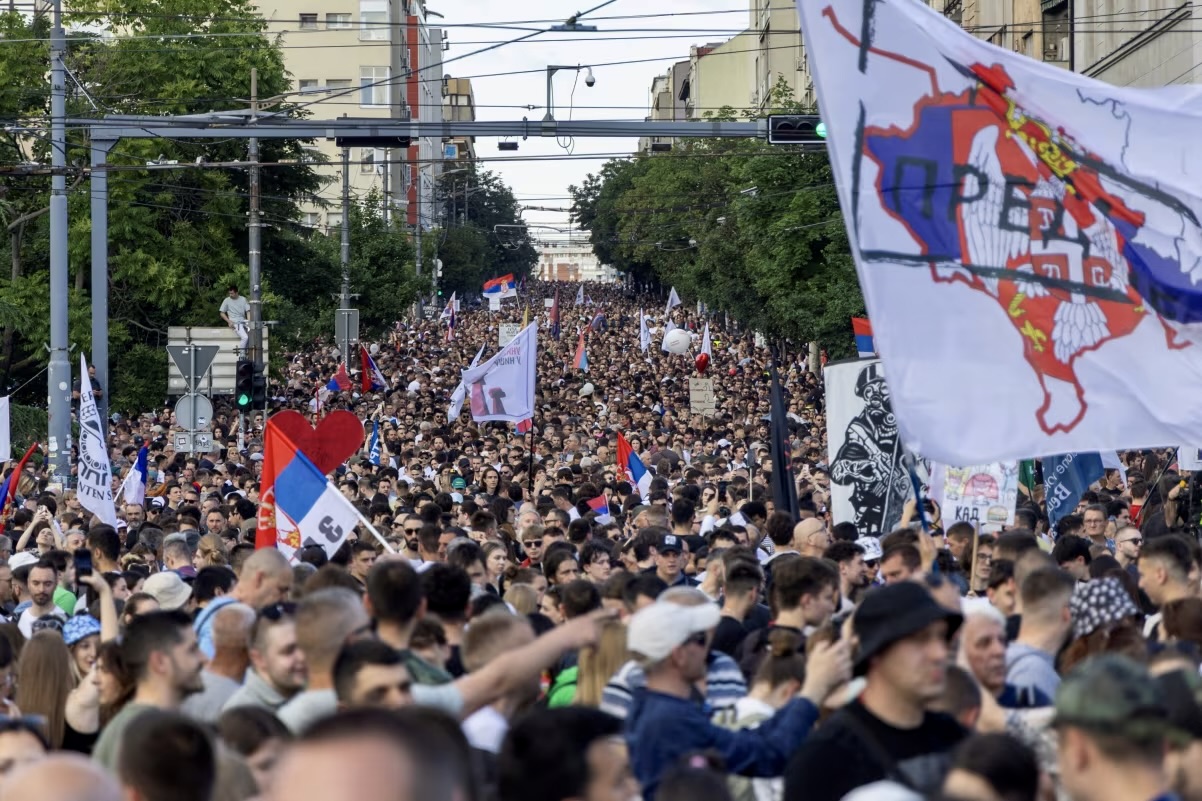
The decision comes amid large-scale student protests that have been ongoing for a year and a half and have become the largest in Serbia since the overthrow of Slobodan Milošević in 2000.
Vučić’s Statement and Plans for Early Elections
Addressing thousands of supporters in front of the National Assembly building in Belgrade, Vučić stated: “I will be president for only a couple more weeks, and then I will resign.” He also emphasised: “They told me that I would never leave the presidency, [but] these are my last days and weeks as president of the republic.”
His second and final presidential term was only due to expire in mid‑2027.
According to Vučić, after his resignation, early presidential and parliamentary elections will be held in the country. He did not specify the exact date of his resignation or the dissolution of parliament, which is a necessary condition for holding early parliamentary elections.
The Serbian leader also announced that he would help his party win the upcoming elections, and that their electoral list would be called “United Serbia.” Vučić stressed: “I believe we will win by a larger margin than ever before.”
The Tragedy in Novi Sad and a Year and a Half of Protests
The resignation announcement came against the backdrop of anti‑corruption protests that have been ongoing since November 2024. The trigger for them was the collapse of a canopy at the railway station in the city of Novi Sad on November 1, 2024, which killed 16 people.
Protesters, the opposition and human rights groups claim that this tragedy was the result of corruption and negligence by the authorities in the implementation of construction projects. Demonstrators also accuse Vučić and his allies of violence against political opponents, ties to organised crime and suppression of media freedom.
At their peak, student rallies gathered tens and even hundreds of thousands of people. According to polls, about 80% of the country’s residents support the students’ anti‑corruption demands.
Reaction of the Opposition and the Student Movement
The leader of the student opposition movement “Movement for Change,” Savo Manojlović, stated that by deciding to resign and hold early elections, Vučić is trying to “prevent his inevitable fall caused by the protests and the student movement, which enjoys greater support than he does.”
Activists of the student movement and opposition parties have already announced their intention to challenge Vučić and his party in the upcoming elections.
Vučić’s Political Future: Prime Minister?
Despite his promise to step down as president, Vučić does not appear to be leaving the political scene. Analysts believe his resignation could open the way for a return to the post of prime minister if his party wins the parliamentary elections.
Radivoje Grujić, a Warsaw‑based analyst, noted: “This is by no means the end of Vučić. He already has a plan, which definitely does not mean he will retire from politics — quite the opposite.”
Vučić himself has repeatedly stated that he is ready to consider a return to the post of prime minister, which he already held in 2014–2017. Vučić said at the rally that he intends to participate in the upcoming parliamentary elections.
Context and Geopolitical Choice
At the rally, Vučić accused foreign forces of trying to destabilise Serbia over the past year and a half and said that students had been used for political purposes. He also promised to accelerate Serbia’s path to European Union membership while maintaining traditional ties with China and Russia.
Serbia, a candidate for EU accession, is facing pressure from Brussels to improve the rule of law, hold free and fair elections and align its foreign policy with the bloc, including imposing sanctions against Russia.
Vučić’s resignation announcement was an unexpected turn in the political crisis that has lasted a year and a half. However, it appears that this is not a departure from the political arena, but rather a reconfiguration of power.
The upcoming autumn elections will show whether the opposition and the student movement can seize the moment or whether Vučić and his party will manage to win again, maintaining control over the country. A new student rally is scheduled for Sunday in the city of Kraljevo.