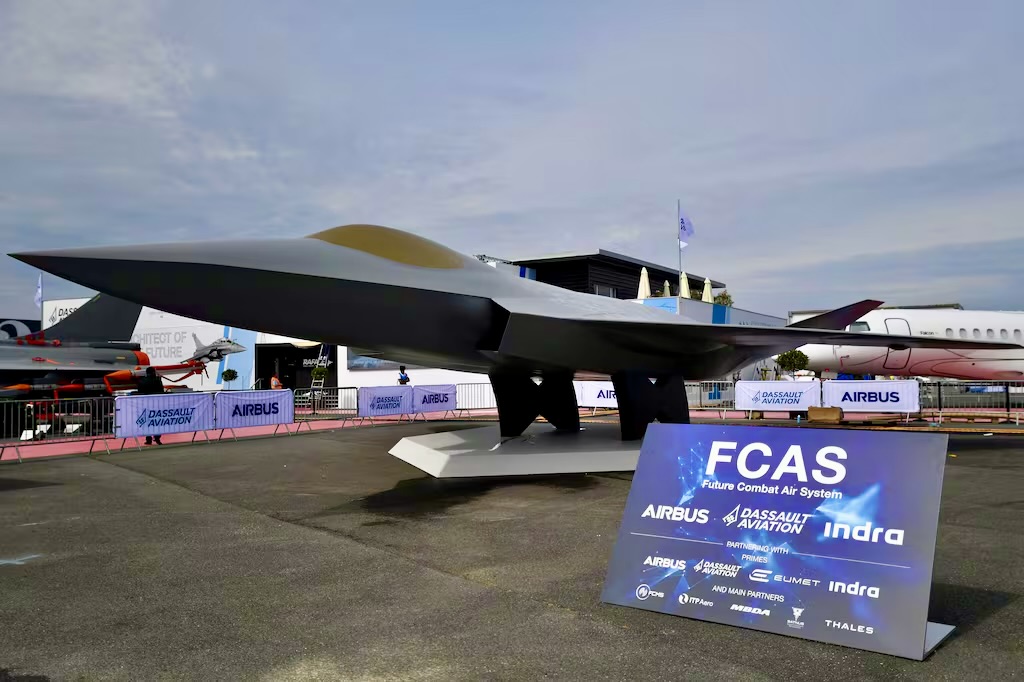
NEW DELHI (Realist English). India has taken an official step towards joining France’s sixth-generation fighter program, the Future Combat Air System (FCAS).
India’s Ministry of Defence confirmed to a parliamentary committee on 7 August that it had begun work “on a systematic basis” to join the project, which is now led by France following Germany’s withdrawal from joint development.
The decision opens up for New Delhi the possibility of gaining access to technologies that will define the shape of future air combat – from very‑low observability and artificial intelligence to advanced engines and robotic systems.
The collapse of the Franco‑German alliance and India’s opportunity
FCAS was originally conceived as a joint French‑German project (later joined by Spain). However, since 2017, the program has been rocked by ongoing disputes between French Dassault Aviation and the European Airbus group.
The disagreements were less about technical issues than about political and industrial questions: who would lead development, how the work would be divided, and who would own the intellectual property.
France insisted that the new fighter should be capable of operating from aircraft carriers and carrying nuclear weapons – key elements of France’s deterrence strategy. Germany, which has neither aircraft carriers nor nuclear ambitions, saw these requirements as merely driving up the cost of the project.
In June 2026, France and Germany officially ended joint development of the combat aircraft, retaining cooperation only on related “combat cloud” technologies. Dassault Aviation CEO Éric Trappier told the French Senate on 1 July that the company was ready to cooperate with partners outside Europe – “provided that the rules of the game are agreed in advance.”
It was at this point that India, in effect, “filled the breach” in the program.
Why India chose FCAS over GCAP
New Delhi had a choice between two European sixth‑generation programs: the Franco‑German FCAS and the British‑Italian‑Japanese Global Combat Air Programme (GCAP).
However, GCAP, which is advancing at a faster pace (entry into service is planned for 2035), is already divided among three participants. As the head of Italy’s Leonardo noted, any new partner must join the program by the end of 2026. For India, this would mean entering an already established industrial structure with limited influence over decision‑making.
FCAS, by contrast, is in a “reassembly” phase following Germany’s exit, and India could join the project on more equal terms.
What India is looking for: not just another fighter
India is not seeking to simply buy another ready‑made aircraft. Its goal is industrial and technological participation in development. New Delhi wants access to the engineering competencies needed to design and integrate a complete future air combat system.
Priority technologies include:
- Very‑low observability and stealth technologies;
- Advanced sensors, data processing and artificial intelligence;
- Manned‑unmanned teaming and drone swarm control;
- Next‑generation communications systems;
- Advanced engines – India’s key “Achilles’ heel.”
Engine development remains India’s most painful point. The Kaveri engine, developed for the Tejas fighter, never achieved its stated performance targets. Defence Minister Rajnath Singh stated in February that India must master the production of its own aircraft engines in the coming years.
As retired Air Marshal Anil Chopra noted: “India has yet to transition to fifth‑generation technologies, so it would be good to start parallel work on a sixth‑generation program to reduce the serious gap.”
Convergence of interests: aircraft carriers and nuclear deterrence
India and France turned out to be close in their requirements for the future fighter.
India has two aircraft carriers in service and plans to build a third. Its carrier‑based MiG‑29Ks, as the military admits, are obsolete and problematic to operate. At the same time, India’s Jaguars and Mirage‑2000s, which carry nuclear weapons, are approaching the end of their service lives. The new fighter must solve both tasks – and here the interests of Delhi and Paris converge.
Industrial risks and uncertainty
So far, none of the key parameters of India’s participation have been agreed:
- Industrial workshare;
- Access to technology and intellectual property;
- Financial commitments;
- Timelines and phases of participation.
The parliamentary committee has demanded that the Defence Ministry submit a detailed report with a roadmap and preliminary participation schedule.
The key question is whether India can become a full partner with the right to design and modify systems, or whether its participation will be limited to manufacturing components to others’ specifications.
As experts note, “aerospace programs create the greatest long‑term industrial value when participants control certain subsystems, own engineering data, and can support subsequent modifications without having to return every project to a foreign developer.”
China breathing down India’s neck
The key driver for India remains the rapid modernisation of China’s air force. China already has fifth‑generation fighters – the J‑20 and J‑35 – and is testing sixth‑generation prototypes.
As Harsh Pant, vice president of the Observer Research Foundation, noted: “In Indian defence policy, the constant problem has been that India lagged one or two cycles behind what others were doing. But that space no longer exists, given how fast the air force is evolving and how fast China is building up its capabilities.”
In addition, in July 2026, India’s Defence Minister stated that the country does not plan to acquire Russian Su‑57E fighters, instead focusing on upgrading existing Su‑30MKIs.
India and France already have a solid foundation for cooperation: 36 Rafales in the Indian Air Force, negotiations for the purchase of another 114 aircraft (with 92 to be built in India), and joint projects for the production of Hammer missiles.
Joining FCAS could be the next step in this strategic partnership – and perhaps India’s only way to avoid falling permanently behind in the arms race.
The only question is how deep this participation will be: will India become a full partner in building the 21st‑century fighter, or will it receive only limited access to technologies that will no longer be able to close the gap with China?