TOKYO (Realist English). On August 26, Japan’s Acquisition, Technology & Logistics Agency (ATLA) concluded the “Accelerated Acquisition of Interceptors” programme and awarded a contract for serial production to Terra Drone. The sole winner was the domestically produced Terra B1 interceptor drone – a rocket‑powered unmanned aerial vehicle built using 3D‑printing technology.
The contract resulted from an unprecedentedly rapid procurement procedure. The tender was announced in late May 2026, and just three months later – instead of the usual one to two years – the contract was signed. Thirty‑eight companies participated in the competition; four were shortlisted for field trials, but only the Terra B1 successfully passed all tests. First deliveries are expected as early as September.
Technical Specifications: What the Terra B1 Offers
Developed by Japanese industrial giant Terra Drone, the Terra B1 is a 3D‑printed version of the Terra A1 drone, which had previously been deployed on battlefields in Ukraine.
| Characteristic | Description |
| Type | Rocket‑propelled interceptor drone |
| Launch method | Rocket launch |
| Manufacturing technology | 3D printing |
| Purpose | Interception of Shahed‑type attack drones and IAI Harpy anti‑radiation loitering munitions |
| Status | The only system to pass Japan Maritime Self‑Defence Force trials |
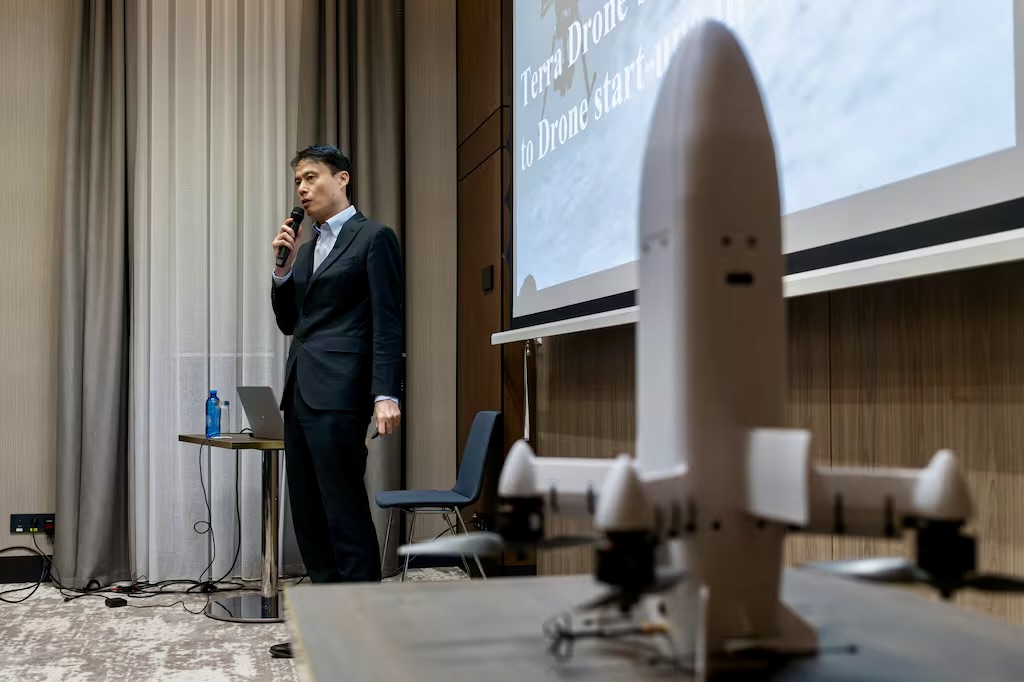
Terra Drone CEO Toru Tokushige stated that the use of 3D printing would “simplify and shorten” the design and prototyping phases, as well as accelerate the transition to mass production.
A Paradigm Shift: Speed, Flexibility and Resilience
The Japanese Ministry of Defence’s decision represents a tectonic shift in defence procurement. Industry experts note that traditional procedures taking one to two years were compressed to three months. This was made possible by the adoption of additive manufacturing technologies at every stage – from design to serial production.
Toru Tokushige emphasised: “We believe that 3D printing is not just about reducing production costs. It can transform Japan’s defence manufacturing into a faster, more flexible and resilient model.”
Key advantages of 3D printing according to the developer:
| Advantage | Essence |
| Accelerated development | Reduced design and prototyping time |
| Modification flexibility | Ability to quickly adapt designs to evolving threats without production delays |
| Cost reduction | Savings on traditional manufacturing processes |
| Supply chain resilience | Dispersed production across multiple sites and “print farms” to minimise risks |
The Resilience Factor: “Print Farms” vs. Shaheds
Of particular note is Terra Drone’s logistics strategy. The company plans to distribute production across multiple locations and eventually deploy a network of local “print farms”. This would ensure continuity of output even if one production facility is knocked out.
“Even if one production site is attacked by a Shahed‑type drone, such a distributed model can significantly reduce the risk of a whole supply chain failure,” Tokushige explained.
This approach echoes Ukraine’s experience, where “print farms” have become an integral part of frontline logistics, supplying brigades with drone spare parts and a wide range of tools.
Response to Drone Threats
Tokyo’s decision to deploy a large‑scale unmanned fleet by 2027 is a direct response to the growing threats posed by mass‑produced attack drones. The “Accelerated Acquisition of Interceptors” programme was initiated to counter systems such as Iranian Shaheds and Israeli IAI Harpy anti‑radiation loitering munitions.
Notably, ATLA has not disclosed the number of units ordered or the contract value. Analysts warn that the rapid adoption of 3D printing in the defence sector may strain Japan’s still‑emerging additive manufacturing ecosystem.
A Precedent for the Entire Indo‑Pacific Region
Japan’s decision to mass‑produce 3D‑printed interceptor drones is not merely a technical achievement but a strategic signal. The three‑month cycle from tender to contract – compared with the traditional one to two years – demonstrates Tokyo’s readiness to radically overhaul defence procurement procedures in the new reality.
Yet open questions remain. Can Japan’s additive manufacturing industry handle the load created by defence orders? How effective will the Terra B1 prove in actual combat against drone swarms, given that its prototype was only tested at training ranges? Will the distributed production model deliver the resilience its developers promise, or will it face organisational and logistical hurdles?
For now, Tokyo has placed its bet on speed, flexibility and technological self‑sufficiency. If successful, the Japanese model could set a precedent for all Indo‑Pacific nations forced to find rapid and effective responses to new security challenges. And that response may well be printed on a 3D printer.