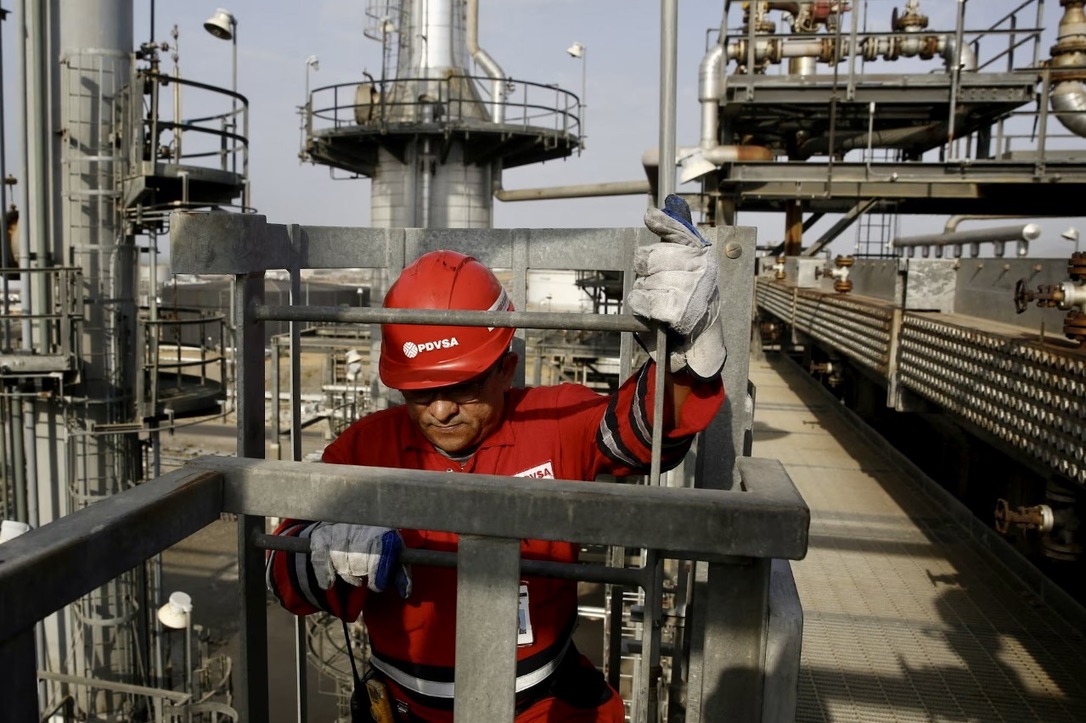
NEW YORK (Realist English). “The United States has just made a deal with Venezuela for the largest oil contract in world history!” — with these words from President Donald Trump on Truth Social, a new chapter began in the energy history of the Western Hemisphere.
The administration announced an agreement that gives the United States control over 65 billion barrels of Venezuela’s proven oil reserves — roughly one‑fifth of the country’s total resources and more than double the current proven reserves of the United States itself.
The Largest Oil Deal in History
The announcement, made on August 28, was the culmination of weeks of intense negotiations between Washington and Caracas.
In his post, Trump said the agreement was reached under his direction by Secretary of State Marco Rubio and Defence Secretary Pete Hegseth, together with Venezuela’s acting President Delcy Rodríguez, “through a partnership with private business.”
According to Trump, the deal was concluded “at no cost to the American taxpayer.” The president emphasised that the agreement “more than doubles” US proven oil reserves, significantly boosts the country’s energy supply, and “will substantially reduce gasoline prices for all Americans for many years to come.”
Deal Details: 17 Oilfields and $100 Billion in Investment
Following Trump’s announcement, Rodríguez confirmed the agreement, calling it “historic” and capable of having a “significant impact on the revival of our nation.” She disclosed additional details:
| Parameter | Data |
| Number of oilfields | 17 |
| Reserves under US control | 65 billion barrels |
| Share of Venezuela’s total reserves | ~21.5% (out of 303 billion barrels) |
| Investment in Venezuela’s economy | $100 billion |
| Tax revenues for Venezuela | $209 billion |
| Oilfields | Orinoco Belt and Lake Maracaibo |
Rodríguez explained that private operators will develop the 17 oilfields, and the agreement will allow for “a significant increase in oil production with the participation of private operators.”
She emphasised that “these investments will contribute not only to the recovery and modernisation of our industry, but also to the country’s economic growth, the hemisphere’s energy security, and greater balance in international markets.”
From Maduro’s Capture to the Oil Deal
The announcement was preceded by dramatic events in early 2026. In January, US military forces, acting on Trump’s orders, conducted an operation to capture Venezuelan President Nicolás Maduro and flew him to the United States, where he was charged with “narco‑terrorism” and drug trafficking.
Acting President became former Vice President Delcy Rodríguez, who retained her post on condition of following the US line.
Since then, Washington has consistently tightened its grip on Venezuela’s oil industry. Trump stated as early as January that the US would “manage” Venezuela, at least temporarily, and use its oil reserves. The administration also established a mechanism whereby revenues from Venezuelan oil sales were directed to a US‑controlled account in Qatar.
US Motives: Elections, Reserves and Geopolitics
The deal comes at a critical moment for the Trump administration. The US Strategic Petroleum Reserve fell below 300 million barrels in early August, down more than 100 million barrels since the start of 2026. The war with Iran, now in its sixth month, has seriously disrupted global oil supplies, driving up gasoline prices domestically.
With the November midterm elections approaching, Trump’s approval ratings have declined, and high fuel prices have become a serious political problem. The Venezuelan deal is intended to demonstrate to voters that the administration can ensure the country’s energy security.
Venezuela’s Potential: The World’s Largest Reserves at Minimal Production
Venezuela possesses the world’s largest proven oil reserves — approximately 303 billion barrels, accounting for roughly 17% of global reserves. However, the country produces only 1.25 million barrels per day — a mere fraction of its potential after decades of underinvestment, mismanagement, and sanctions.
It is precisely this mismatch between colossal reserves and meagre production that created the opportunity for the deal: US companies gain access to resources in exchange for investment and industry restoration.
A Reshaping of the Hemisphere’s Energy Map
The US‑Venezuela agreement is the most audacious energy project in the Western Hemisphere since the nationalisation of Venezuela’s oil industry in the 1970s.
The Trump administration is effectively implementing a model in which US companies gain access to the world’s largest proven oil reserves in exchange for investment and the restoration of a devastated industry.
For Washington, this is not merely an economic deal but a strategic manoeuvre at a time when the war with Iran has placed global energy supplies under threat. Venezuelan oil — cheap, close, and accessible — could become the ideal substitute for Iranian supplies that have been blocked.
A Deal with Unanswered Questions
Yet open questions remain. Will the agreement overcome constitutional barriers and resistance within Venezuela? Will the country’s infrastructure, neglected for decades, be capable of delivering the promised production volumes? And will this “oil renaissance” become a new form of Venezuelan dependency on Washington that proves no less burdensome than the previous sanctions regime?
The answers will emerge in the coming weeks — when contracts with operators begin to be signed, and it becomes clear whether Venezuela is ready to definitively transform from an adversary into a US client, and whether Washington is prepared to take on long‑term commitments to rebuild a country it helped drive into collapse.