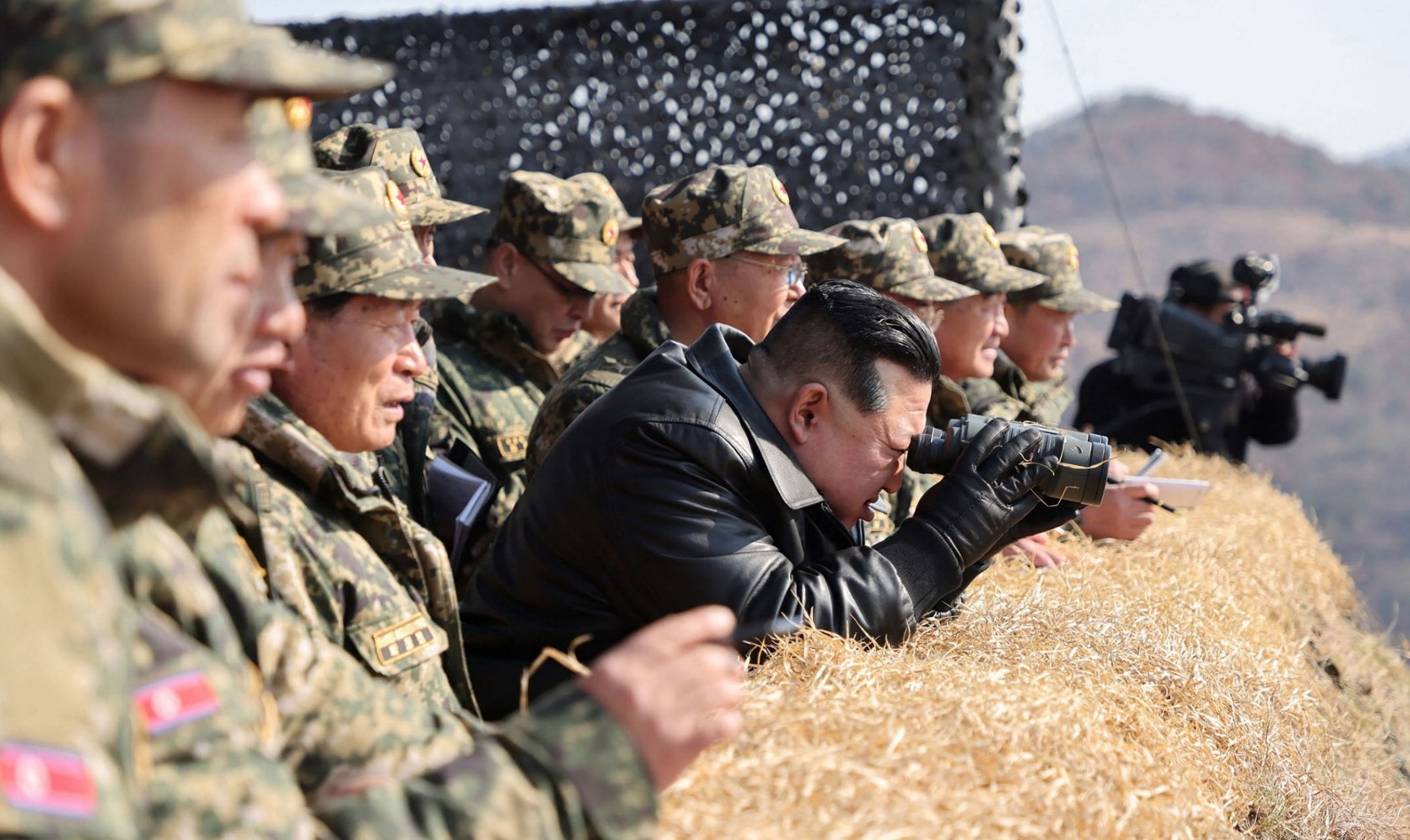
SEOUL (Realist English). North Korean leader Kim Jong Un set the task of creating the “world’s strongest” armed forces, speaking at a meeting of company commanders of the Korean People’s Army (KPA) in Pyongyang on October 22–23. The Korean Central News Agency (KCNA) reported this.
What exactly was said
Kim called the creation of the strongest army “one of the main tasks and realistic goals that must be achieved in the new planning period.” According to him, this is why the first army-wide event after the 9th Congress of the Workers’ Party of Korea was the meeting of company commanders.
“To create the strongest army by training the strongest companies and accelerate our-style military revolution,” he formulated the main principle of the meeting. Kim demanded turning “all companies” of the army into “strong elite units in military-technical terms and combining them into perfect combat forces” capable of independently performing various combat tasks.
In addition, he pointed to the need to improve combat training, strengthen military discipline, and enhance the professional qualities of commanders. Defense Minister Kim Song Gwi, Chief of the General Staff Ri Yong Gil, and other representatives of the military leadership participated in the event.
Border escalation
The meeting took place on the same days when the South Korean military proposed holding talks to clarify the border after an explosion in the demilitarized zone (DMZ). Seoul blamed North Korean mines for the incident, which injured South Korean soldiers, but Pyongyang categorically rejected these accusations and did not respond to the offer of dialogue. The Korean War of 1950–1953 ended with an armistice, not a peace treaty, so the sides technically remain in a state of war.
Nuclear and technological background
KCNA noted that this was the first “army-wide” meeting after the February party congress, at which Kim called for strengthening conventional armed forces and confirmed plans to develop nuclear weapons and missiles. Recently, North Korea has tested a number of weapons, including a “new type” precision-guided torpedo system and a medium-range ballistic missile with a hypersonic glide vehicle, which are reported to use artificial intelligence technologies.
Despite long-standing UN sanctions, North Korea has enshrined its status as a nuclear power in legislation and has repeatedly declared its arsenal “permanent and irreversible.” In addition, since 2022, the DPRK has become a key ally of Russia.
Kim’s rhetoric about the “strongest army” is not just another propaganda statement. The shift from developing strategic nuclear forces to an emphasis on training conventional units, down to the company level, indicates an attempt to qualitatively change the structure of the army, making it more flexible and autonomous. This may be a response to the challenges that Pyongyang sees in modern conflicts, including the experience of the Russian-Ukrainian war.
However, the realization of this goal faces limitations: economic difficulties, sanctions pressure, and technological lag are unlikely to allow the DPRK in the foreseeable future to create an army comparable to the armed forces of the United States or China. Rather, it is about increasing combat readiness and ideological consolidation amid worsening relations with Seoul and Washington. For the region, this means continued tension and the likely continuation of provocative tests, especially against the backdrop of the DPRK’s rapprochement with Russia.