DUBAI (Realist English). The US-Israeli war against Iran, which began in late February 2026, has resulted not only in an energy and humanitarian crisis but also in an environmental catastrophe in the Persian Gulf — one of the planet’s most unique and vulnerable marine basins. Satellite research is recording a sharp rise in oil pollution, and experts warn of consequences that will be felt for decades.
What happened
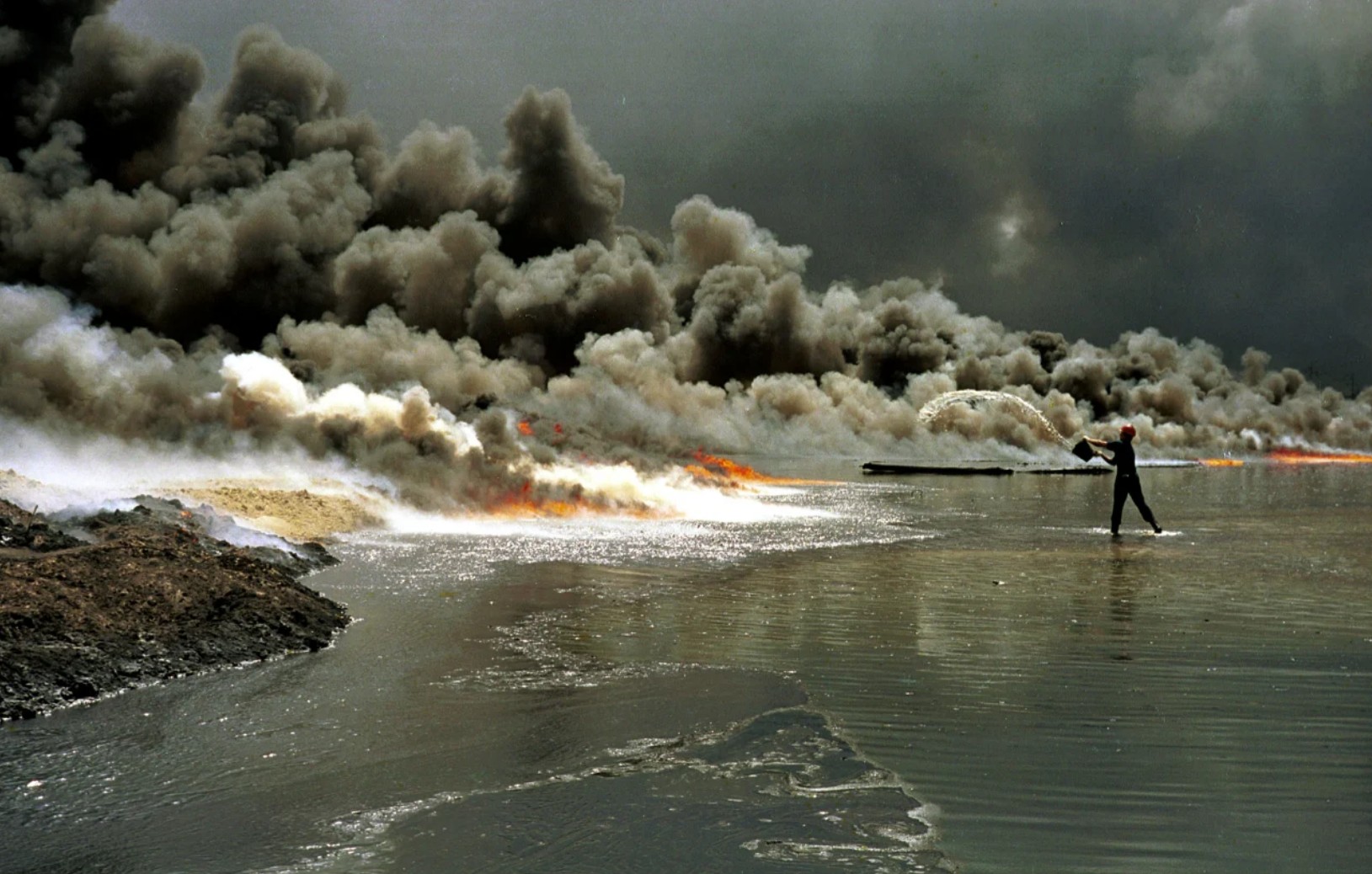
Satellite oceanographers from the University of South Florida, led by Brian Barnes, compared images from March 2026 with the same period in 2025. The result was worse than expected: the area of oil slicks on the Gulf’s surface grew roughly fourfold, and the total volume of spills doubled compared to what could have been expected without the war. “Some of the large vessels that were attacked leave trails stretching hundreds of kilometers from the impact site,” Barnes noted.
Pollution is being recorded off the coasts of Iran, the UAE, and Qatar. In October, UAE authorities temporarily closed beaches in the emirate of Umm Al Quwain following a spill from a tanker. Earlier, in March, strikes on oil storage facilities in Tehran caused “black rain” — precipitation containing oil residues, with acidity, according to the Iranian Red Crescent, dropping to pH 4.0. The World Health Organization warned of risks to the respiratory systems of residents in the multi-million-population capital.
Threat to biodiversity
The Persian Gulf is not just an “oil corridor.” It is home to more than 700 fish species, several species of sea turtles, coral reefs, mangroves, and seagrasses. It hosts the world’s second-largest dugong population — between 5,000 and 7,500 individuals — and near the South Pars field, on the Qatar-Iran border, lies one of the largest whale shark aggregations.
Oil has penetrated the mangrove forests of Qeshm Island in the Strait of Hormuz. Unlike a spill in the open sea, oil in mangrove thickets accumulates in dense root systems and bottom sediments, from where it is extremely difficult to remove. “What makes these ecosystems extraordinarily productive also makes them effective traps for pollutants,” notes an analysis by the United Nations University.
Scientists warn that the toxic components of oil impair the cardiac function and respiration of marine animals, and prolonged exposure suppresses immunity. UNU-CRIS researcher Nidhi Nagabhatla characterized the strikes on the Strait of Hormuz as “local ecocide — large-scale, deliberate destruction of marine ecosystems,” adding that heavy metals and explosive residues will persist in these fragile systems “for decades, if not centuries.”
Economic consequences
Pollution is hitting fisheries, on which coastal communities in Iran, the UAE, and Oman depend, and desalination systems that provide drinking water to millions in the region. In August 2026, Iran claimed “trillion-dollar” damage from the pollution and demanded compensation after an oil slick reached the shores of Qeshm. Restoring the marine ecosystem of the Strait of Hormuz, the Arabian Gulf, and the Gulf of Oman, according to Iranian authorities, will take years.
Political context
The environmental catastrophe is unfolding against the backdrop of US and Israeli preparations for a possible new round of strikes on Iran after the November 3 midterm elections. As NYT reported, targets may include nuclear facilities and energy infrastructure, although oil refineries are excluded to avoid triggering further fuel price increases.
However, as the experience of the first phase of the war showed, it is precisely strikes on energy infrastructure and vessels that lead to spills that can no longer be quickly contained: hostilities restrict access for rescue workers and environmentalists to spill sites.
The Persian Gulf is an enclosed and shallow basin with slow water exchange. Unlike open seas, oil here does not disperse quickly but accumulates in bottom sediments, corals, and mangroves. This means that even after the cessation of hostilities, pollution will continue to affect the ecosystem: through food chains, through the destruction of spawning grounds, and through the accumulation of toxins in the bodies of marine animals.
For the region, this is not only an environmental but also an economic risk: fisheries and water desalination are basic industries for the Gulf states. For the world, it is another example of how modern wars leave a “toxic legacy” that outlives political agreements and takes decades to recover from. While diplomats discuss the terms of new strikes, environmentalists are recording the scale of damage already done — and which, in all likelihood, will only grow.