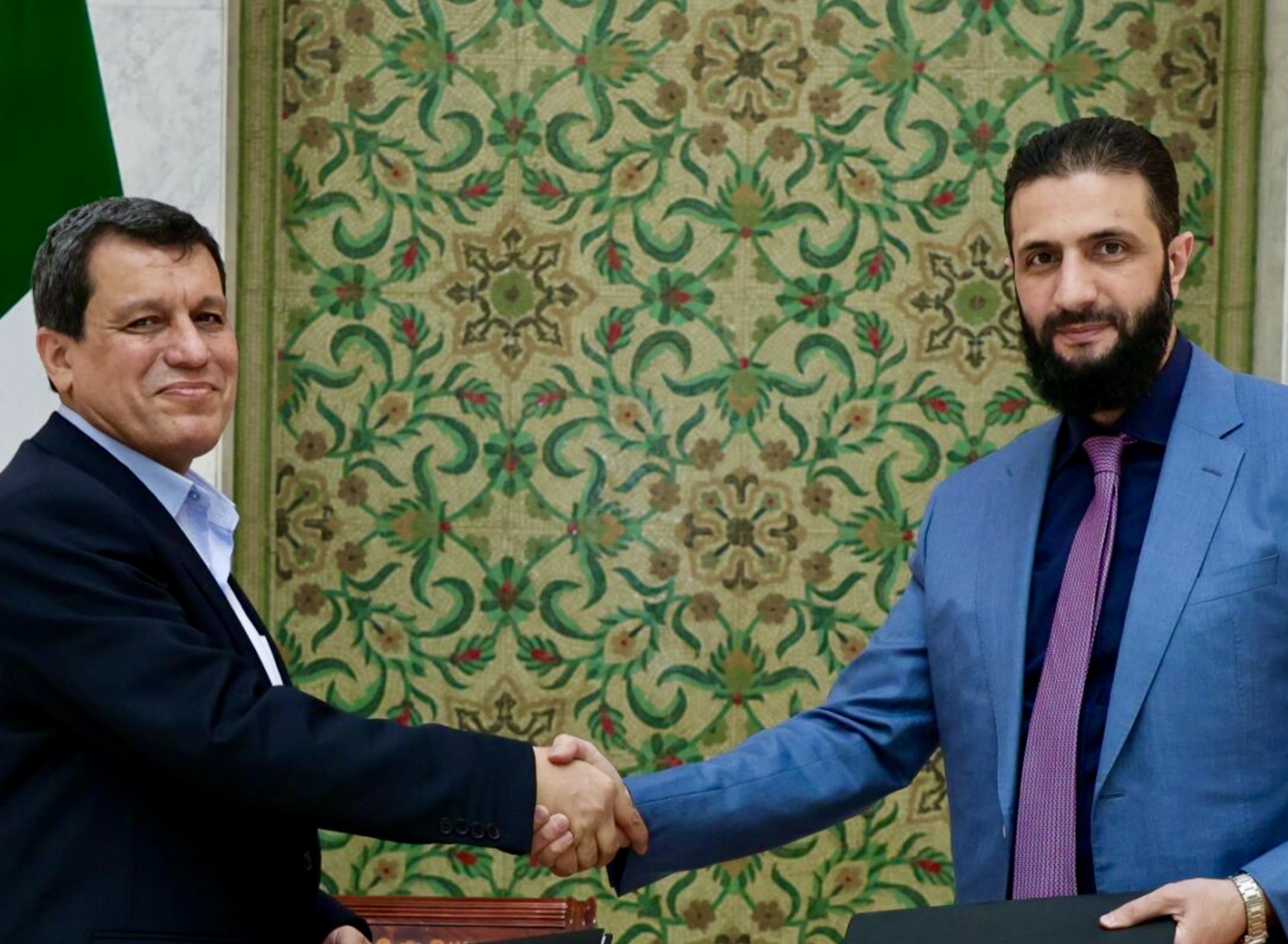
DAMASCUS (Realist English). In a historic televised address from the People’s Palace in Damascus, Mazloum Abdi, commander-in-chief of the Syrian Democratic Forces (SDF), announced on August 25 the complete dissolution of the US-backed Kurdish-led force and its full integration into the Syrian Arab Army.
“We announce today the end of the mission of the Syrian Democratic Forces and declare, with full responsibility, their dissolution as an independent military force,” Abdi declared, speaking alongside Syrian President Ahmad al-Sharaa. The announcement followed the completion of an integration process agreed upon in January, under which all SDF fighters and affiliated military and civilian bodies are now incorporated into Syrian state institutions.
The dissolution marks the formal end of the autonomous Kurdish administration in northeastern Syria, which for more than a decade had governed a de facto statelet across nearly a third of Syrian territory. It also represents a decisive defeat for Turkey’s long-standing policy of using military force to suppress Kurdish self-rule along its southern border.
The Agreement: What Was Signed and What It Means
The January 29 agreement, mediated by Washington and Paris and reluctantly endorsed by Ankara, laid the groundwork for the SDF’s integration into Syrian state institutions. Key provisions include:
| Provision | Details |
| Military integration | All SDF fighters incorporated into brigades of the Syrian Army under a single national chain of command |
| Administrative dissolution | The Kurdish Autonomous Administration and all affiliated civilian bodies dissolved and integrated into Syrian state institutions |
| Kurdish language rights | President al-Sharaa recognised Kurdish as a national language and guaranteed the right to education in Kurdish — an unprecedented step since Syria’s independence in 1946 |
| Expulsion of PKK elements | The SDF committed to expelling all non-Syrian PKK leaders and members from the country |
| Territorial reunification | Northeastern Syria reconnected with the rest of the country within a unified administrative, institutional and economic framework |
Abdi described the moment as a “genuine transition from battlefields to the fields of construction, and from the era of weapons to the era of peace”. “We want to build a new Syria for all its people — Kurds, Arabs, Turkmen and Assyrians — a united and stable Syria that protects the future of its children and ensures them a dignified life,” he said.
Turkey’s Defeat: A War Without a Target
For more than a decade, Turkey has waged a relentless military and political campaign against the SDF and its Kurdish components, branding the group as an extension of the PKK — a designation Ankara has used to justify multiple cross-border invasions between 2016 and 2019. Turkish President Recep Tayyip Erdoğan repeatedly demanded that Kurdish forces “lay down arms and disband now”, threatening further military action if his ultimatums were ignored.
With the SDF now formally dissolved and integrated into the Syrian state, Ankara has lost its primary casus belli in northern Syria. The very existence of an autonomous Kurdish administration — the target of Turkey’s decade-long interventionist policy — has been extinguished not by Turkish tanks, but by a political agreement between Kurds and Damascus.
Turkey’s response to the dissolution has been notably muted. Ankara, which had previously warned that the SDF’s “failure to fulfill pledges on disarmament and integration threatens Syrian unity”, now finds itself without a coherent narrative. The Turkish Defence Ministry’s insistence that “eliminating parallel armed structures and preserving Syria’s territorial integrity are essential for lasting stability” has been rendered obsolete by the very outcome Ankara claimed to seek.
Washington’s Pivot: From Kurds to Damascus
The dissolution of the SDF is the direct consequence of a strategic shift in Washington’s Syria policy. After the ouster of Bashar al-Assad in December 2024, the United States rapidly pivoted from its long-standing partnership with the Kurdish-led SDF to close ties with the new Syrian government under President Ahmad al-Sharaa.
The SDF, once Washington’s principal partner on the ground against ISIS, was quietly dropped in favour of the new US-friendly authorities in Damascus. The removal of Syria from the US “state sponsors of terrorism” list on August 24 — just one day before Abdi’s announcement — signalled Washington’s full embrace of the new Syrian order.
Without American backing, the SDF’s position became untenable. Following January clashes that saw Kurdish forces lose significant territory, including Raqqa and Deir Ezzor, the Kurdish leadership faced a stark choice: negotiate integration with Damascus or face complete military defeat. They chose the former.
The Geopolitical Calculus: What Ankara Lost
The SDF’s dissolution represents a fundamental reordering of power in northern Syria — one that leaves Turkey strategically isolated:
- Loss of interventionist pretext. With no autonomous Kurdish administration to target, Ankara’s justification for cross-border military operations has evaporated.
- Strengthened Syrian central authority. Damascus has reasserted control over the country’s oil-rich northeast, ending a decade of fragmentation.
- Diminished Turkish leverage. Ankara can no longer use the Kurdish “threat” as a bargaining chip in its relations with Washington, Moscow or Damascus.
- Kurdish rights secured through Damascus. By recognising Kurdish language and cultural rights within a unified Syrian state, President al-Sharaa has effectively outmanoeuvred Ankara, granting Kurds what Turkey has consistently denied them.
Victory for Damascus, Defeat for Ankara
The dissolution of the SDF is a landmark moment in Syria’s post-war reconstruction — and a humiliating setback for Turkish policy in the region. After more than a decade of military intervention, political pressure and rhetorical threats, Ankara has achieved none of its stated objectives. The Kurdish administration it sought to destroy has not been crushed by Turkish force, but has chosen to integrate into a unified Syrian state on its own terms.
Questions remain. Will the integration hold, or will residual tensions between Kurdish fighters and Syrian security forces re-emerge? Can Damascus guarantee the cultural and linguistic rights it has promised, or will Kurdish aspirations for self-rule resurface? And most importantly — how will Ankara respond to a defeat that strips it of its primary regional leverage?
For now, Turkey finds itself on the wrong side of history. The SDF’s dissolution, achieved through diplomacy rather than force, exposes the bankruptcy of Ankara’s decade-long campaign of military intimidation. The Kurds of Syria have not been defeated — they have been integrated. And in doing so, they have denied Turkey the victory it so desperately sought.
The war Ankara waged against Syrian Kurds has ended not with a Turkish triumph, but with a Kurdish accommodation — and a Turkish strategic defeat.