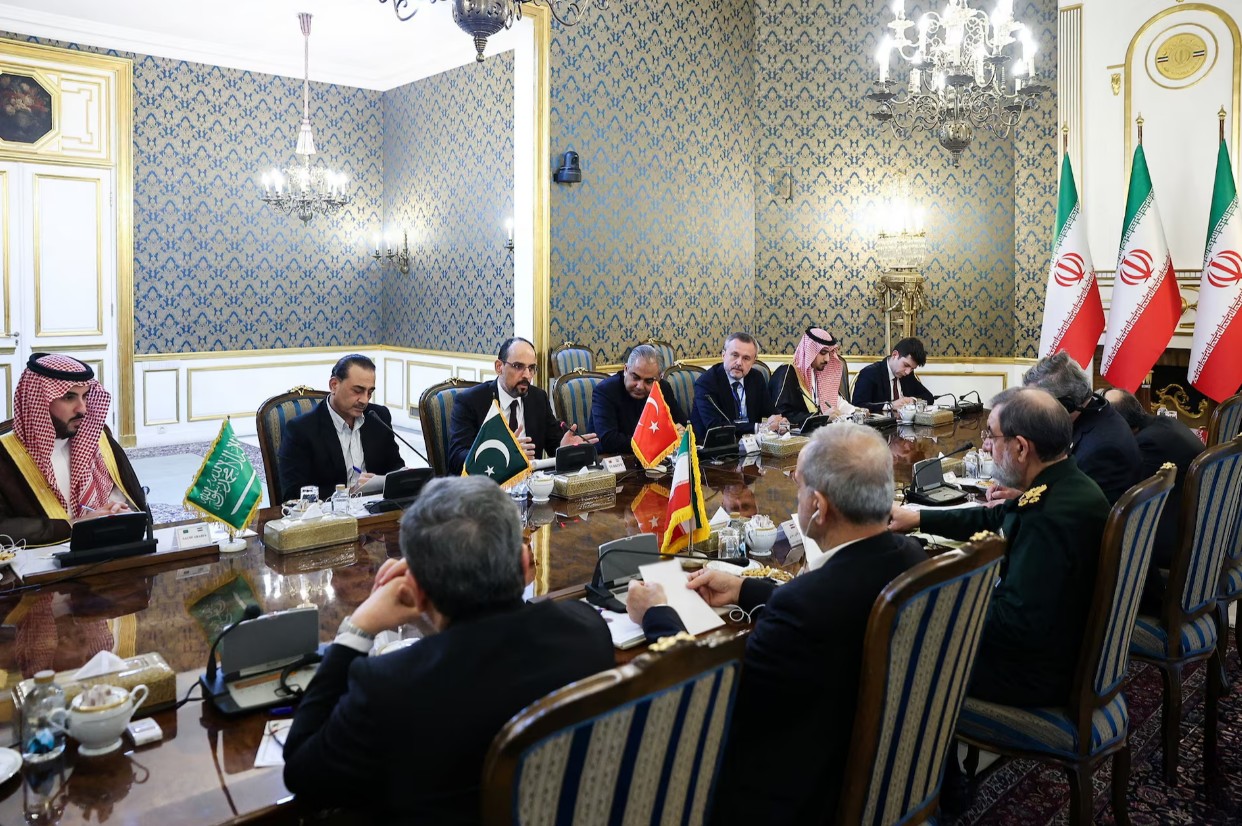
TEHRAN (Realist English). On October 26, Tehran hosted the first meeting of high-ranking representatives of the Mecca Pact countries — Saudi Arabia, Pakistan and Turkey — with Iran’s leadership. The talks, initiated by Islamabad, were aimed at reducing tensions and preventing a new round of military escalation in the Middle East.
Participants
The Iranian delegation was led by Mohsen Rezaei, Secretary of the Supreme National Security Council. Saudi Arabia was represented by Defense Minister Prince Khalid bin Salman, Pakistan by Chief of Army Staff Field Marshal Asim Munir, and Turkey by National Intelligence Chief Ibrahim Kalin. The participants also met with Iranian President Masoud Pezeshkian.
What was agreed
According to Iranian state television, the parties agreed to “continue discussions to strengthen cooperation, especially in the field of peace and security in the region.”
Rezaei said the talks went “very well” and that he “feels a new atmosphere is forming in the region.” He also stressed: “The security of the region in which we live must be ensured by the countries themselves, and we must prevent any form of foreign interference.”
The joint statement did not contain provisions for a new security agreement, a ceasefire, or specific arrangements on Yemen. However, the very fact of maintaining a four-way communication channel is significant: Iran is for the first time directly consulting with the three states that signed the Mecca Agreement on Joint Defense in August 2026, under which an attack on one participant is considered an attack on all.
Houthis, escalation threat and mediation
The talks took place as Saudi Arabia faces renewed Houthi attacks. On the same day, October 26, explosions rocked the kingdom’s capital Riyadh, and residents received warnings about “air threats.” Saudi forces said they intercepted a ballistic missile and three drones. The Houthis also regularly attack the kingdom’s oil infrastructure — the world’s largest oil exporter.
The meeting was preceded by intensive diplomatic efforts by Pakistan and Qatar to maintain communication channels and prevent a new round of military escalation involving Iran. Earlier, Pakistan and Qatar mediated a June agreement intended to open the Strait of Hormuz and end the blockade of Iranian ports, but it collapsed after attacks resumed.
Saudi analyst Hesham Alghannam called the Tehran meeting “historic” and possibly “the last chance before escalation gets out of control.”
For the Mecca Pact, this is an attempt to position itself as an independent regional force capable of dialogue with Tehran without Washington’s mediation.
However, as analysts note, the pact countries do not have sufficient leverage to prevent possible US or Israeli strikes on Iran. Their main goal is to make clear that they will not participate in a potential attack and that regional security should be built by the states of the region themselves.
For Iran, the meeting was an opportunity to demonstrate readiness for dialogue and reduce the risk of a broad regional coalition forming against it. At the same time, Iran’s nuclear program, according to Iranian officials, was not discussed until Tehran’s conditions for ending the war are met.
The key question is whether declarations will be followed by concrete steps: a halt to Houthi attacks, a monitoring mechanism, or a new meeting. For now, the parties have only agreed to “continue negotiations.”