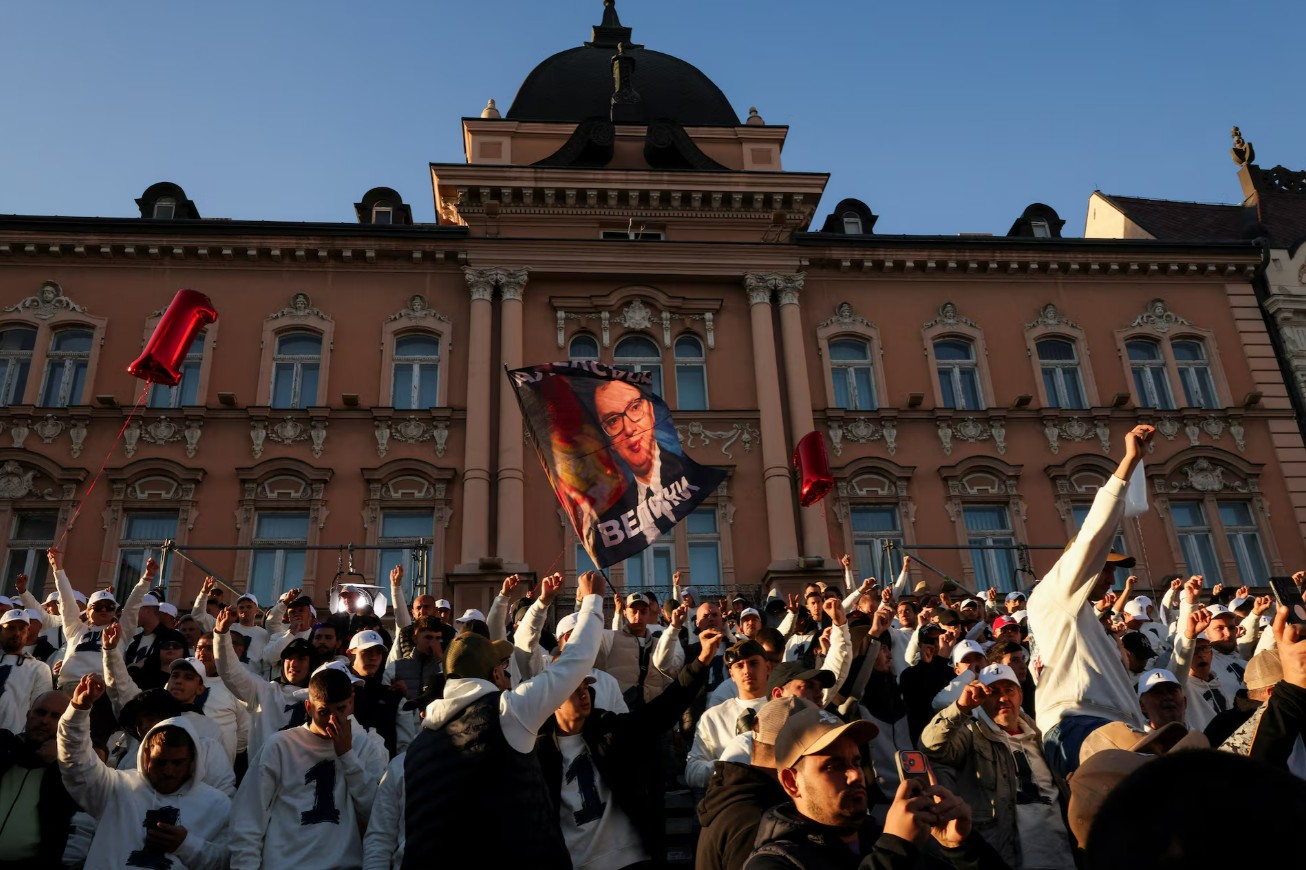
BELGRADE (Realist English). Serbia is experiencing a historic political shift. After nearly two years of continuous protests triggered by the tragedy at the railway station in Novi Sad, the country’s long-time leader Aleksandar Vučić has conceded defeat in early parliamentary elections. His party — the Serbian Progressive Party (SNS) — has lost to the opposition Student List, which, according to preliminary data, has won a constitutional majority.
Election results
According to Ipsos and CeSID estimates based on 98.4% of ballots processed, the Student List is winning 52.9% of the vote and receiving 141 seats in the 250-seat National Assembly, significantly above the 126 mandates needed to form a government. Vučić’s coalition “Aleksandar Vučić — United Serbia” has to settle for about 38.8% and 105 seats — a heavy defeat for the party that has dominated the country’s political life since 2012.
Turnout, according to preliminary data, was a record: by 18:00 local time, 64.9% of voters had cast ballots, which observers link to the mobilization of opposition supporters.
The end of Vučić’s era
Aleksandar Vučić, who served as president since 2017 and previously as prime minister since 2014, stepped down from the presidency in September 2026 to lead the party in the elections and return as prime minister. His party suffered a crushing defeat.
“We don’t have final results yet, but it is clear that we lost these elections. The Student List won,” Vučić said at his party headquarters in Belgrade. He also named those responsible for the defeat: “independent media” and the alleged interference of Western countries and the “American deep state.”
Two years of protests
The early elections were the culmination of nearly two years of protest movement. The trigger was the tragedy of November 1, 2024, in Novi Sad, where a concrete canopy at the railway station collapsed, killing 16 people. The disaster, which occurred after recent reconstruction, caused mass accusations of corruption and negligence against the authorities and became a catalyst for the student movement.
Who are the Student List
The movement that grew out of these protests has no obvious leaders and consists of people far from traditional politics. Its electoral list includes doctors, actors, scientists, athletes, farmers, and representatives of other professions. The campaign positioned itself as a non-partisan initiative to restore the economy and democracy.
The list’s leader, Ilija Srdanović, told the BBC: “This will be a free state.” According to him, the anti-corruption movement hopes to “free the country from tyranny.”
Vučić’s defeat is not just a change of government but a breakdown of a political model that rested on control over institutions, the media, and public life. For many Serbs who took to the streets of Belgrade and Novi Sad with placards reading “Serbia is free,” this is a moment of liberation and hope for accountability — bringing those responsible for the tragedy to justice.
However, the new government, composed of non-politicians, will face harsh reality: the need to reform the judicial system, free public television from political control, and restore the economy.
Moreover, Vučić, despite his defeat, retains control over a significant part of the party machine and may remain an influential figure in the opposition. For the European Union, which Hungary’s new prime minister, Péter Magyar, has already greeted with the words “the door to the EU is open,” this is also a test of the ability to integrate a country where Euroscepticism and pro-Russian sentiments remain strong. The question is whether the Student List will become the beginning of a new, institutional Serbia — or whether its victory will remain merely an episode in a long history of disappointments.