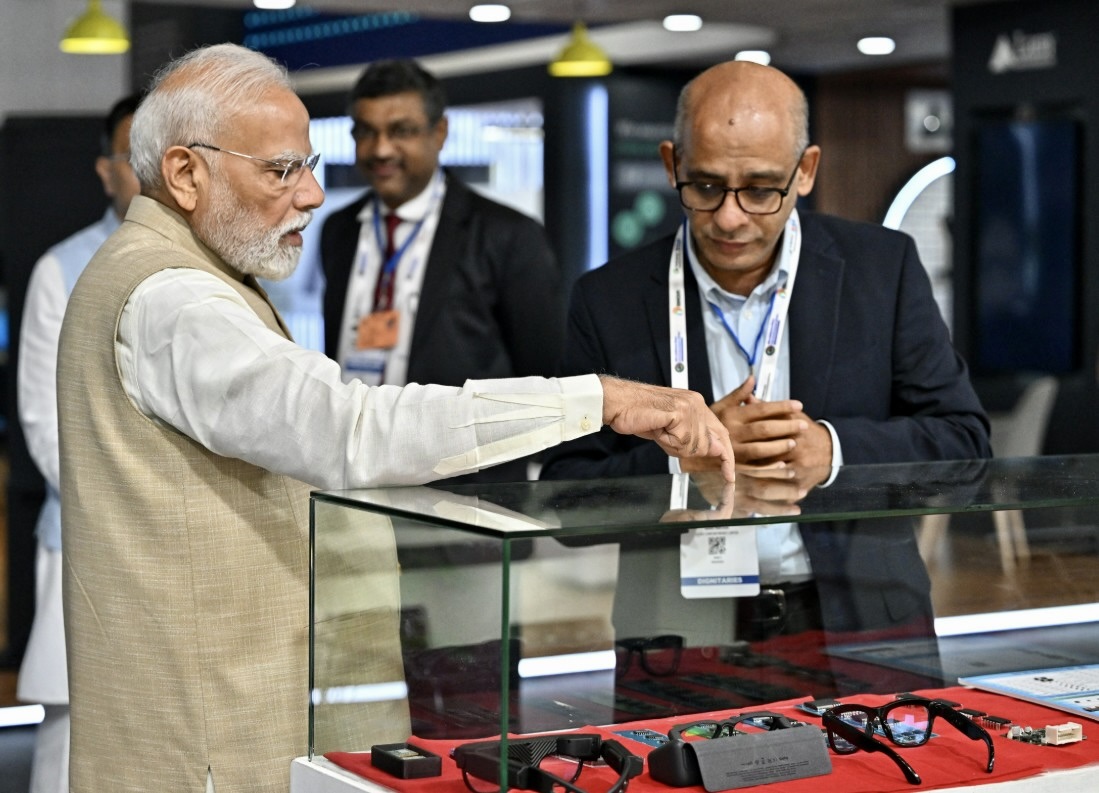
NEW DELHI (Realist English). On September 17, Indian Prime Minister Narendra Modi opened the fifth SEMICON India 2026 exhibition in New Delhi, presenting the country as a new global semiconductor manufacturing hub. In his speech, he emphasized that India is ready to become a reliable platform for global chip manufacturers.
“When a country like ours succeeds in a critically important industry, it strengthens the global supply chain — a fact that has gained even greater significance at a time when supply chains are used as a weapon,” Modi said.
Scale of the Exhibition and International Interest
SEMICON India 2026 is being held in New Delhi from September 17 to 19. The event features more than 600 exhibitors, including 300 international companies from more than 40 countries. About 40,000 delegates from 52 countries are registered, a third of whom are foreign.
Among the participants are heads of the world’s largest chip and equipment manufacturers: ASML, Applied Materials, Lam Research, Micron, Intel, Infineon, Tokyo Electron, IBM Research and Merck, as well as Indian Tata Electronics and CG Power.
Second Phase of the Program: Semicon 2.0
Modi announced that India has entered the second phase of its semiconductor program — India Semiconductor Mission 2.0, whose budget has been increased to $13.5 billion from $8 billion in the first phase. The program expands support beyond chip manufacturing to cover design, equipment, materials, research and development, and workforce training.
Key parameters of Semicon 2.0:
- Design support: up to 50% of project cost or up to 15 crore Indian rupees for startups and MSMEs
- Fab financing: 40% of capital expenditure for large silicon fabs
- Equipment and materials support: 30% of capital expenditure
- Advanced packaging: 35% of capital expenditure
- Adoption incentive: reimbursement of 9% of net sales over five years
New Investments by Global Giants
The exhibition became a platform for announcing major investments. Applied Materials announced a $5 billion investment over ten years under the India Vision 2035 program, including the creation of a 140-acre research park and a tenfold expansion of local supply chains.
Lam Research announced plans to invest about 10,000 crore Indian rupees ($1.2 billion) in creating India’s first silicon components manufacturing facility, as well as expanding R&D operations.
Micron Technology reported that its plant in Sanand (Gujarat) has already begun supplying DRAM and NAND memory to customers worldwide. This year, the facility plans to assemble and test tens of millions of chips, and next year — hundreds of millions.
Progress of the First Phase
According to government data, under the first phase of the India Semiconductor Mission, 12 projects have been approved with total investments of more than 1.64 lakh crore Indian rupees ($20 billion). Five facilities have already entered commercial production.
India has also joined the US-led Pax Silica coalition, which brings together “trusted partners” in semiconductors and critical minerals.
Workforce Training
Modi emphasized the scale of efforts to train specialists. The government’s goal is to train 100,000 engineers for the semiconductor industry.
So far, more than 70,000 have been trained. According to Minister of Electronics and IT Ashwini Vaishnaw, India achieved the target of 85,000 engineers in four years instead of the planned ten.