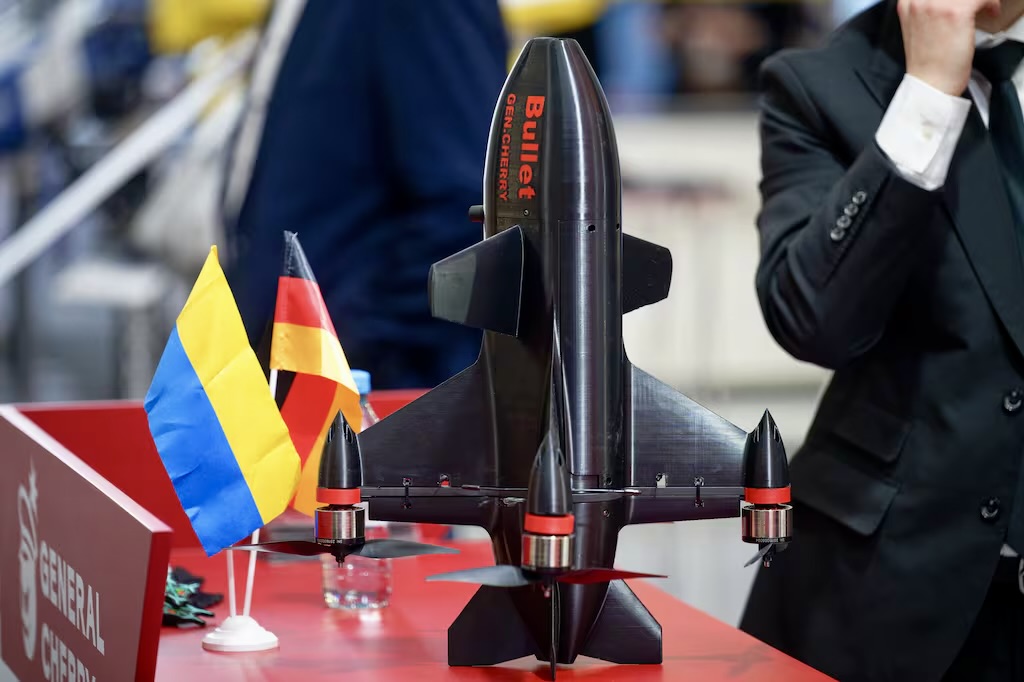
PARIS (Realist English). Finnish defence company Patria has announced a partnership with Ukrainian drone manufacturer General Cherry (LLC “Centre of Unmanned Technologies”) to jointly develop and organise the production of unmanned aerial vehicles on Finnish territory. A corresponding memorandum of intent was signed on August 23, 2026.
The signing ceremony took place in Kyiv during a visit by Finnish President Alexander Stubb, who participated in a roundtable on defence‑industrial cooperation between the two countries. Ukrainian President Volodymyr Zelenskyy confirmed that Ukrainian companies had signed documents on the development and production of UAVs in Finland for the needs of Ukraine and Europe.
Who signed and what was discussed
On the Patria side, the deal was overseen by Mikko Leino, Executive Vice President for Defence and Weapon Systems. The Ukrainian side was represented by General Cherry co‑founder Stanislav Hryshyn.
The parties agreed on cooperation in three key areas:
| Area | Essence of the agreements reached |
| Localisation of production | Launch of serial production of General Cherry’s Ukrainian drones at Patria’s facilities in Finland |
| Joint development | Creation of new unmanned solutions for Western European defence needs |
| Expansion of product range | Joint development of maritime unmanned systems and ground robotic complexes |
According to Janes, production in Finland has already commenced — currently, the Bullet interceptor and the Air Speed FPV drone are being manufactured. The main output will be supplied “primarily for the European Union.”
“Unmanned defence systems are central to the future of defence, which is why we have invested in the development of unmanned systems for many years,” said Mikko Leino. “Our unique combat experience, combined with Patria’s technological capabilities, can help fundamentally transform European and global security architecture,” added Stanislav Hryshyn.
Context: a wave of European cooperation with Ukrainian manufacturers
The Patria–General Cherry agreement is part of a systemic trend: European countries are increasingly integrating Ukrainian defence technologies into their own production chains.
- Germany. Chancellor Friedrich Merz announced in December 2025 plans to produce various Ukrainian drones on German territory.
- United Kingdom. Ukrainian UAV manufacturers, including Skyeton and Ukrspecsystems, are forming partnerships and investing in production facilities in the UK.
- Finland. In addition to the Patria–General Cherry deal, Airlogix signed a memorandum of intent with Finnish Innokas to establish a joint venture for the production of unmanned systems.
In July 2026, the European Commission announced a “Drone Deal” with Ukraine, providing for joint UAV production. Ukraine currently produces about 10 million drones per year and intends to double that figure with European partners’ support.
The Patria–General Cherry agreement is being implemented under the Build with Ukraine initiative, launched by President Zelenskyy on June 21, 2025. Its goal is to enhance the security of Ukraine’s supply chains and facilitate technology transfer between partners. On July 1, 2026, the Ukrainian government approved a mechanism for exporting defence technologies, simplifying partner countries’ access to Ukrainian developments.
What is known about General Cherry’s drones
General Cherry was founded in Ukraine and has become one of the country’s leading manufacturers of interceptor drones. Its product line includes:
- FPV strike drones – classic kamikaze drones;
- Fibre‑optic drones – resistant to electronic warfare countermeasures;
- Interceptor drones – including the flagship Bullet platform, designed to counter Russian Shahed‑type and Molniya‑type UAVs;
- Fixed‑wing UAVs.
The company’s products are used by more than 200 military units of the Armed Forces of Ukraine.
Geopolitical subtext: from Kyiv to Helsinki – a NATO transit
The Patria–General Cherry deal has not only commercial but also strategic dimensions. Moving Ukrainian drone production to Finland – a NATO member state – solves at least two tasks:
- Supply chain security. Production in Northern Europe reduces the vulnerability of Ukraine’s defence industry to strikes on critical infrastructure inside Ukraine.
- Technology transfer. Ukrainian combat experience – the most relevant and intense in the world – is being systematically integrated into the European defence industrial base.
At the same time, Finland is strengthening its own defence technology base, gaining access to combat‑proven developments. Patria, which is 50.1% state‑owned and 49.9% owned by Norway’s Kongsberg Defence & Aerospace, has long been active in Ukraine’s defence R&D landscape.
Tactical breakthrough or strategic puzzle?
The Patria–General Cherry agreement is yet another confirmation that Ukraine’s defence‑industrial complex is becoming an integral part of Europe’s security architecture. Ukrainian combat experience, refined into serial products, is finding its place in NATO countries’ production chains.
Yet open questions remain: can Finland scale up production to match Ukraine’s needs? How long will the political will of European capitals hold to support Ukrainian drone‑making if the intensity of fighting at the front changes? And most importantly – will the massive relocation of production outside Ukraine gradually strip Ukraine itself of its status as a competence centre in favour of European hubs?
For now, the parties prefer to speak of “long‑term and effective partnership,” leaving volumes, timelines and economic models off the table. But it is precisely these details that will determine whether Finland becomes a new hub for Ukrainian drone‑building or whether the deal remains merely a tactical manoeuvre in a larger geopolitical game.