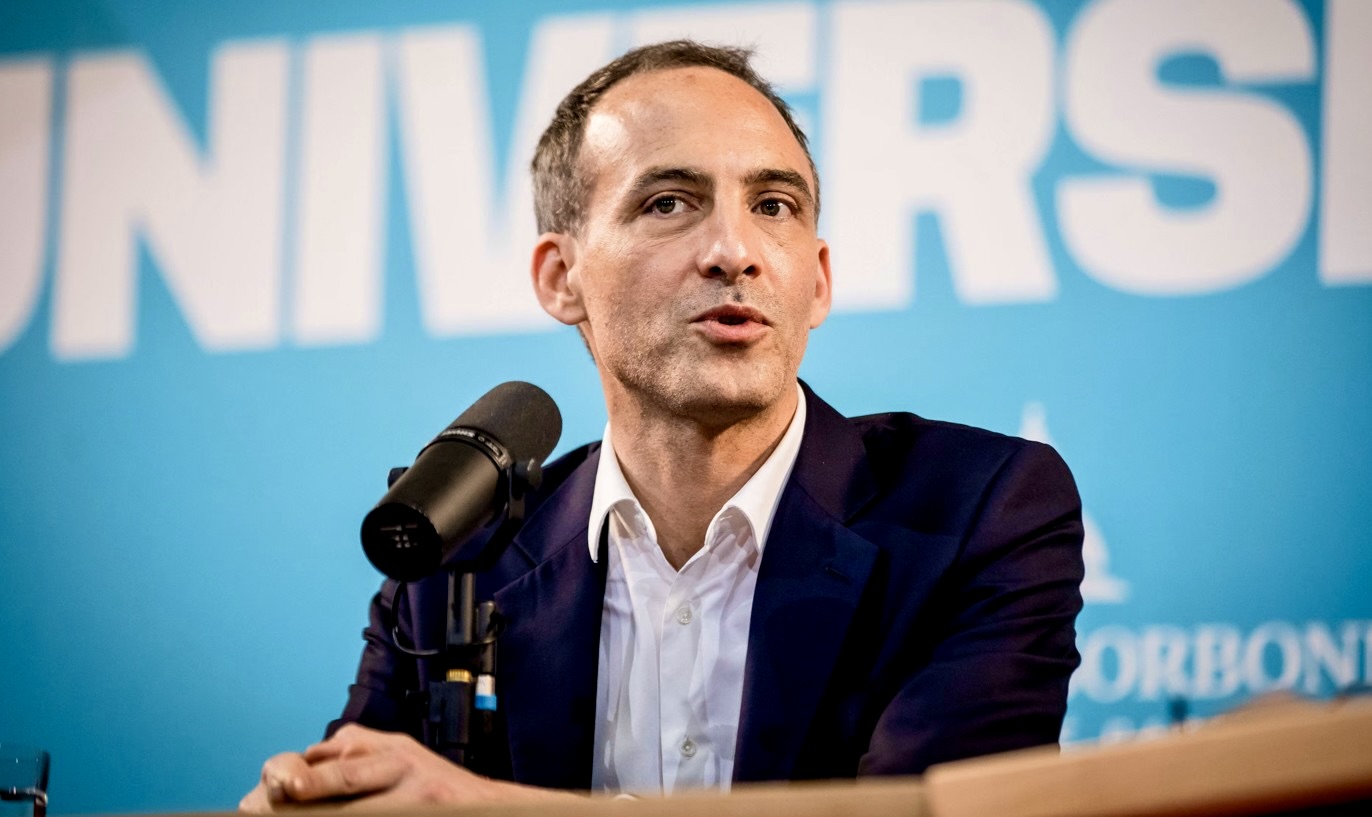
PARIS (Realist English). On 23 August, leader of the centre‑left party Place Publique and Member of the European Parliament Raphaël Glucksmann officially announced his candidacy for the 2027 French presidential election.
The politician aims to unite the fragmented left and challenge far‑left leader Jean‑Luc Mélenchon amid the dominance of the far right in opinion polls.
Who is Raphaël Glucksmann?
Glucksmann, 46, is the leader of the centre‑left party Place Publique and an MEP who led the left‑wing alliance in the 2024 European elections with a result of 14% of the vote.
| Parameter | Details |
| Age | 46 |
| Party | Place Publique |
| Position | Member of the European Parliament |
| 2024 EU election result | 14% (left alliance) |
| Family | Grandson of Soviet intelligence officer Rubin Glucksmann; married to France 2 anchor Léa Salamé |
Media attention to his persona is fuelled not only by his political agenda. Glucksmann is the grandson of Rubin Glucksmann – a Soviet intelligence officer who worked for the Comintern in the 1920s–1940s. His wife is France 2 evening news anchor Léa Salamé; French media call them one of the country’s main “power couples.”
Announcement: ‘I could not stay on the sidelines’
On Sunday, 23 August, in an interview on TF1, Glucksmann confirmed his candidacy and explained his motives:
“Yes, I am running for president. Are we really going to hand our country over to the far right? Faced with such a choice, I could not stay on the sidelines.”
He also stated that he intends to take part in the primary organised by his party together with the Socialist Party (PS). Glucksmann stressed: “I am a candidate to win and to change France.”
The Mélenchon challenge and the left’s split
Glucksmann’s main rival within the left camp is far‑left leader Jean‑Luc Mélenchon, whom he outpaces in some polls. However, according to surveys, Glucksmann currently trails Mélenchon in ratings – he is supported by about 10% of voters.
At the same time, Glucksmann rules out any alliance with Mélenchon’s La France Insoumise, stating: “With them, I will never reach an agreement if I win the primary.” Instead, he is reaching out to the Greens and the Communists.
| Candidate | Party | Poll Support |
| Jean‑Luc Mélenchon | La France Insoumise (far left) | Higher than Glucksmann |
| Raphaël Glucksmann | Place Publique (centre left) | ~10% |
Policy platform: redistribution and ecology
At the core of Glucksmann’s platform is raising workers’ incomes by reducing social contributions on salaries, to be compensated by increased taxation on large inheritances and the wealthiest 1% of citizens. By his estimates, this would bring €15 billion to the budget.
He also promised a “plan to save public education” and made the ecological transition a central pillar of his campaign, criticising the current government for insufficient action on climate change and wildfires.
Strategy: primaries and the path to unity
Glucksmann has bet on participation in the social‑democratic primary scheduled for October 2026. He previously refused to take part in a broader primary that could have united all non‑Mélenchon leftists.
In his words: “The left can win the presidential election if it firmly holds to its principles. We must stop being afraid of Mélenchon.”
The 2027 French elections will be held without incumbent President Emmanuel Macron, whom the Constitution bars from running for a third term. Far‑right leader Marine Le Pen consistently leads in first‑round polls.
Glucksmann, a pro‑European and pro‑Ukrainian politician, criticises Macron’s business‑friendly policies but holds positions close to his on key international issues.
Uniting the left – a question mark
Glucksmann is betting on uniting the social‑democratic wing and distancing himself from the radical left. His strengths include name recognition, media profile and a clear pro‑European stance.
However, polls show that he faces a difficult struggle for leadership of the left camp against Mélenchon, and the primary could be the first serious test of his ability to consolidate centrist and left‑wing forces. If he succeeds, he could become a real alternative to Le Pen in the second round.
The question is whether Glucksmann can overcome the fragmentation of the left‑wing electorate and offer a programme capable of uniting disparate forces amid the far‑right’s dominance.