PARIS (Realist English). At the Eurosatory 2026 defense exhibition near Paris, French automaker Renault Group and defense contractor Thales announced a strategic partnership for the series production of TOUTATIS loitering munitions (kamikaze drones). The agreement, signed on June 16, marks an “invasion” of the automotive industry into the defense sector under the concept of a “war economy.”
Production plan: 1,000 drones per month from 2027
Under the partnership, Renault will produce the TOUTATIS loitering munitions at one of its plants. Production is scheduled to start in 2027, with a target of 1,000 units per month in the first year. For comparison, the entire DAMOCLES programme of the French army provides for the delivery of 460 drones over several years. The Renault-Thales partnership would produce twice that amount in a single month.
TOUTATIS: tactical drone resistant to electronic warfare
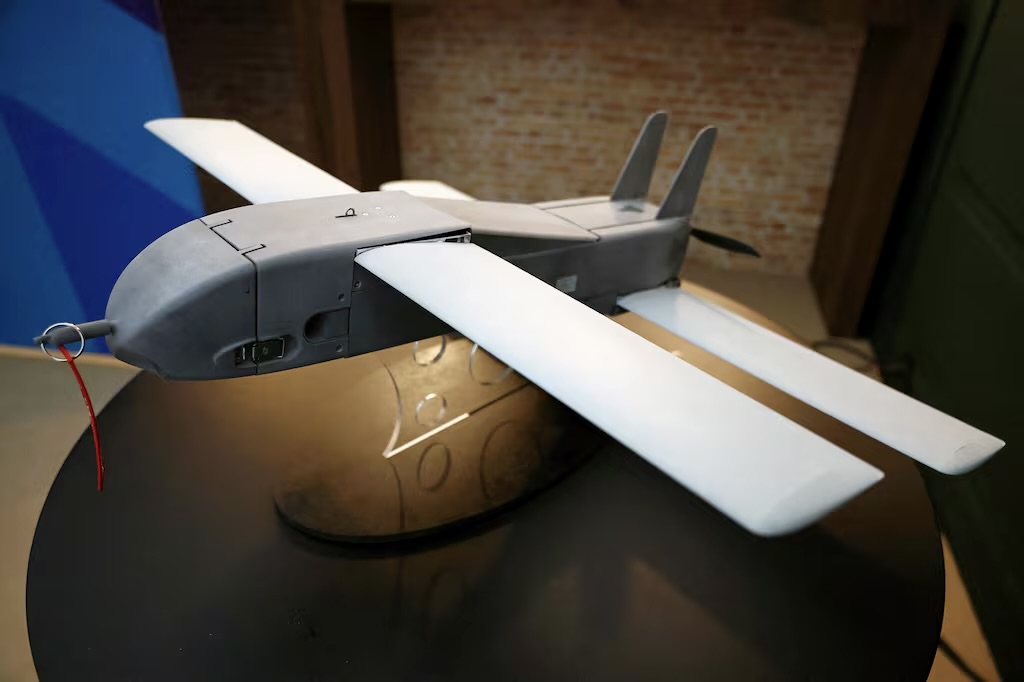
TOUTATIS is a lightweight loitering munition designed for high‑intensity conflicts.
- The drone weighs less than 4.5 kg. It has folding wings with a span of 850 mm and can be carried and launched by a single soldier from a tube, as well as from combat vehicles, helicopters, ships and other drones.
- The 1 kg warhead is capable of engaging lightly armoured targets. Depending on the modification of the warhead, it can also destroy heavier armour.
- The standard version has a range of up to 10 km (over 30 minutes of flight), while the modified version exceeds 30 km. Cruise speed exceeds 90 km/h, and attack speed reaches 150–180 km/h.
- The drone is resistant to electronic warfare (EW) and GPS jamming — a critical requirement confirmed by combat experience in Ukraine.
Why this matters
The war in Ukraine has turned loitering munitions from a niche weapon into a mass‑production requirement. However, Thales currently produces only about 100 TOUTATIS drones per year.
Renault will enable scaling by shifting from 3D printing to high‑volume injection moulding and adapting the design for assembly‑line production.
“We started with a military requirement, carefully studying the situation on several theatres of operations, especially in the east,” said Thales CEO Patrice Caine.
“Renault Group brings to the TOUTATIS project its industrial expertise and the best automotive standards to design, implement and produce on a large scale, in short timeframes and at optimised costs,” said Renault Group CEO François Provost.
Two projects in one: 4 TROOP
Also presented at Eurosatory was a prototype of the 4 TROOP tactical hybrid all‑terrain vehicle — a mobile command post integrating drones, sensors, communications and AI‑based decision‑making systems. The 4 TROOP is designed for reconnaissance, troop coordination and drone control.
Geopolitical context
The war in Ukraine and the shift in US foreign policy under President Trump are forcing European countries to increase defence spending and seek additional production capacity in the automotive sector. France, striving to ensure sovereign army supply and boost the competitiveness of its national defence industry, is betting on cooperation between the civilian and defence sectors.
Renault had already received a request from the French Ministry of the Armed Forces to strengthen the defence sector. In addition, the automaker is developing the long‑range Chorus drone with Turgis Gaillard: the first demonstrator is expected by the end of 2026, after which the Renault plant in Le Mans will produce 600 units per month.
Outlook
There are currently no plans for the French army to purchase significant quantities of TOUTATIS — the company is targeting exports.
Nevertheless, the Renault‑Thales partnership is a striking example of the transformation of Europe’s defence industry under the conditions of a “war economy.”