BESLAN (Realist English). On September 3, Russia commemorates one of the most horrific tragedies of modern history — 22 years ago, a terrorist attack on School No. 1 in the town of Beslan claimed the lives of 334 people, 186 of whom were children.
At this moment, the schoolyard echoes with the tolling of bells, 334 white balloons rise into the sky, and to the rhythm of a metronome in the “City of Angels,” the names of all the victims are read aloud.
Twenty‑two years later, the pain has not subsided, and the memory of the heroes — those who gave their own lives to save the hostages — lives on in the hearts of thousands.
22 Years: From School Assembly to Hell
September 1, 2004, began as a normal School Day for the people of Beslan. Early in the morning, a covered GAZ‑66 truck and a car pulled up to School No. 1, from which armed men in masks emerged. The terrorists opened indiscriminate fire, and the first victims fell.
Panic broke out, but most people found themselves trapped inside the schoolyard. The militants herded more than a thousand people into the gymnasium. For nearly three days, the hostages remained without food or water, under the constant threat of execution.
On September 3, 2004, two powerful explosions inside the school building forced law enforcement to launch an assault. The operation to free the hostages ended with the deaths of 334 people. A further 810 were wounded. 126 former hostages became disabled, including 70 children.
Children and Teachers: The Greatest Victims and the Greatest Heroes
Among the dead were 186 children, aged from one to seventeen. Many had come to school with their parents for the celebratory assembly. Even infants were taken hostage. In total, 17 teachers and school staff perished that day.
For them, the school was not merely a workplace but a second home, and their pupils were family. Of the 59 teachers working at the school, eight died. Six of them were primary school teachers.
Among them was Galina Vataeva, a primary school teacher. According to witnesses, she protected the youngest children until the very end. Emma Karyaeva, also a primary school teacher, died alongside her daughter after saving at least 15 children from her class by throwing them out of a window, giving them a chance to escape.
Ivan Kanidi, 74, a physical education teacher, was the first to be shot by the terrorists. They offered him the chance to leave the school, saying they did not fight old men, but he refused to abandon his pupils. He stood in front of the gun barrels, shielding children with his body. When his body was recovered from the rubble, more than ten bullet wounds were counted. Earlier, he had removed explosives from several children.
Alena Dzutseva, 28, an Ossetian language teacher, was blown out of the gymnasium through a shattered window by the blast. Despite being burned, she crawled back to her pupils, saying: “I will not run ahead of the children!” She helped many children escape the building, but did not manage to save herself.
Emma Karyaeva and Irina Khanaeva also died while saving children. Nadezhda Nazarova, a biology teacher, died alongside her daughter and two grandchildren. Tarkan Sabanov, 89, a former school principal invited as a guest of honour, voluntarily stayed with the hostages and was killed. Ivan Karlov, a school boiler worker, led about ten children out of the school in the first minutes of the siege and was then killed.
Other teachers who died included: Zlata Azieva, Albina Alikova, Darima Alikova, Zarema Gadaeva, Svetlana Kantemirova, Natalia Rudenok, Olga Soskieva, Albina Tuskaeva‑Tebeeva, Taisia Khetagurova, Roza Cherdzhieva, and others.
Negotiations That Did Not Save, But Preserved Lives
Immediately after the takeover, the terrorists said they would negotiate only with three people — President of North Ossetia Alexander Dzasokhov, President of Ingushetia Murat Zyazikov, and children’s doctor Leonid Roshal. Roshal responded immediately and arrived in Beslan on the evening of September 1. However, negotiations lasting through the night yielded no results.
On September 2, former President of Ingushetia Ruslan Aushev managed to reach an agreement with the Ingush faction of the terrorists. He was allowed into the gymnasium and led out about 20 women with infants — the only time the terrorists agreed to release hostages before the assault.
The operational command also attempted to involve other intermediaries, including former Security Council secretary Vladimir Rushailo, but the militants remained intransigent.
The Special Forces’ Feat: Ten Lives for Hundreds Saved
Ten members of the FSB’s Special Purpose Centre — three from Alpha and seven from Vympel — gave their lives during the hostage rescue operation. They operated under extremely difficult conditions, with terrorists using women and children as human shields. Their priority was saving the children — they shielded them with their own bodies.
Among the first to storm the school building was Lieutenant Andrei Turkin (Vympel). When a terrorist threw a grenade towards the children, Turkin covered it with his body, saving dozens of them at the cost of his own life. Among those he saved was Nadezhda Badoeva. Her mother later recalled that at Nadezhda’s wedding, an elder told her: “If not for your son, this wedding would not have happened.”
Lieutenant Colonel Dmitry Razumovsky (Vympel) was killed while providing covering fire for escaping hostages. Major Alexander Perov (Alpha) led an assault group and personally neutralised a terrorist who was firing into a room containing around 150 hostages. Lieutenant Colonel Oleg Ilyin (Vympel) also fell in battle while saving children.
For their courage and heroism, Andrei Turkin, Alexander Perov, Oleg Ilyin and Dmitry Razumovsky were posthumously awarded the title of Hero of Russia. Five other participants in the operation also received the title of Hero of Russia, and five were awarded the Order of Merit for the Fatherland, IV degree.
| Aspect | Details |
| Anniversary | 22 years (2004–2026) |
| Total killed | 334 people (186 children) |
| Wounded | 810 people |
| Disabled former hostages | 126 people (70 children) |
| Teachers killed | 17 teachers and school staff |
| Special forces killed | 10 operatives (Alpha — 3, Vympel — 7) |
| Heroes of Russia (posthumous) | Andrei Turkin, Alexander Perov, Oleg Ilyin, Dmitry Razumovsky |
| Negotiators | Leonid Roshal, Ruslan Aushev (released 20 women with infants) |
“Life After Hell”: What Became of Beslan’s Surviving Children
Twenty‑two years on, those who were trapped inside the explosives‑packed gymnasium in 2004 have grown up and chosen their paths. Among them are doctors, teachers, police officers, athletes and lawyers. Many chose medicine — surgeons, intensive care doctors, oncologists, cardiologists, ENT specialists, dentists and infectious disease specialists.
Oksana Makieva, who was 10 in 2004, became an infectious disease specialist. During the coronavirus pandemic, she worked in the “red zone” in North Ossetia and now continues to save lives in Moscow.
Zaurbek Kozyrev, after renowned cardiac surgeon Leo Bokeriya saved his life with a complex heart operation — a shrapnel fragment had lodged in his heart — himself became a cardiac surgeon. He now assists Professor Bokeriya.
Georgy Ilyin, whose photograph circulated around the world in 2004, also became a doctor.
Bela Gubieva, who lost many classmates in the tragedy, became a doctor.
Alan Gappoev, then only six years old, lost his mother, who shielded him with her body. He survived, graduated from law school, professionally trains in sports, and focuses on building his health. His brother Soslan became a professional coach.
Artur Naifonov, a former hostage, became an Olympic medallist in freestyle wrestling.
Marina Duchko, who lost the ability to walk as a result of the tragedy, now grows and sells violets online.
Vyacheslav Ailyarov, now chairman of the public organisation “Children of Beslan,” helps others alongside fellow survivors. In 2026, they travelled to the Dagestani settlement of Mamedkala, severely affected by floods, to restore a school. “It all happened spontaneously… Just, how else could it be?” says one of the volunteers, Aslan Persaev.
Many survivors have started families and are raising their own children. Some work as teachers, police officers, musicians, pharmacists or lawyers — they live for themselves and for those who never came out of the gymnasium.
“The Pain Does Not Fade”: How Beslan Remembers
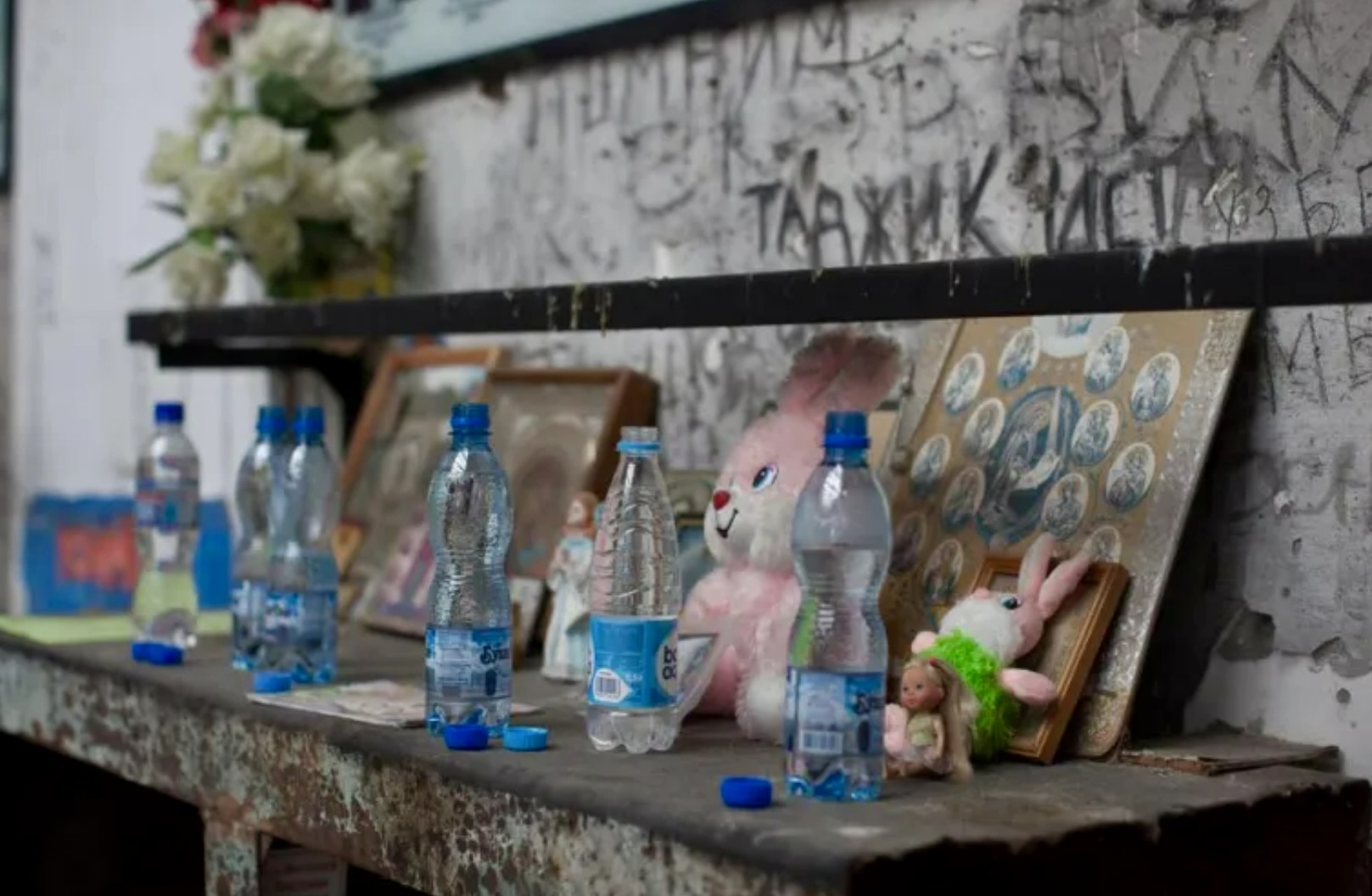
A three‑day vigil of remembrance has been held in North Ossetia since September 1. On the morning of September 1, the republic’s head Sergei Menyailo laid flowers at the memorial in the school gymnasium. Residents bring toys and water — symbols of what the hostages so desperately needed during those terrible days.
“Twenty‑two years have passed since those tragic events at Beslan School No. 1, but the pain does not fade. It still lives in the hearts of thousands of people in Ossetia, Russia and far beyond. There are wounds that time cannot heal. Beslan is one of them,” Menyailo wrote on his Telegram channel.
15 New Halls: Memory Becomes a Museum
To mark the 22nd anniversary, 15 new themed halls were opened at the International Cultural and Patriotic Centre “Beslan. School No. 1.” There are now 20 in total. The exhibitions include archival footage, personal belongings of the victims, investigation materials, and testimonies from those fateful 52 hours. One hall is titled “Premonition” — on its walls are drawings and poems by children written before the attack. Almost all of these children were taken hostage and died. The exhibitions also show how the children in the gymnasium supported each other, found water, and shared their last drops with friends.
A new hall dedicated to the continuity of generations and the traditional values of North Ossetia has also been opened. Entire families — grandparents, parents and children — perished in the tragedy, creating a tragic rupture in family lineages.
Across Russia — Minutes of Silence and Candles
The Day of Solidarity in the Fight against Terrorism is observed across the country. In Novosibirsk, more than 1,000 people gathered in front of the Globus Theatre for a large‑scale “Remember Beslan” event.
In Serpukhov, a youth action “Beslan. We Remember” was held at the “Black Tulip” memorial. Across Russia, schools held class hours, “Crane of Memory” and “Tree of Peace” events, and drawing contests.
EMERCOM rescuers in Birobidzhan observed a minute of silence. In Rovereto, Italy, a memorial service was held for the fallen children, hostages, teachers and special forces operatives of Alpha and Vympel.
Memory That Cannot Be Erased
Twenty‑two years later, Beslan remains not just a point on the map, but a symbol of pain, courage and inconsolable grief. The three days that changed the lives of an entire people still echo in the hearts of thousands — not only in Ossetia, but far beyond its borders.
The first days of September in North Ossetia have been declared days of remembrance; the Day of Knowledge is celebrated not on September 1, but on September 5. For the people of Ossetia, Beslan is a personal tragedy whose wounds have not healed.
Every evening in the schoolyard and in districts across the republic, candles are lit. To the sound of the metronome, the names of the 334 victims are read once more. The school that became a symbol of one of modern history’s most terrible tragedies continues to preserve the memory of those who never left the gymnasium.