BEIJING (Realist English). China has taken a decisive step to bypass traditional maritime chokepoints by launching its first regular container route through the Arctic.
The initiative, dubbed the “Ice Silk Road,” is designed not only to nearly halve the transit time for goods from Asia to Europe, but also to serve as Beijing’s strategic response to growing instability in the Red Sea, the Strait of Hormuz and the Strait of Malacca.
From Ningbo to Felixstowe: a new route
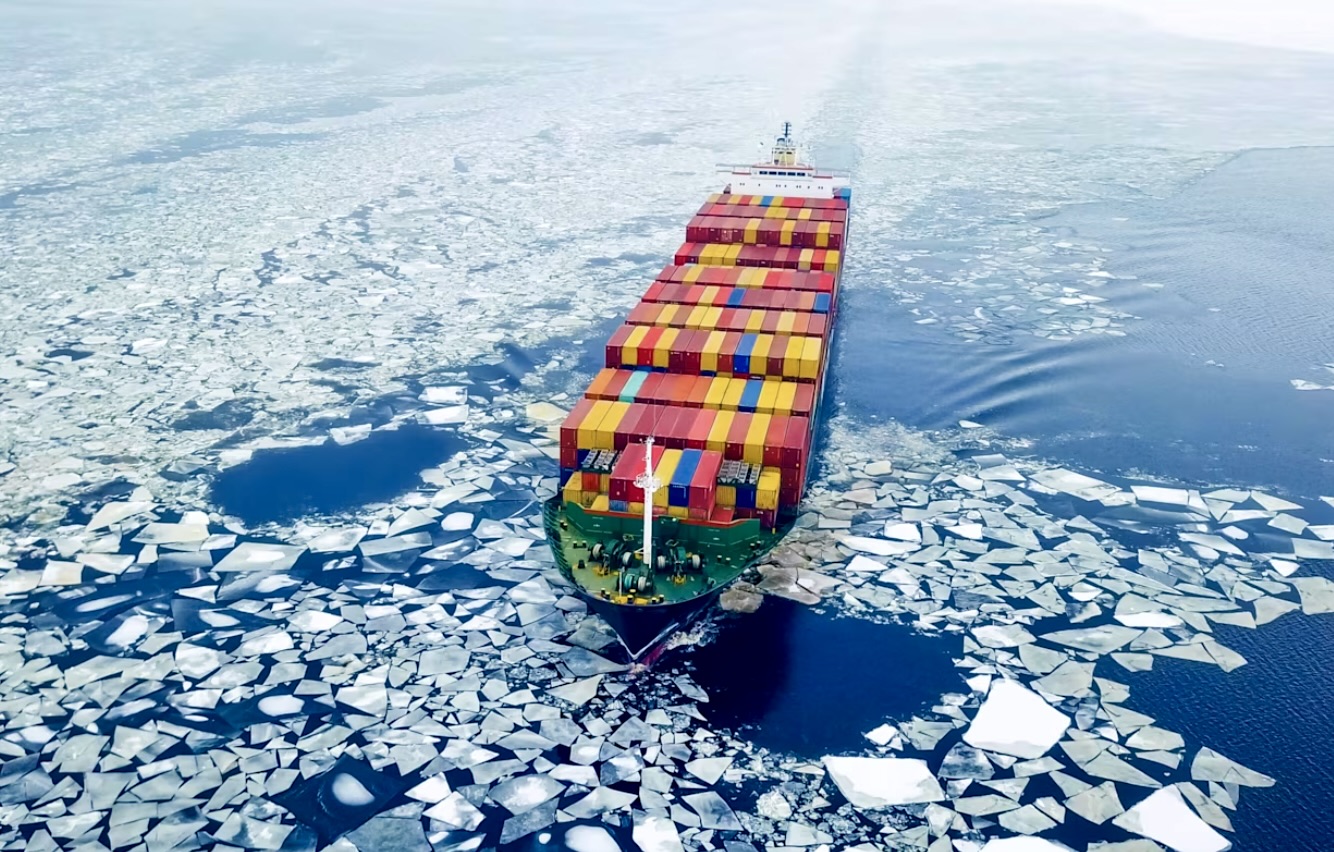
Chinese container shipping company Sea Legend is launching its first regular service this week, plying the route from Ningbo (eastern China) to Felixstowe (UK). The vessel will follow the Northern Sea Route (NSR) along Russia’s northern coast.
Depending on ice conditions, the journey will be cut almost in half – from the usual 40 days to approximately 20 days.
Weekly sailings are scheduled for the entire navigation season – from August to October. Russia’s state nuclear corporation Rosatom, which operates the Northern Sea Route, has issued permits for seven Chinese vessels. A total of 8 sailings are planned through October.
Bypassing the ‘bottlenecks’ of global trade
Beijing’s primary goal is to diversify trade routes and reduce vulnerability in strategic chokepoints. The traditional route from China to Europe passes through the Strait of Malacca, the Indian Ocean, the Bab el‑Mandeb Strait and the Suez Canal. Each of these points has become a high‑risk zone in 2026.
The new route completely bypasses:
- The Strait of Malacca – one of the world’s busiest sea lanes, which China has long called its “strategic vulnerability”;
- The Red Sea and Bab el‑Mandeb – where Houthis continue to attack commercial vessels;
- The Strait of Hormuz – effectively blockaded since February 2026 due to the US‑Iran war;
- The Suez Canal – also under threat from regional instability.
As the China Shipowners’ Association noted, the Arctic route “completely bypasses high‑risk zones, including the Red Sea and the Strait of Malacca, helping to ensure timely delivery of export orders.”
Russian‑Chinese cooperation in the Arctic
The “Ice Silk Road” is a logical continuation of years of Moscow‑Beijing cooperation in the Arctic. The initiative was first launched in 2018 as part of the broader Belt and Road Initiative.
By 2026, the two sides had reached a fundamentally new level of cooperation:
- A joint venture to design and build high‑ice‑class container vessels;
- A plan to build five vessels for year‑round Arctic navigation, with the first ARC7‑class vessel expected in 2027;
- A target of 20 million tonnes of annual cargo traffic on the NSR by 2030;
- In 2026, cargo volumes between the two countries via the Northern Sea Route have already exceeded 5 million tonnes.
Rosatom CEO Alexei Likhachev emphasised that 2026 marks the transition “from experimental and single voyages to a full‑fledged regular service.”
Investments in the Arctic
Beijing’s ambitions extend beyond shipping. Chinese companies have invested heavily in Russian Arctic energy projects, including nearly 30% of the $27 billion Yamal LNG project. China continues to invest in Russian LNG projects despite Western sanctions pressure.
In response, Moscow and Beijing have approved a joint “roadmap” to boost cargo traffic on the NSR to 20 million tonnes by 2030.
The “Ice Silk Road” has become not just a logistics project, but a geopolitical one. At a time when traditional sea routes have become zones of conflict, the Arctic offers China an alternative that reduces time, lowers risk and strengthens economic ties with Russia.
As analysts note, “Arctic transit allows ships to avoid high‑risk zones, which today include the Red Sea, the Strait of Hormuz and the Strait of Malacca.” The question is how quickly Beijing can scale up this route and transform it from a seasonal experiment into a year‑round artery. The first step has already been taken.