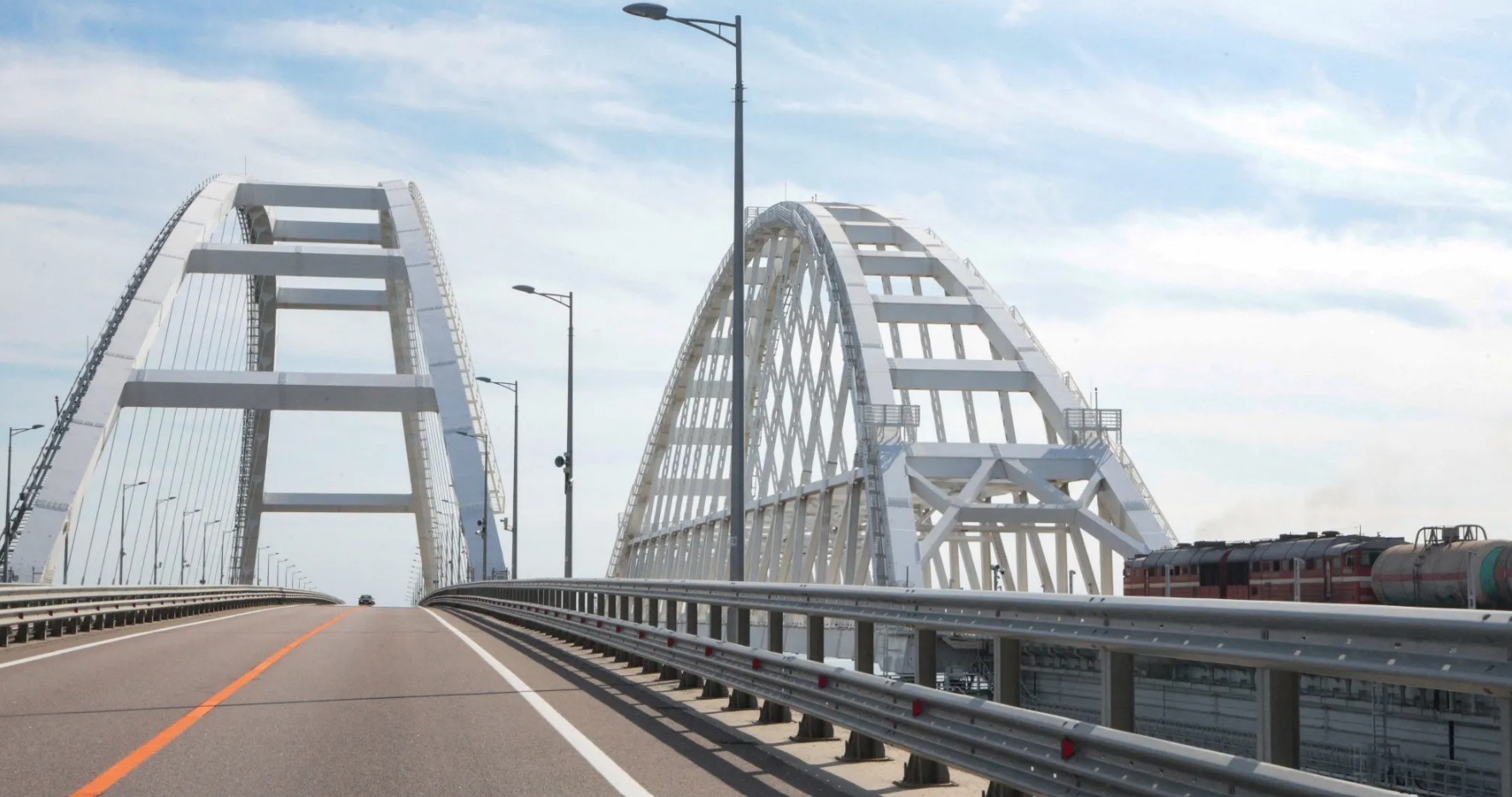
SIMFEROPOL (Realist English). On 16 November, the Crimean Bridge came under attack, and vehicle traffic across it was temporarily suspended. This was reported by Crimean head Sergey Aksyonov, who described the incident as a strike by Ukrainian forces. According to him, restrictions are expected to last until midday, all necessary services are involved in eliminating the consequences, and an operational headquarters has been set up in Kerch.
What is known about the attack and its consequences
According to the Russian Ministry of Transport, the attack was carried out using drones, targeting the bridge’s infrastructure. Traffic on the road section of the crossing has been halted, restoration work is underway, and the possibility of launching traffic in a reversible mode is being assessed.
According to preliminary information, there were no casualties as a result of the attack. The extent of the damage has not been officially specified. Rail traffic across the bridge, according to the Ministry of Transport, is operating normally.
Traffic across the bridge was closed for more than seven hours — since 2:22 a.m. Four trains were delayed due to the closure. The “Crimea — Caucasus” ferry crossing continues to operate around the clock; two ferries designed to carry trucks are operating on the route.
Reaction of the parties
The Ukrainian side has not officially commented on the incident. Aksyonov urged residents and guests of the peninsula to trust only official sources of information.
Not the first attack on the bridge
The Crimean Bridge, which connects the peninsula to mainland Russia across the Kerch Strait, has repeatedly been targeted since the start of the full-scale conflict. In October 2022, an explosion occurred on the bridge, killing four people and limiting the crossing’s capacity for several months.
Since that incident, security protocols have been in place under which trucks may use only ferries, while the bridge is open to passenger cars, buses and certain types of rail transport.
In March and April 2026, Ukrainian forces attacked the two remaining ferries, which also supported military logistics; they are estimated to be under repair.
Limits and risks
As observers note, the key feature of the current episode is the absence of confirmed information about the extent of damage and the targets of the attack. Official Russian sources limit themselves to reports of suspended traffic and the absence of casualties, without disclosing the nature of the impact on infrastructure.
This makes it difficult to assess whether this was a pinpoint strike with minimal consequences or a more serious damage capable of affecting the peninsula’s logistics.
For transport links with Crimea, the immediate effect will be most noticeable primarily in the timing of the resumption of road traffic and in the load on the ferry crossing — and that is precisely where it is most sensitive for the peninsula’s supply and passenger transport.