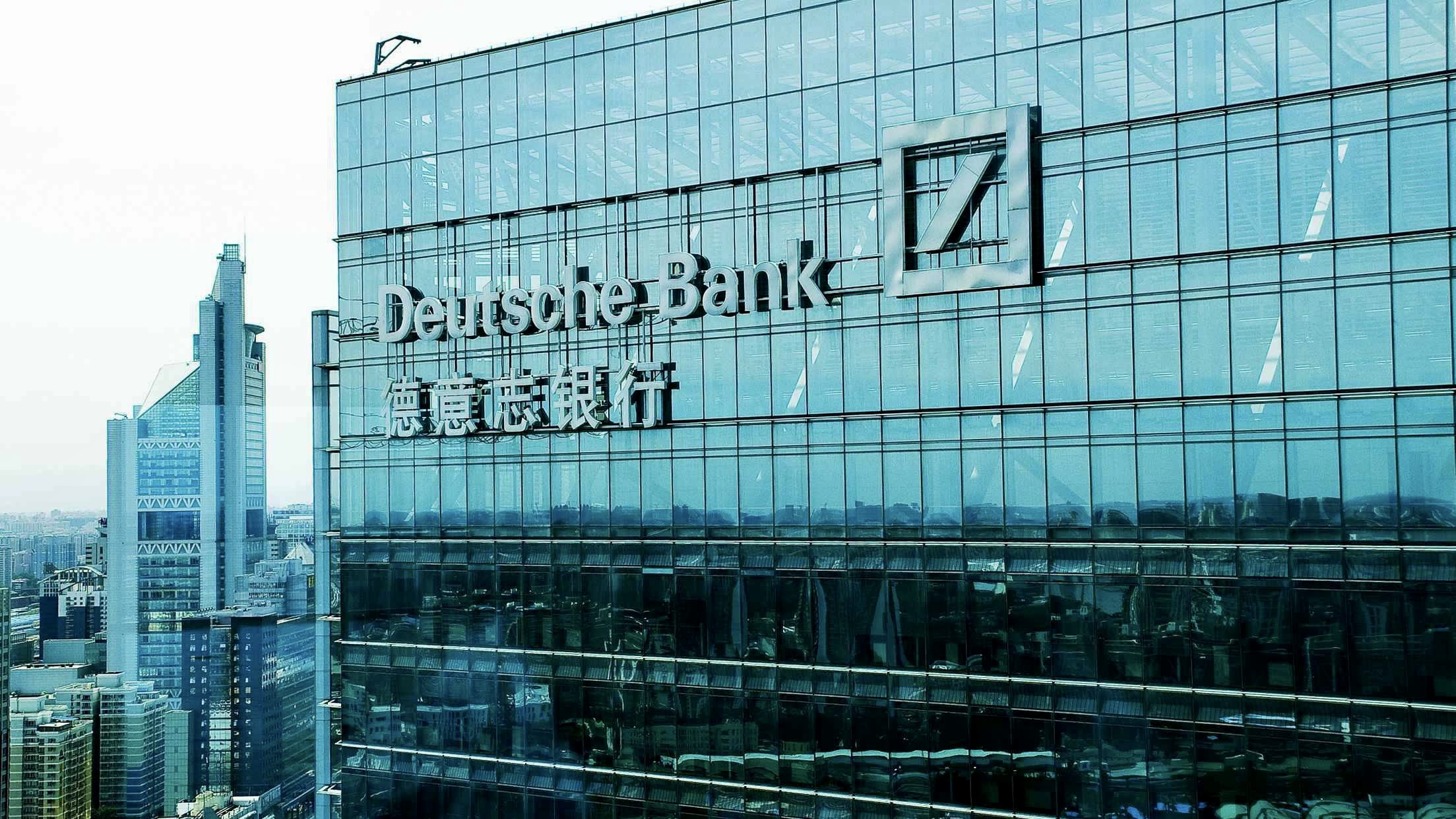
FRANKFURT (Realist English). The People’s Bank of China has appointed Deutsche Bank as a clearing bank for renminbi (RMB) settlements in Frankfurt.
The German lender has become the first European bank to receive this status, which was previously held exclusively by subsidiaries of Chinese state‑owned banks.
Clearing reinvented: what changes
Deutsche Bank’s designation as a clearing operator means that European financial institutions and companies will now be able to conduct direct end‑to‑end RMB settlement transactions without intermediary Chinese banks.
The bank will act as a local “bridge” to China’s payment systems, providing the full cycle of processing, clearing and settlement for cross‑border RMB transactions.
Previously, RMB clearing services in Europe were provided exclusively by branches of Chinese banks. In Frankfurt, this function was performed by the Industrial and Commercial Bank of China (ICBC); in Zurich, by China Construction Bank (CCB).
Now European players have an alternative – from a systemically important bank with a global network.
Legal basis and background
The People’s Bank of China’s decision was made on the basis of a memorandum of understanding between the central banks of China and Germany. The official announcement followed on 10 August.
Deutsche Bank has a long history of working with the Chinese currency: it was one of the first international banks to gain direct access to China’s cross‑border interbank payment system CIPS in 2015. Its appointment as a clearing bank was a logical continuation of this cooperation.
Strategic significance
The new status allows Deutsche Bank to offer clients optimised direct RMB solutions across a full range of services – from payments and liquidity management to trade finance and investments.
As Alexander von zur Mühlen, Deutsche Bank’s CEO for Asia‑Pacific, Europe, the Middle East and Africa, noted: “The appointment as an RMB clearing partner in Europe reinforces our role as a trusted global clearing bank and underlines our long‑term commitment to the internationalisation of the renminbi. It will strengthen financial connectivity between China and Europe and enable us to better support clients in cross‑border trade and investment activities.”
Leo Yin, President of Deutsche Bank (China), added that the bank aims to “connect the onshore and offshore RMB ecosystems and expand the use cases for RMB across Europe and key trade corridors.”
Frankfurt vs Zurich: the race for the RMB hub
Deutsche Bank’s appointment is a significant signal for European financial centres. More than a decade ago, the creation of an RMB hub in Europe was the subject of intense competition between continental capitals. In Switzerland, the project was seen as important for the prestige of the banking industry: in October 2015, China Construction Bank received a banking licence from the Swiss regulator, and in January 2016 opened a branch in Zurich, which has since been engaged in RMB clearing.
Now Frankfurt is strengthening its position not only as a location for Chinese banks, but also as a centre where a European bank independently provides clearing in the Chinese currency.
Deutsche Bank’s appointment as an RMB clearing bank is an important step in promoting the internationalisation of the Chinese currency. For European businesses, this means faster and cheaper settlements with Chinese counterparties, reduced counterparty risk and easier access to offshore RMB liquidity.
The question is whether other European banks will follow Deutsche Bank’s example. UBS and the Zurich Cantonal Bank are mentioned as potential candidates for similar status. For now, Frankfurt is strengthening its position as a key node in the financial connectivity between China and Europe.