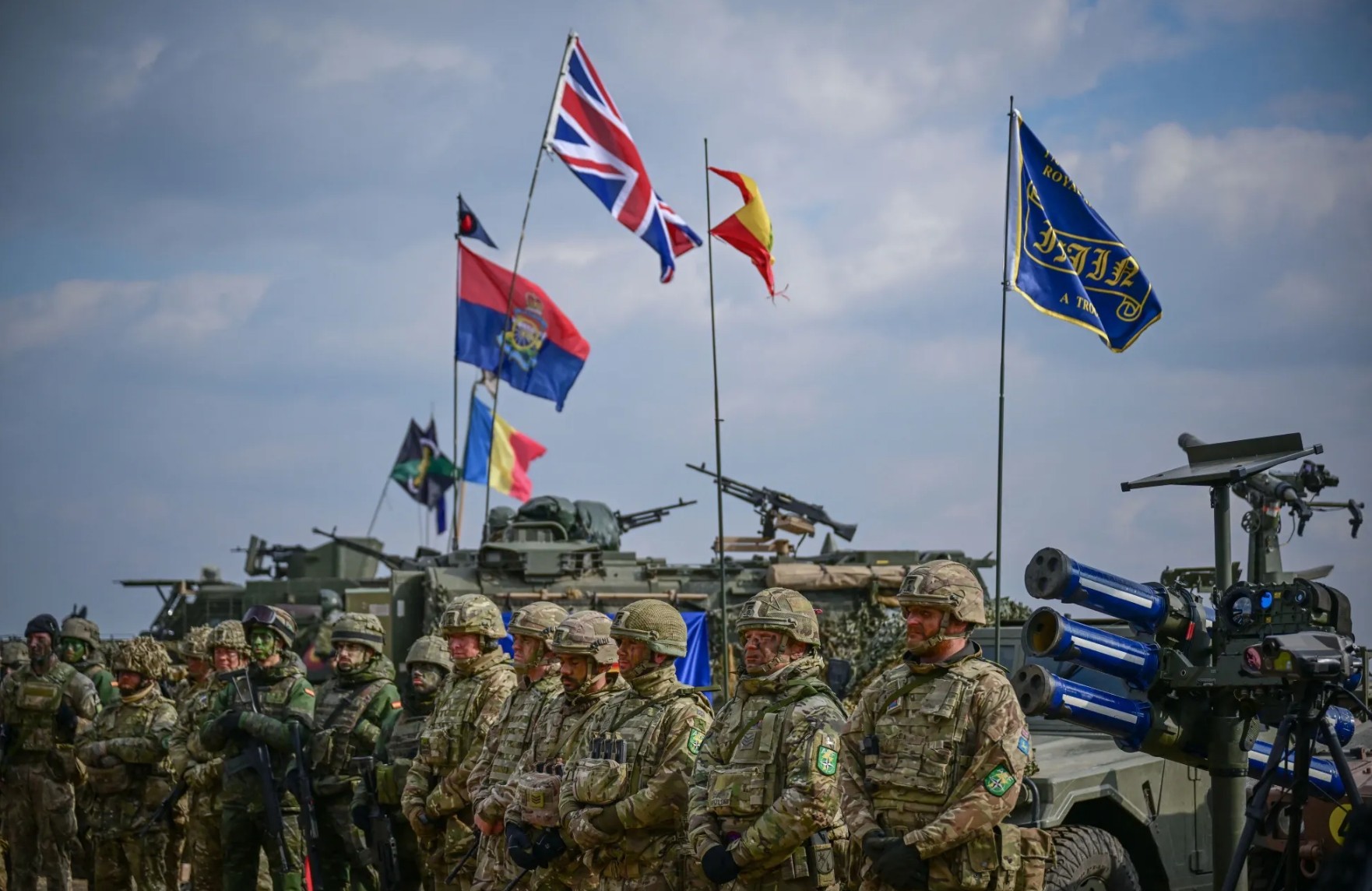
WARSAW (Realist English). The main goal of the maneuvers is to work out practical mechanisms for the rapid deployment of a multinational contingent to Ukraine after a ceasefire and at Kyiv’s request. The exercises are intended to test how quickly units from different armies can leave their permanent bases, cross borders and begin operating under a unified command.
Scenario: a rehearsal for “after peace”
The exercises include air, land and sea components. On land, the transfer, protection and supply of forces that may subsequently help rebuild the Ukrainian army are being practiced.
In the air, British Typhoon fighters and Voyager tanker aircraft are simulating the provision of security for commercial flights in case the sky over Ukraine reopens. At sea, Turkish officers in Istanbul are coordinating a staff exercise on demining approaches to Ukrainian ports to restore safe navigation.
It is important to note: the Multinational Force Ukraine (MNF-U) will not have a peacekeeping mandate or a ceasefire monitoring mandate and will not operate under NATO command. Their task is to support and train the Ukrainian Armed Forces, not to conduct offensive operations.
Participants and contributions
11 countries are taking part in the exercises: Belgium, the United Kingdom, Germany, Spain, Lithuania, the Netherlands, Poland, France, Sweden, Turkey and Estonia. The United States is not participating.
Key contributions:
- France is sending about 1,100–1,500 servicemen, including a drone unit.
- The United Kingdom is sending 300 troops from the 7th Armoured Division “Desert Rats,” as well as Typhoon fighters and Voyager tankers.
- Germany, which had previously hesitated, confirmed participation with a small contingent in the “low double digits.”
- Poland, as the host country, is providing reception, accommodation and transportation for foreign contingents, but will not send its soldiers to Ukraine after the conflict ends.
The land component headquarters is in Paris, the maritime one in Istanbul. Command of the MNF-U is exercised by British Lieutenant General Tom Bateman, with his French colleague General Armel Dirou overseeing the exercises.
Russia’s reaction: “militarization” and “red lines”
The Russian side reacted harshly. Foreign Ministry spokeswoman Maria Zakharova said that holding the exercises on the eve of trilateral talks in Abu Dhabi “shows that European countries have nothing to do at the negotiating table.” Moscow again stressed that it categorically rejects the deployment of foreign military contingents on Ukrainian territory and will regard them as legitimate military targets.
Russian military experts, commenting on the exercises for TASS, characterize them as the creation of an “intermediate, forward bridgehead” on Polish territory for building up forces and subsequently deploying a contingent to Ukraine. They separately point to the participation of British fighters capable of carrying both precision weapons and nuclear munitions, which, in the experts’ view, leads to “nuclear anarchy” and the militarization of territories bordering Russia.
The Koalicja 26.2 exercises are not just a staff game but the first practical step toward institutionalizing the “coalition of the willing” as a permanent instrument of the West’s military-political presence in Ukraine.
Although the deployment of forces is contingent on a ceasefire and a request from Kyiv, the very fact of practicing logistics, command and interaction among 11 armies creates infrastructure and procedures that can be activated quickly and without additional preparation.
The key contradiction these maneuvers expose is this: the West is preparing for “peace” in a way that Moscow considers a direct threat to its security. The exercises are taking place just days before a new round of talks in Abu Dhabi, and this coincidence is hardly accidental — it demonstrates that military preparation is proceeding in parallel with diplomacy, not instead of it. The question is whether these forces will become a real security guarantee for Ukraine or turn into an additional source of escalation that will derail diplomatic efforts.
For now, Poland, which provided the bridgehead but refused to send its soldiers, illustrates the caution with which even Kyiv’s closest allies approach direct confrontation with Russia.