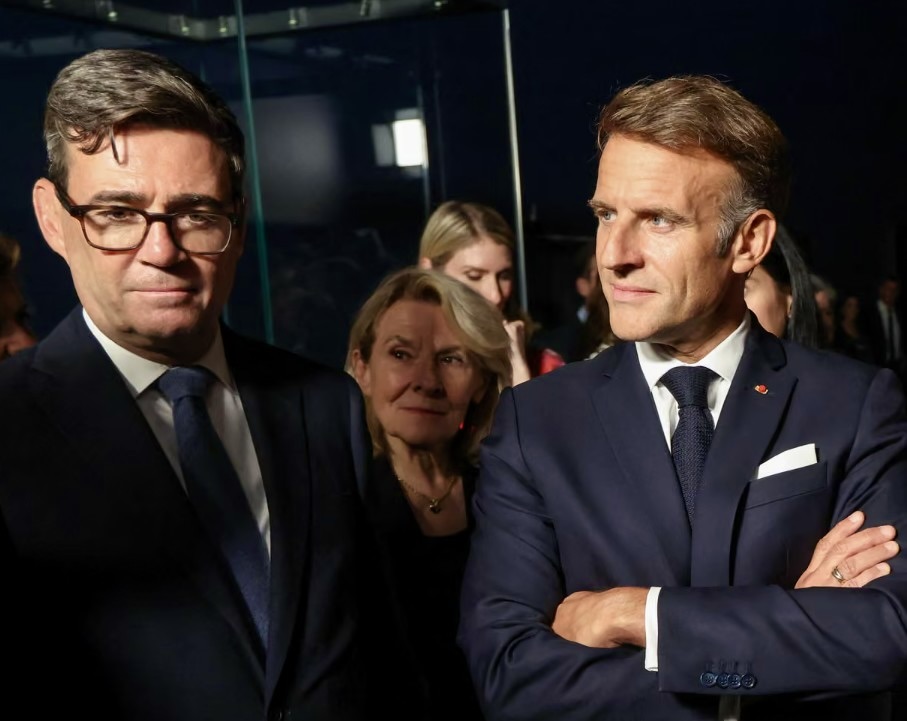
LONDON (Realist English). On September 2, French President Emmanuel Macron arrived in London for a two‑day visit that was both a cultural event and a significant diplomatic gesture.
At the centre of attention were the opening of the Bayeux Tapestry exhibition at the British Museum and Macron’s first meeting with Britain’s new Prime Minister Andy Burnham, who took office just six weeks ago.
While King Charles III called the exhibition an “unprecedented loan” and a symbol of the closeness between the two nations, and politicians exchanged jokes about the Norman Conquest, behind the scenes, issues of migration and European security were being addressed.
Although both sides emphasised continuity, experts warned that the symbolic gestures might not be followed by tangible agreements.
“An Unprecedented Loan”
On September 2, a private preview of the Bayeux Tapestry was held at the British Museum — a unique 11th‑century artefact that left France for the first time in over nine centuries. The 70‑metre‑long embroidered cloth, made in England but kept in Normandy, tells the story of the Norman Conquest of England in 1066.
Macron personally proposed the idea of loaning the tapestry to London for a year during his state visit to the UK in July 2025. “It is a reminder of what our countries can do when they join forces,” the French president said at the opening.
| Parameter | Details |
| Private preview date | September 2, 2026 |
| Public opening date | September 10, 2026 |
| Exhibition closing date | July 2027 |
| Tapestry length | 70 metres |
| Age | Approximately 950 years |
| Attendees at preview | Charles III, Camilla, Macron and his wife Brigitte, Burnham and his wife Marie‑France van Heel |
| Originator of the loan idea | Emmanuel Macron (proposed in July 2025) |
King Charles III, who described himself as a direct descendant of one of the tapestry’s key figures — William the Conqueror — noted that “the rivals depicted on the tapestry — the Normans and the Anglo‑Saxons — would have been delighted to see this unity between France and Britain.”
Burnham, in turn, joked that the tapestry “shows a new leader emerging from a northern territory,” alluding to his own background and his recent appointment as prime minister.
Political Background: Macron at Sunset, Burnham at Dawn
Macron’s visit is the first by a European leader to the UK since Andy Burnham succeeded Keir Starmer as prime minister in mid‑July.
For the 47‑year‑old Macron, this is one of his last major foreign visits before the end of his presidential term in May 2027. For Burnham, it is an opportunity to make his mark on the international stage, particularly in the context of post‑Brexit relations with the EU.
What They Discuss Behind Closed Doors
Migration. Combating illegal Channel crossings remains a key issue. Burnham stated that Britain and France “can achieve more together.”
Next week, a “rapid response group” of 45 French officers will be deployed on the beaches to counter the launch of large inflatable boats. Authorities noted that this summer saw the lowest number of Channel crossings since 2019, but Burnham warned: “We cannot be complacent. Criminal gangs are constantly adapting their tactics.”
European Security. Macron continues to promote the idea of a “European sovereignty” independent of the US, and sees Britain as a key player in this process, despite Brexit.
The Middle East and the Strait of Hormuz. The talks also addressed the situation in the Middle East and possible ways to unblock the Strait of Hormuz, which remains closed due to the ongoing US‑Iran conflict.
Cautious Optimism and Doubts
Previous Prime Minister Keir Starmer, according to French officials, built “very friendly and highly effective relations” with Macron, particularly on security matters. Coordination with Burnham is expected to be “equally important and regular.”
However, Professor Anand Menon of King’s College London warned of the danger that the visit might prove to be “style without substance.” “In essence, especially on issues that have economic implications for growth, everything remains very, very difficult,” he told AFP.
Diplomacy Against a Historical Backdrop
Macron’s visit to London was a display of “soft power”: a cultural gesture — the Bayeux Tapestry exhibition, symbolising shared history — provided the backdrop for discussion of pressing political issues.
For Burnham, the meeting was his first serious test on the international stage and an opportunity to consolidate relations with Paris, which reached their peak under his predecessor Starmer.
Yet questions remain. Can Burnham maintain the same level of trust with Macron that Starmer enjoyed? Or will the change of leadership in London and Macron’s impending departure from the Élysée Palace lead to a cooling of relations that, after the turbulent Brexit years, had become unexpectedly warm?