
BERLIN (Realist English). China, which for decades served as the main source of profit for the German auto industry, has turned into a zone of greatest risk. The share of Chinese automakers in their home market grew from 37.8% in 2019 to 65.3% in 2025, leading to a collapse in sales of German brands. Combined annual deliveries of Volkswagen, BMW and Mercedes-Benz in China over this period fell by about a third — to 3.87 million vehicles.
Loss of the Chinese market: a blow to the main source of profit
The dynamics for each conglomerate look threatening. Volkswagen sales in China in the third quarter of 2026 plummeted by 39% year-on-year; over nine months, the decline was 30% amid an overall market contraction of 21%.
BMW deliveries in the third quarter fell by 24.8%, Mercedes-Benz — by 8%. Mercedes’ failure in the premium segment is particularly telling: in the first half of 2026, the company sold only 1,153 cars in China, while the Xiaomi SU7 model sold more than 80,000 units.
Financial consequences and restructuring
The sharp drop in sales and profitability led to serious financial losses. Volkswagen Group posted a loss of €5.8 billion ($6.5 billion) in the third quarter of 2026. BMW’s profit in the same quarter fell by almost 15%. The contribution of Chinese joint ventures to Volkswagen Group’s profit fell from €4.4 billion in 2019 to a negative value of -€0.1 billion over nine months of 2026.
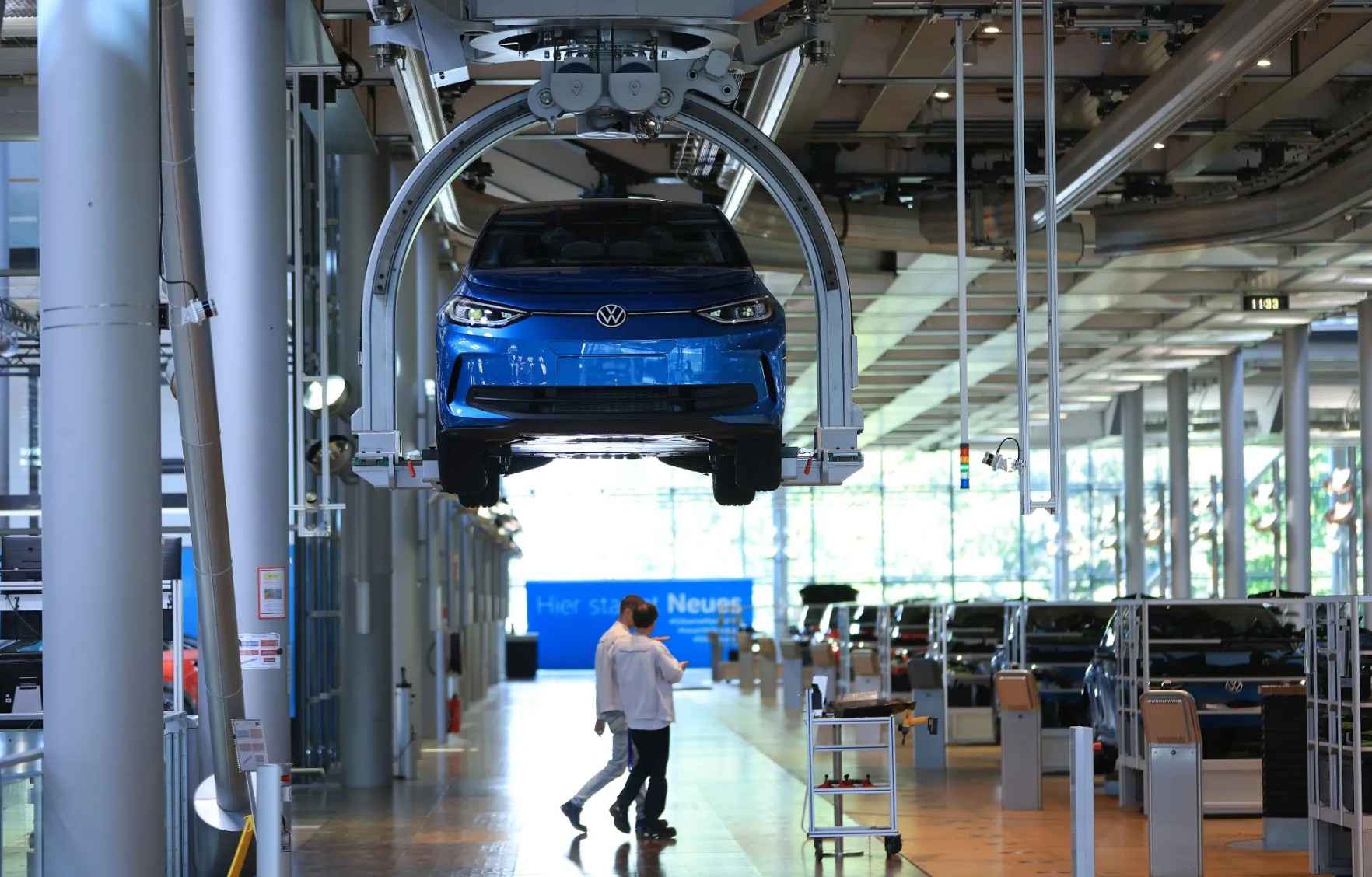
The response to the crisis has been mass layoffs and plant closures. Volkswagen is considering cutting up to 100,000 jobs and closing four plants in Germany by the end of the decade. BMW plans to lay off 8,000 people (about 5% of its workforce) by the end of 2027. The crisis has also affected suppliers: Schaeffler announced the closure of four plants in Germany and the elimination of 3,460 jobs worldwide.
Root of the problem: structural lag
The crisis is not only cyclical but also deeply structural. German companies, which had succeeded in perfecting internal combustion engines, were unprepared for a new reality where software, batteries and digital ecosystems became key. “Legacy automakers in China came to a digital party with analogue toys,” an expert from Sino Auto Insights was quoted as saying.
If in 2019 electric vehicles and plug-in hybrids (NEVs) accounted for a minority of sales in China, by the end of 2026 their share reached a record 67.8%, making the Germans’ technological advantage in internal combustion engines increasingly irrelevant.
Seeking a way out: cooperation instead of competition
Realising the scale of the threat, German companies and politicians began looking for a way out, one of which is cooperation with recent competitors from China.
This includes creating joint ventures and using Chinese platforms to produce cars at underutilised capacities in Germany, as well as turning China into a global technology development centre and export base. For example, Volkswagen plans to export cars developed in China to other world markets.
The German auto industry has found itself facing the need for a painful and rapid transformation. The crisis, caused by the technological shift and the strengthening of Chinese competitors, has already led to multibillion-euro losses and mass layoffs.
The future of Volkswagen, BMW and Mercedes-Benz now depends on their ability not only to cut costs but also to radically restructure their business model, including through cooperation with those who until recently were considered the pursuers. The key question is whether the German conglomerates can overcome their structural lag in software and batteries before their positions in the global market become irreversibly undermined.