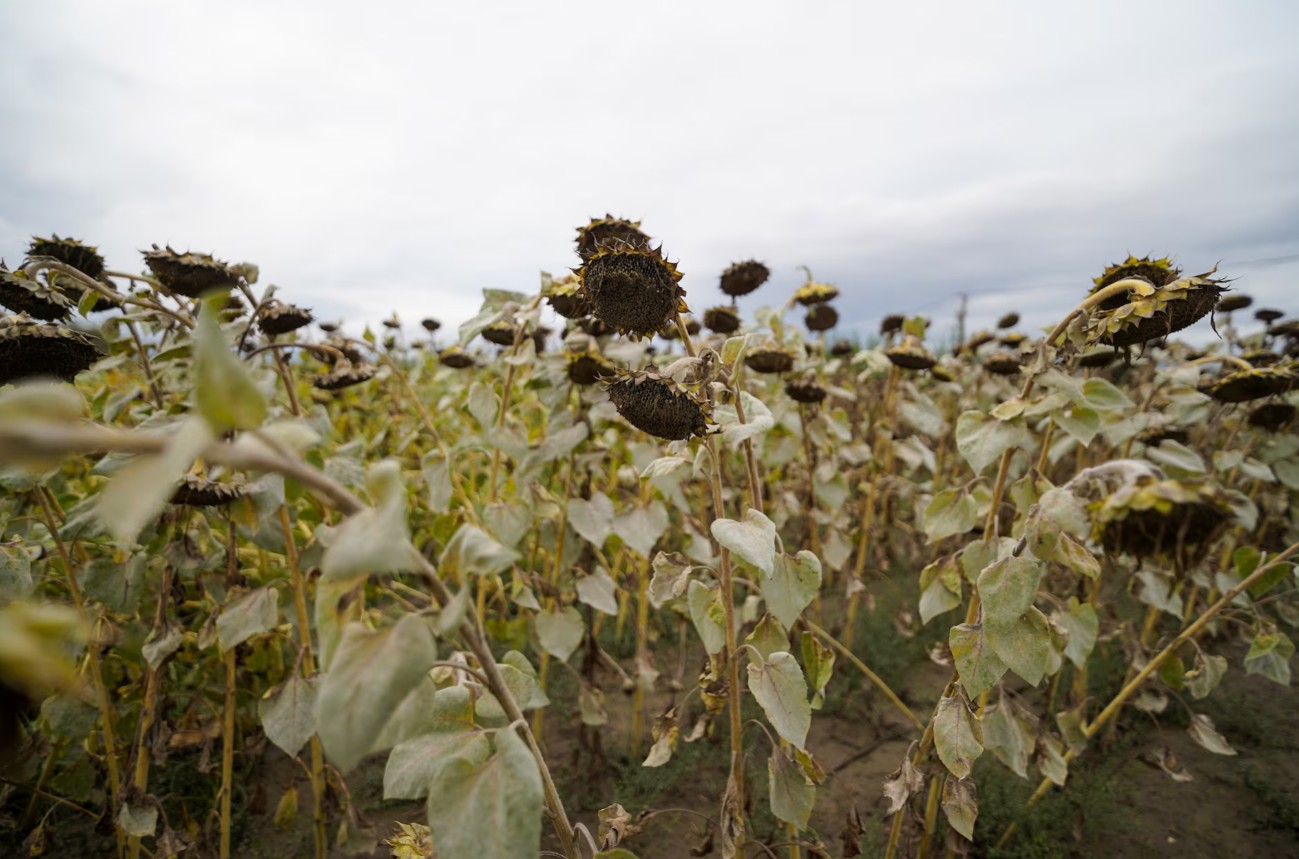
ANTALYA (Realist English). Farmer Mehmet Kabak had been growing cotton on his land in a drought-prone area of western Turkey for decades. This year he switched to wheat and sunflower — crops that require less water and are cheaper to produce. Kabak is one of many farmers around the world forced to find their own paths to adapting to a changing climate instead of waiting for countries to resolve long-standing disputes over adaptation finance at annual climate negotiations.
Scale of the problem
Agriculture accounts for about 5% of Turkey’s economic output and consumes 79% of the country’s water, almost half of which is lost due to inefficient infrastructure and irrigation. Last year Turkey experienced its worst drought in more than 50 years: precipitation was 27% below the long-term norm. A Reuters analysis shows that water use in the country’s cotton-growing basins needs to be reduced by 25–60% to maintain healthy ecosystems.
Production decline and rising costs
Turkey was the world’s eighth-largest cotton producer according to FAO data for 2023, but in 2026 total raw cotton production is expected to fall by 38% year-on-year to 1.2 million metric tons. Drought and rising costs have led to a reduction in cotton acreage in the Söke area by about 60% to 120,000 decares in 2026. Kabak complains that irrigation costs have risen “even though the crop has suffered,” and fuel and fertilizer costs have increased by 40–60%.
Infrastructure inefficiency and barriers to investment
Existing infrastructure remains inefficient: water from dams and rivers often arrives unfiltered, clogging drip hoses before treatment infrastructure is built.
However, farmers are in no hurry to invest in new systems. In some cases, switching to modern systems leads to an initial drop in yields that farmers can barely afford. In addition, many work on rented land and are not interested in long-term investments.
“Adaptation is no longer an option for farmers, but it is expensive, and today they mostly pay for it themselves,” Reuters quoted FAO representative in Turkey Ayşegül Selışık as saying.
Government support and COP31 initiatives
In October, the Turkish government announced that spending on land and water management would rise by 40.5% to 174 billion lira (about $3.5 billion) allocated for investment in agricultural irrigation.
The country’s largest private lender, Işbank, has opened 56 specialized agricultural branches and offers financing for drip and sprinkler irrigation with repayment tied to crop cycles.
As part of COP31, which will be held in Antalya from 9 to 20 November, the Turkish presidency is putting forward the Food-Water-Climate Nexus initiative, which treats food, water and climate as a single interdependent system. Priorities include climate-resilient agriculture that protects producers from drought and floods, as well as scaling up adaptation practices and climate-smart technologies. In addition, in June 2026 the COP31 Turquoise Nexus (TNI) Initiative was presented, developed by the Turkish Ministry of Agriculture and Forestry together with the FAO to bridge gaps in food systems management.
The situation in Turkey is a clear example of how the climate crisis is ceasing to be an abstract threat and becoming an everyday economic reality for rural communities. Farmers are already changing crops, reducing acreage and bearing rising costs without waiting for global negotiations to determine who will finance adaptation and in what volume.
Government and private initiatives — from budget allocations for irrigation to specialized credit products — signal an understanding of the problem, but questions remain: are these measures sufficient to curb the degradation of soil and water resources, and can they compensate farmers for growing risks.
COP31 in Antalya gives Turkey an opportunity not only to demonstrate its own approaches but also to draw attention to the fundamental gap between stated climate goals and actual adaptation finance, which, according to FAO estimates, receives only a small share of what is needed.