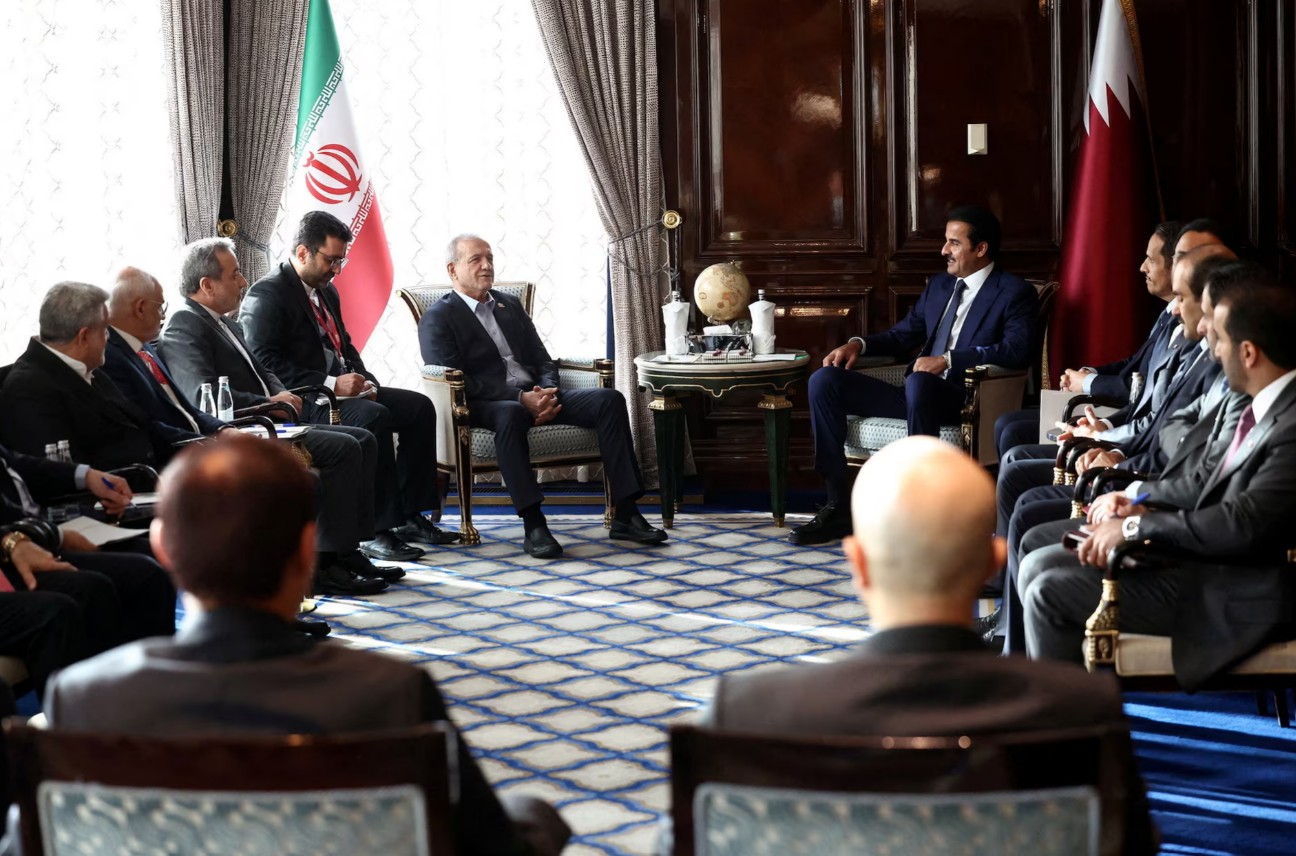
DOHA (Realist English). Iranian negotiators left Doha on Sunday, 1 November, after three days of consultations with Qatari mediators, a senior official familiar with the talks told Reuters. According to him, the delegation’s departure was not caused by difficulties in the negotiations, and a draft proposal for ending the war with the United States is currently in circulation, with a follow-up meeting possible. Iranian Foreign Ministry spokesman Esmail Baghaei confirmed that Deputy Foreign Minister Kazem Gharibabadi was in Doha to facilitate the exchange of messages with Washington through Qatari mediators.
Tehran’s conditions and the “two-day” scenario
Baghaei stressed that the basis for the talks remains the seven-step plan proposed by Iran in September to open the Strait of Hormuz and end the US naval blockade. However, Tehran now allows that this plan could be implemented in a shorter timeframe: Foreign Minister Abbas Araghchi said in an interview with Al Jazeera that, if an agreement is reached, the strait could be opened within two days, rather than seven as originally envisaged.
“Our demands are set out very clearly and transparently. They are reasonable and logical: no final agreement can be initiated, and the Strait of Hormuz cannot be opened or secured until the US naval blockade is ended, Iran’s demands are met and its legitimate needs are satisfied,” The Star quoted Baghaei as saying.
Iran’s conditions include an end to the war on all fronts in the Middle East, the unfreezing of Iranian assets abroad, the lifting of sanctions on the oil sector and an end to the naval blockade. Araghchi also mentioned the need to agree on a new transit route through the strait with Oman and to reduce the number of US troops in the region.
What is known about the draft agreement
Although officials have not disclosed details of the circulating document, Al Arabiya English reported on 31 October that a preliminary draft framework agreement includes the transfer of Iran’s enriched uranium to a third country or a reduction in enrichment levels, as well as a seven-day deadline for opening the Strait of Hormuz after an initial agreement.
China is named as a possible guarantor of the agreement’s implementation, and Doha, rather than Istanbul, is proposed as the venue for direct talks. The draft also provides for independent verification at each stage and a dispute resolution mechanism involving mediators and guarantor countries.
US midterm elections and military risks
The diplomatic activity is unfolding ahead of the US midterm elections on 3 November, after which, according to fears in the region, the conflict could escalate again. US President Donald Trump has said Washington will not launch new strikes on Iran before the vote and that talks with Tehran are “productive,” but he has not ruled out further military action. Commenting on the elections, Baghaei said Tehran does not expect them to “give birth to a new America.”
At the same time, Iran officially denies holding direct meetings with the US delegation in Qatar. “There was no meeting and none was planned between the Iranian delegation in Qatar and the American delegation,” Araghchi said. Messages are exchanged exclusively through Qatari mediators.
The departure of the Iranian delegation from Doha is not a sign of a breakdown in talks but rather a technical pause: the sides exchanged drafts and returned to consultations with their capitals. However, behind the facade of diplomatic activity a fundamental gap remains. Tehran demands a complete end to the war and the lifting of the blockade before implementation of any agreement begins, whereas Washington, judging by leaks about the draft, links sanctions relief to nuclear concessions and the opening of the strait.
Araghchi’s “two-day” scenario is a signal of flexibility, but not a substantive concession: it is conditioned on the fulfilment of Iranian demands that Washington has not yet accepted. The key fork remains 4 November: if Trump authorises the resumption of strikes after the elections, the negotiation track may be curtailed and the circulating draft will remain a document never brought to life. If diplomacy continues, the central question will not be the formal opening of the strait but the sequence of steps — who does what first.