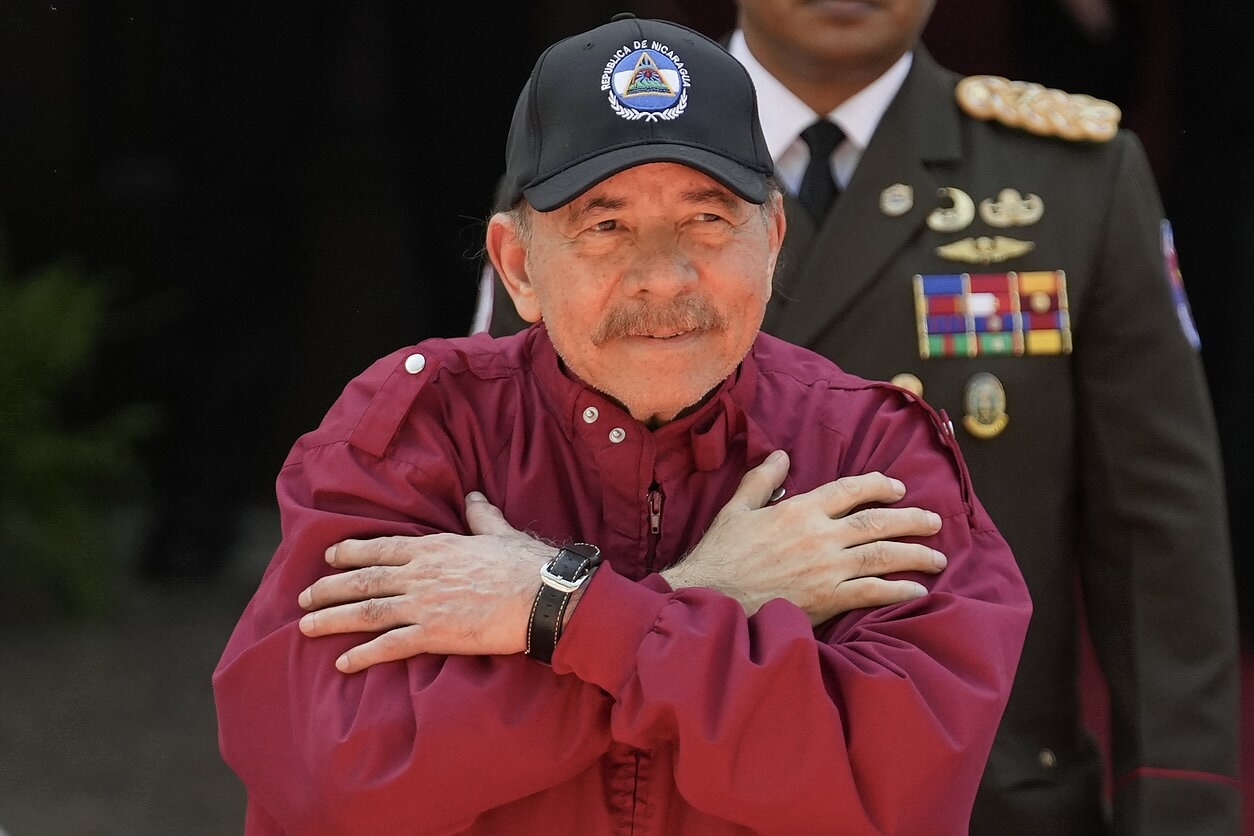
MANAGUA (Realist English). On July 20, the 47th anniversary of the Sandinista Revolution, Nicaraguan President Daniel Ortega made a statement that effectively put an end to democratic procedures in the country.
“There will be no more elections here, so that they (the opposition) can try to seize the government and power,” the 80‑year‑old leader said, appearing in public for the first time in two months.
Ortega also promised to coordinate with the ruling‑party‑controlled parliament to pass new laws aimed at “building a wall” against those he called “conspirators and traitors to the country.”
He did not specify how the abandonment of elections would be legally formalised.
The following day, the Nicaraguan parliament announced a “work plan” to implement the president’s directive, stating that the upcoming constitutional changes would ensure “peace, security, and stability” in the country.
How Nicaragua Came to Cancel Elections
Ortega, a former Sandinista guerrilla who overthrew the US‑backed regime of Anastasio Somoza in 1979, has been in power continuously since 2007 (he had previously served as president in the 1980s). In recent years, he has systematically dismantled democratic institutions:
- The 2021 elections were widely contested: opposition candidates were arrested before polling day.
- In 2025, Ortega pushed through a constitutional reform extending the presidential term from five to six years and appointing his wife, Rosario Murillo, as “co‑president.”
- Since 2018, Nicaragua has operated under a harsh regime: after the crackdown on anti‑government protests, more than 300 people died, according to the UN. Authorities have imprisoned opposition politicians, religious leaders, and shut down thousands of civil society organisations.
- In January 2026, the Inter‑American Court of Human Rights recognised that “the lack of integrity of the electoral process contributed to Ortega’s re‑election.”
US Reaction: Words, Not Action
US Secretary of State Marco Rubio condemned Ortega’s decision, saying it “exposes their true authoritarian nature.” He called on the international community to unite to show the “Murillo‑Ortega dictatorship” that it cannot count on “business as usual” with other countries. Rubio also called Ortega’s move “proof of his cowardice and fear of the will of the Nicaraguan people.”
However, as CNN notes, words have not been followed by decisive action. Washington has not proposed regime change, as in the case of Cuba, nor has it used force, as in the case of Venezuela, where President Nicolás Maduro was captured in January 2026.
In April 2026, the US imposed new sanctions on Nicaragua, this time targeting two of Ortega and Murillo’s sons. In total, more than 2,350 Nicaraguan officials are under US sanctions. However, these measures are “far less severe than the blockade on Cuba.”
Why the US Is Not Acting More Harshly: Three Key Reasons
Analysts point to several factors explaining Washington’s restraint.
1. Nicaragua Does Not Pose the Same Kind of Threat
Professor Kai Thaler of the University of California, Santa Barbara, noted: “For Marco Rubio, Cuba means much more than Nicaragua. Moreover, Nicaragua does not have Venezuela’s natural resources.” Unlike Caracas, Managua is not a major oil exporter and does not have a comparable impact on energy markets.
2. No Successor Available
Thaler also pointed to another important difference: unlike Venezuela, where after Maduro’s capture power passed to Delcy Rodríguez, in Nicaragua “every alternative for leadership has been eliminated by Ortega and Murillo.” US intervention could lead to chaos rather than a managed transition.
3. Strategy of “Gradual Pressure”
Nicaraguan political scientist Manuel Orozco, director of the migration programme at the Inter‑American Dialogue, explained that Washington wants to avoid actions that could trigger waves of migration or repression, and is betting on gradual change without direct intervention.
“One interpretation is that political inertia in the Murillo‑Ortega dictatorship will generate internal conflict, economic decline, possible social protest, where (the US) can use its pressure. But not the other way around.”
Furthermore, the Trump administration is already overloaded with the war with Iran and other international crises. As CNN notes, Washington is “tied hand and foot.” The Ortega government, for its part, is avoiding provocations: after Maduro’s capture, Nicaragua released dozens of prisoners and reinstated visa requirements for Cubans, limiting their migration to North America.
International Condemnation and Possible Consequences
UN High Commissioner for Human Rights Volker Türk strongly condemned the events in Nicaragua, saying that “people of all political views must have the right to vote and stand for office.” He noted that the recent events “further deepen serious restrictions on fundamental freedoms.”
The Organization of American States also condemned the Ortega regime, stating that it had “cast democracy aside.” Opposition activists in exile, such as Juan Sebastián Chamorro, warn that Ortega intends to “turn Nicaragua into a one‑party state, like China, North Korea, or Cuba.”
The Nicaraguan government, for its part, declines to comment, responding to criticism: “Thank you for your interest.”
Nicaragua has become the third country in the “ideological trio” of Latin American autocracies to abandon even formal democratic procedures. However, the US response remains restrained: the Trump administration is limiting itself to diplomatic pressure and targeted sanctions, without resorting to the forceful methods used in Venezuela and Cuba.
As Professor Thaler noted, the US does not have a “domino strategy” toward Venezuela, Cuba, and Nicaragua — priorities differ depending on political impact. The question of whether Nicaragua will become Washington’s next target remains open, but for now, the White House appears willing to tolerate the cancellation of elections in this Central American country.