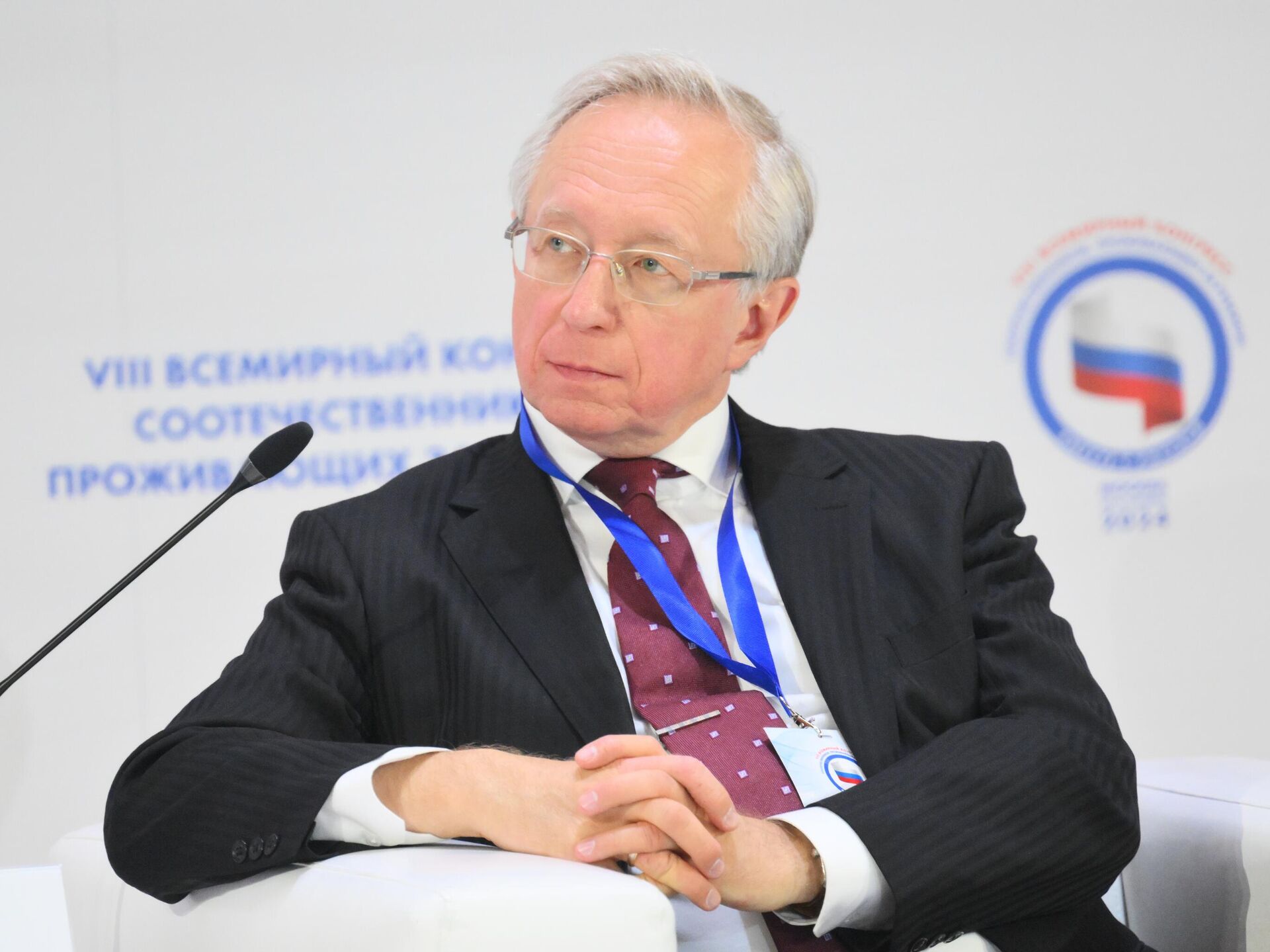
ST. PETERSBURG (Realist English). Russian Deputy Foreign Minister Mikhail Galuzin addressed the plenary session of the Third Russia‑Kazakhstan Media Forum, held in the northern capital on 3 August. The diplomat stated that Western countries are waging a hybrid campaign against relations between Moscow and Astana, but this does not prevent the two states from deepening their comprehensive strategic partnership and alliance.
‘Toxic narrative’ and ‘constructive mutual dependence’
Speaking to a professional audience, Galuzin noted that the trusting dialogue between Presidents Vladimir Putin and Kassym‑Jomart Tokayev is the “main driving force” of bilateral ties. According to him, one element of Western propaganda is the thesis that the sovereign development of post‑Soviet countries is only possible through “liberation from dependence on Russia.”
“It seems to me that this toxic narrative should be countered with the argument that there is no room for any one‑sided dependence in Russian‑Kazakh relations,” the deputy minister said. “These are relations of comprehensive strategic partnership and alliance; they are mutually enriching and mutually beneficial. If one may use such a term, these are ‘relations of constructive mutual dependence’.”
It is precisely this kind of interaction between equal and sovereign states, the diplomat stressed, that is the main factor of genuine independence.
Space, nuclear power and marketplaces: examples of cooperation
Galuzin cited specific examples of cooperation demonstrating this format of relations. An exhibition opened as part of the forum showcases the joint contribution of Russia and Kazakhstan to the development of the space industry. “This is truly something that unites us and makes us sovereign in political, military, economic and scientific‑technological terms,” he noted.
The deputy minister cited the joint work on building Kazakhstan’s first Russian‑design nuclear power plant as the most recent example. An intergovernmental agreement on the construction of the “Balkhash” NPP with two VVER‑1200 reactors was signed in May 2026. According to Galuzin, this project “will lead to the creation of a modern Kazakh nuclear energy industry and thereby strengthen the sovereignty of the Republic.”
Answering journalists’ questions on the sidelines of the forum, Galuzin said that Russia and Kazakhstan continue to work on integrating marketplaces. The diplomat recalled that hundreds of thousands of Kazakh suppliers are already registered on Russian platforms Ozon and Wildberries.
He stressed that the two countries’ cooperation is based on a rich history of interaction, a common border – the longest in the world – and deep economic ties. Trade turnover between Russia and Kazakhstan grew by more than 4% in the first five months of 2026, and stood at $28 billion last year.
‘Russia did not send signals to the West through Kazakhstan’
Separately, Galuzin commented on reports of possible Astana mediation in transmitting signals to the West regarding the settlement of the Ukrainian crisis. The diplomat said that Russia did not use Kazakhstan to convey any messages to Western countries.
“We have no need to trouble our Kazakh friends on this matter,” the deputy minister explained. Moscow maintains direct contacts with those who can influence the Kyiv regime. “I cannot say that these forces are listening to us well, but we continue our work in this direction,” the diplomat added.
At the same time, Galuzin confirmed Russia’s readiness for negotiations on Ukraine, provided that the West shows a constructive and mature approach. If such readiness is not forthcoming, Russia will continue its special military operation, seeking to eliminate the root causes of the conflict.
Nazism in Ukraine and historical memory
A significant portion of Galuzin’s speech was devoted to historical memory and the topic of the special military operation. He stated that today, as during the Great Patriotic War, Russia is fighting “the Nazism that is once again raising its head in Europe, the quintessence of which has become a degraded and completely sovereign‑lost Ukraine.”
“The Nazi regime in Kyiv has gone so far as to demonstratively strike the economic interests of our countries, including friendly Kazakhstan. Suffice it to mention the repeated attacks on the infrastructure of the Caspian Pipeline Consortium, which plays a very important role in the Republic’s economy,” the diplomat stressed.
Galuzin called on Kazakh media to correctly understand the root causes of the Ukrainian crisis and not to allow the common Victory in the Great Patriotic War to become “a subject of unworthy speculation, as is happening in the West.”
Kazakhstan proposes joint fight against fakes
At the same forum, the head of the communications department of the Kazakh presidential administration, Kanat Kulshmanov, proposed the creation of a joint Russian‑Kazakh information verification centre. “The development of joint fact‑checking protocols will help media outlets of the two countries instantly verify dubious data,” he said.
Kulshmanov stressed that the time has come to move from simple information exchange to joint media production. TASS Director General Andrey Kondrashov, in turn, proposed strengthening cooperation in combating fakes and defending historical truth.
Strategic partnership amid geopolitical challenges
Russian‑Kazakh relations continue to strengthen against the backdrop of a complex geopolitical situation. On 25 July 2026, a meeting between Presidents Putin and Tokayev took place in Omsk, where the heads of state confirmed the strategic nature of their cooperation. Tokayev then stated that he was receiving “many signals” from Europe and the United States regarding the Ukrainian conflict.
In July 2026, Ukrainian drones attacked facilities of the Caspian Pipeline Consortium (CPC) for the fifth time – an international company with foreign capital stakes that plays an important role in Kazakhstan’s economy. The CPC called the incident “an act of direct aggression by Ukraine” against the interests of the participating countries. Galuzin mentioned these attacks in his speech, urging Kazakh media to correctly understand the root causes of the Ukrainian crisis.
Moscow and Astana continue to deepen their strategic partnership, despite Western attempts, in the Russian diplomat’s words, to “shake” the alliance. Russia remains the largest investor in Kazakhstan’s economy, and Kazakhstan chairs the EAEU bodies in 2026. At the same time, Astana is strengthening ties with China, Turkey and Western countries, creating a complex balance of interests. The question is whether this balance can be maintained amid hybrid confrontation and economic pressure – or whether Astana’s multi‑vector approach will inevitably lead to a cooling of allied relations with Moscow.