WASHINGTON (Realist English). The US Army has announced plans for a dramatic expansion of Guided Multiple Launch Rocket System (GMLRS) production. According to a Sources Sought notice published on 17 August, the service intends to procure 133,014 rockets by 2034.
The contract covers seven years — from 2028 through 2034 — and requires annual production of 19,002 rockets. First deliveries are scheduled to begin in February 2030. Interested contractors have until 1 September to submit proposals.
Reasons: war with Iran and Ukraine have drained arsenals
The request is a direct consequence of the depletion of US precision munition stockpiles. Since the start of the full-scale war with Iran on 28 February 2026, the US has expended a significant portion of its strategic GMLRS reserves.
At the same time, massive supplies of these rockets to Ukraine for its fight against the Russian invasion have also contributed to the drawdown.
As the Center for Strategic and International Studies (CSIS) notes, “wars fought by the United States in the past decade have required high-end munitions at levels not needed during the counterterrorism campaigns of the early twenty-first century”.
Scale of the challenge: +40% above current capacity
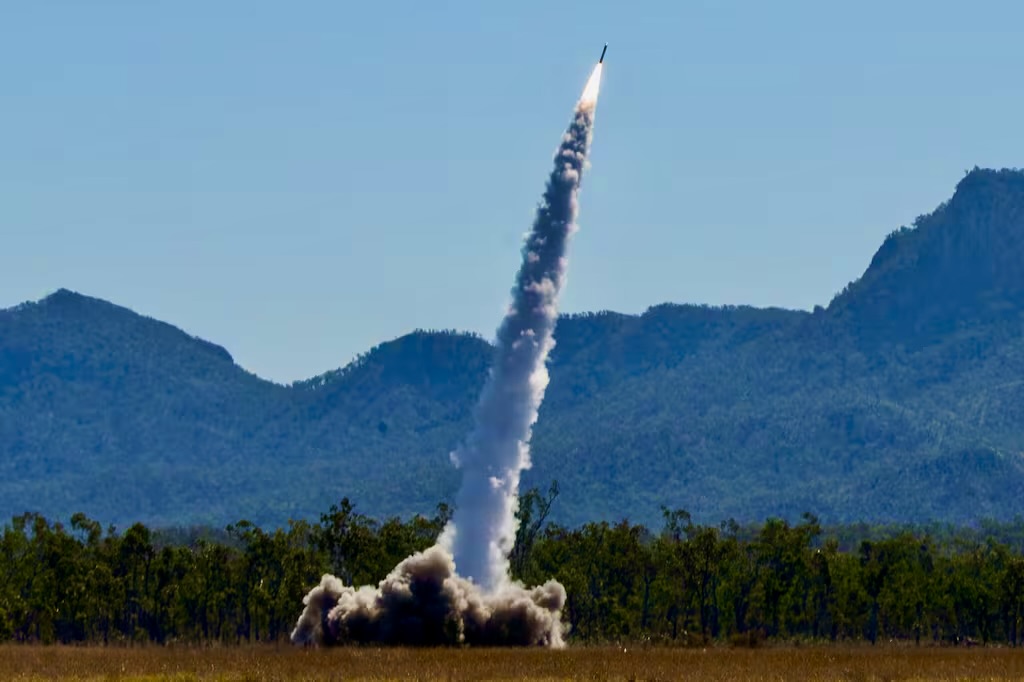
GMLRS is a family of precision-guided rockets fired from the M270 MLRS and the mobile M142 HIMARS launchers. The baseline version has a range of 70 km, while the extended-range GMLRS-ER variant can reach up to 150 km.
Currently, the sole manufacturer of GMLRS is Lockheed Martin. The company has announced it is ramping up capacity to 14,000 rockets annually. The Army’s new requirement calls for an increase of approximately 36–40% — to 19,000 rockets per year.
By comparison, cumulative GMLRS production through 2024 remained below 75,000 rockets. The new contract for 133,000 rockets is nearly double the total volume delivered by Lockheed Martin over previous years.
Cost: over $21 billion
According to Defense Express estimates, the contract could be worth over $21 billion, based on an average rocket cost of approximately $160,000 per unit.
However, real costs in the coming years may be higher.
22,169 rocket containers — six rockets each — represent the full combat load for HIMARS and M270 systems.
Challenges: a painful history of production ramp-ups
The US Army has faced serious difficulties in expanding defence production. A previous attempt to build a facility for 155-mm shell components costing over half a billion dollars failed to produce a single finished item.
In response, the request specifically emphasises that contractors must present “the most efficient and cost-effective methods” to achieve the required volumes. Attention will be paid not only to production capacity but also to supply chain management.
International context: demand exceeds supply
Beyond the US Army’s own needs, GMLRS is also procured by the US Marine Corps and international partners, including NATO allies who have also supplied these rockets to Ukraine. This means new production capacity must support not only the US Army but also other customers.
The Army has not yet launched a procurement competition or secured funding. The current request is a market survey, not a firm order. A decision on whether production will remain concentrated with Lockheed Martin or distributed among multiple suppliers has not yet been made.
However, the very fact of the request signals that the Pentagon is preparing for a protracted war of attrition and views precision munitions as a critical resource whose shortage is already being felt.