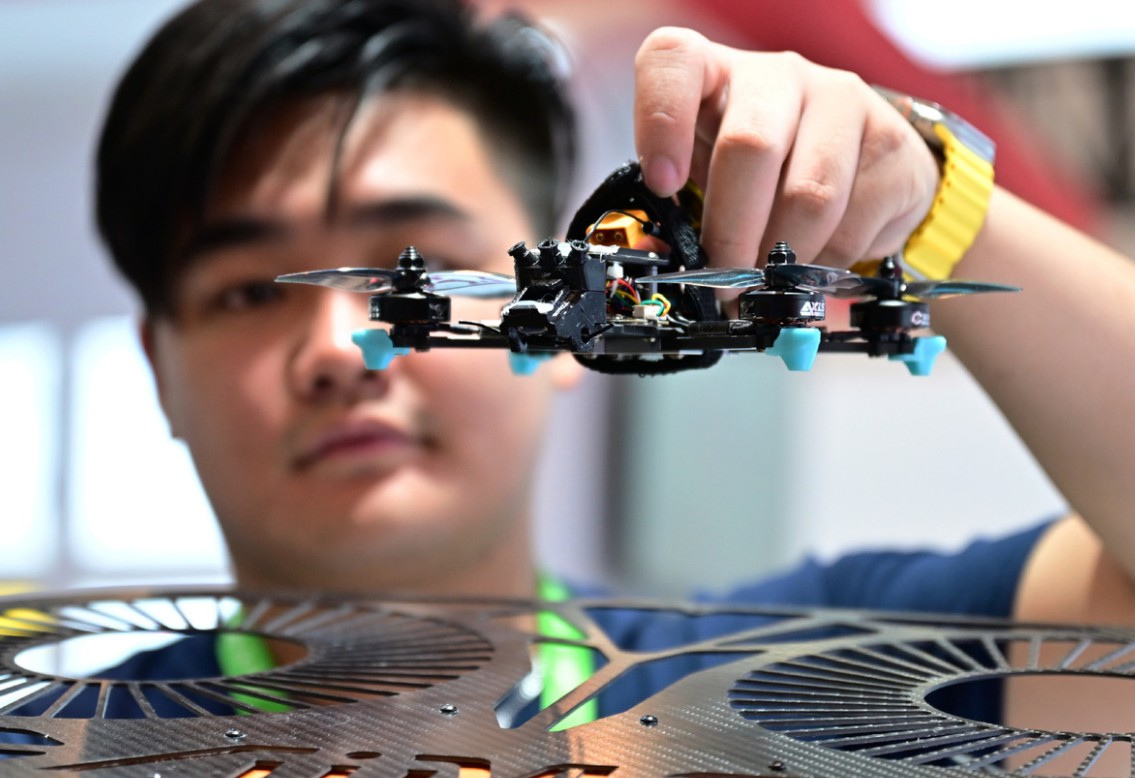
BEIJING (Realist English). Beijing is launching a large-scale drone disposal campaign ahead of the revised version of the rules governing unmanned aerial vehicles, which enters into force on 15 November. The document, adopted on 12 September, adds a new provision to the existing bans on flights, sales, and transport — a “total ban on storage.”
From “Ban on Flights” to “Ban on Storage”
On 1 May 2026, the first version of the rules entered into force in Beijing, declaring the entire city a controlled airspace zone: flights, sales, and the import of drones into the capital were prohibited. The revised version went further: from 15 November, owning or storing drones and their key components on Beijing territory becomes illegal.
The revised document explicitly establishes: the entire territory of Beijing is a controlled zone for unmanned aerial vehicles; flights are prohibited; ownership and storage are prohibited; transport and import into the city are prohibited; the creation of new storage sites is prohibited.
For special needs — counter-terrorism, maintaining stability, disaster response, scientific research, agriculture — exceptions are provided: after a security assessment, special support may be requested.
Disposal Channels and Compensation
Authorities have opened four channels for legally disposing of devices:
On-site buyback — selling the drone to enterprises designated by district authorities. For disposal from 12 September to 31 October, 30% of the buyback price is compensated, but not more than 3,000 yuan per device; from 1 to 14 November, compensation drops to 15%, but not more than 1,500 yuan.
Scrap disposal — handing in to collection points. Until 31 October, compensation is 200 yuan per device; from 1 to 14 November — 100 yuan.
Sending outside Beijing — mailing via EMS to an address outside the city, free of charge.
Self-removal — the owner personally removes the device by air, rail, or road transport, necessarily before 15 November.
Compensation applies only to devices in personal ownership for which information has been verified with public security authorities.
Disputes Over Buyback Prices: “This Is Real Robbery”
The wave of sell-offs is unfolding simultaneously on secondary platforms and at official buyback points. According to media reports, one resident said a DJI Mini 2 drone bought for 3,000 yuan was valued at buyback at only 360 yuan — this was called “real robbery.”
60-year-old drone enthusiast Mr Zhu, in an interview with Agence France-Presse, called the buyback programme “robbery”: “It cost me a lot of money. This is my private property.” He said he had already sold five drones, losing several thousand yuan on each. Due to the mass influx of drones into disposal channels, secondary market prices temporarily fell by 40%.
48-year-old drone owner Mr Wu took a more understanding view: “I think it’s reasonable. I understand why the government wants to ensure security and manage airspace — after all, Beijing is the capital.” A drone he bought six years ago for about 6,000 yuan he expects to sell for at least 1,000 yuan.
Air Crash and Tightened Control
The immediate trigger for the policy was an accident in June 2026: a light aircraft crashed into Beijing’s tallest building, the pilot died, 13 people were injured, and approach traffic at Shoudu Airport was briefly disrupted. The incident occurred just a few kilometres from the government quarter.
A deeper context is the military use of drones in the Russia-Ukraine war and Middle East conflicts, which prompted China to strengthen control over low-altitude airspace. According to Yonhap, civilian drone flights are effectively banned in about 20 major Chinese cities, and the “low-altitude economy” strategy as a future growth driver is facing security restrictions.
Impact on the Industry: DJI Removes Products
The world’s largest drone manufacturer, DJI, has since 29 April completely removed its products from shelves in Beijing stores, and online platforms have stopped delivery to Beijing. An employee of the DJI flagship store in Guomao said Beijing stores do not handle repairs — users will have to send devices to other provinces or contact authorised service centres.
Analysts note that the policy marks the transition of China’s low-altitude economy from “disorderly expansion” to “standardised management.” Executive Chairman of the China Low-Altitude Economy Alliance, Luo Jun, said: “This is not an attempt to stop drones, but an attempt to manage them so the industry can grow sustainably and safely.”
Key Dates
| Date | Event |
| 1 May 2026 | First version of the rules enters into force: ban on flights, sales, and transport |
| 12 September 2026 | Revised version adopted, “total ban on storage” added |
| 31 October 2026 | Deadline for 30% buyback compensation |
| 14 November 2026 | Final deadline for all disposal channels |
| 15 November 2026 | Revised version enters into force: total ban on storage |